Anyone courageous enough to take a deep dive into U.S. history knows that the U.S. constitutional system was regarded as experimental and that it was intended to function as a modified confederation, albeit one that secured the general government with sufficient revenue to conduct a cluster of all-union responsibilities – hence, the national motto: E. pluribus unum, underscoring that the United States is a community of republics.
The column linked above is especially instructive terms of how the appearance of a secession initiative on the 2024 Texas ballot not only would enhance the likelihood of the mainstreaning of the Texas National Movement but also would foster serious discussion about secession in other red states, as none of these states could look forward to a viable future within American Union without the presence of the red behemoth of Texas.
Barring wholesale red state secession, some form of serious decentralization is vital to the preservation of constitutional liberty as it is historically understood in this country.
As I have stated before in this forum, I agree with the late diplomat George F. Kennan, who argued that a United States governed by a centralized state of managerial elites is an untenable one and that the most ideal arrangement would be one in which the overwhelming bulk of power is consigned to individual “constituent republics,” roughly the size of Texas. Hopefully, a successful Texas secessionist movement will prime this discussion and contribute to the rapid dissolution of corrupt, centralized power.
I wrote this tribute to American independence some nine years ago, and reflecting on it today it doesn’t seem to have weathered all that well.
Indeed, with each passing year in the face of an obstinate and utterly corrupt ruling class that stands at the commanding cultural heights and that stares down with withering contempt at the deplorables, the ancestors of whom caused the previous proprietors, the British nobility, a measure of heartache, I wonder how much time remains for the American enteprise, long regared as history’s most conspicuous experiment in self-government.
This hard truth has left me with a resolve to offer what aid I can toward preserving a saving remnant of the the American project – the sprawling American heartland – what I have come to call the “Ruby-Red Republic.”
As the British surrendered at Yorktown, they played “A World Turned Upside Down,” apparently to underscore their disbelief that a ragtag league of states comprised of provincials and peasants could defeat an army of the greatest empire in the world.
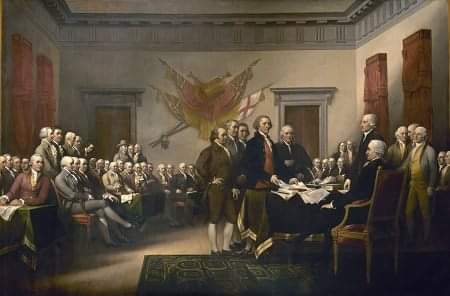
Indeed, for a very long time, Britain and the other great empires of the earth did not consider this feuding aggregation of post-colonial states a nation in any real sense. During a hot, sultry summer in Philadelphia, these provincials rather reluctantly convened to forge an agreement to unite their cantankerous states, one that ultimately worked not only to secure unimaginable levels of freedom and material prosperity for citizens but that has also been emulated to one degree or another by nations throughout the world.
Today this union of states holds the fortunes of an entire planet in its hands. To be sure, its immense power and cultural influence invokes jealously, resentment and, in not a few cases, hatred in some quarters of the world. But after almost a quarter of a millennium, it continues to inspire countless millions of people of all races, nationalities and creeds. It remains the world’s indispensable nation. Happy Birthday to the United States of America.
Displaying my pride flag during American pride month in July to commemorate Secession Day, July 4, and to remind my friends that on that date in 1776 the thirteen former colonies issued a joint declaration affirming the independence of “Free and Independent States.”
We forget that the author of this declaration, Thomas Jefferson, the third president, later expressed serious misgivings that a union of states destined to become a continent-sized country could continue to secure effective self-government among its citizens and even speculated that Americans sooner or would be better off governed by smaller polities, though which continued to share common cultural and republican affinities.
Today, almost a quarter millennium later, academics and public intellectuals on both ends of the political spectrum – and I can name them if you doubt me – have posited some form of peaceful separation, whether in the form of a full-blown parting of the ways or some looser confederative arrangement.
Franky, our present path is unsustainable over the long haul. That is why I personally feel compelled to affirm the Jeffersonian principles of radical decentrism and self-governnance every year on July 4, which the vast majority of Americans have forgotten marked the secession of 13 former colonies from the British Empire.
Woodrow Wilson, whose ascent to the American presidency marked the advent of the managerial class.
This column speaks volumes about the deep and increasingly unbridgeable chasm that characterizes cultural and political life in the United States, one that pits our ruling class (i.e., the managerial elite that presumes to run things) against ordinary Americans who chafe under their rule.
Whatever one thinks of Donald Trump, his presence only has served to expose the deep chasm between the ruling class and ordinary Americans.
To be sure, a number of astute political observers – mostly journalists and columnists but even a few academics – have been warning about the rise of the managerial class for the past century, certainly since the advent of the Woodrow Wilson presidency.
Many perceived even that far back how the Hegelian mindset of these reformers, in the course of enhancing the efficiency of centralized government, would erode the sinews of constitutional governance, particularly as this historically was expressed by Madisonian federalism. Indeed, that, in fact, was one of the expressed intentions of these American Hegelians: to replace this quaint anachronism with a higher standard of governance, which involved governance by a highly educated, credentialed and, consequently, far more enlightened class.
What I find fascinating is how long this elite-imposed social order has soldiered on despite the misgivings of millions of Americans, including the 34th president, Dwight Eisenhower, who devoted much of his presidential farewell address to warn American about its potential harm this class could cause to American liberty, particularly in the singular conditions prosecuting the Cold War in the face of the Soviet menace.
To be sure – and Eisenhower, the former Allied Supreme Commander would be the first to acknowledge this – it’s central coordinating competencies carried the country through World Wars I and II as well as the Cold War. Even so, over the course of time, this imperium has been subject to a measure of second guessing, particularly at the end of the Cold War, as this managerial class arrogated to itself the task of imposing a post-Soviet global economic order which, among other things, required the diminution American manufacturing base to accommodate industrialization in other countries.
This has had the effect, certainly within the last 30 years, of rekindling the spirit of what could be broadly characterized as the Old Right political vision, the older version of American liberalism that viewed the role of the federal government simply as one focused on preserving American national sovereignty and economic prosperity, not on imposing a global imperium.
Meanwhile, the managerial class doubled down on its efforts to build a post-Cold War global order, increasingly more inclined to employ U.S. military resources and disformation and, following the 9/11 attacks, even prescibed forms of torture against presumed captive terrorists. This was augmented by other efforts to “protect the homeland” against both foreign and domestic threats, which have prompted many within this class to call for the circumvention of constitutional rights that previously regarded as sacrosanct.
To paraphrase the 16th president, Abraham Lincoln, we are are now engaged in a cold civil war testing which side, conceived in widely disparate views of liberty and governance, ultimately will prevail.
Until recently, I reluctantly would have placed my bets on the managerial class. Within the last couple of years, though, several disruptions, a few entirely unexpected, have led me to wonder if ordinary Americans finally have marshaled a new resolve – the necessary pluck – to oppose this ruling class.
The most heartening development of all was Elon Musk’s acquiring and transferring Twitter into a major medium of free discourse. One occasionally is struck by the impression that this application not only is marshaling and focusing pervasive and implacable national discontent in this the United States but also is helping growing numbers of Twitter users to connect the dots and to cultivate an increasingly refined understanding of the manifold shortcomings of the managerial class, particularly its sense of entitlement, its sweeping corruption and its enduring disdain for ordinary Americans.
Quite frankly, David Brooks’ recent column on the ways in which American culture appears to be coming apart is why I now identify exclusively as a Southerner and not as an American.
The South, despite its historical baggage, always has incorporated a sense of propriety, connectedness and reciprocity in its culture – that goes for black and white Southerners alike.
Much of what we are dealing with now is bound up in the pathologies of an increasingly deracinated American national culture, which really could be likened to a dumpster fire.
To those, such as the Biden regime and the rest of the left who would characterize such talk as sedition, I readily concede that the South has secured a measure of economic and material progress through its unity with a larger polity – certainly in the aftermath of World War II. And I am thankful for the progress black Southerners have made in the last 50 years, and I readily acknowledge that this could not have been achieved but for landmark civil rights legislation.
On the other hand, I think that many Southerners are entirely unaware of the extent to which Southern history resembles Irish history in many ways – at least, in the way that the Irish have long regarded their association with Britain and how the region long functioned as a kind of economic extraction zone. Moreover, I do resent deeply how we continue to be regarded as the national foils – how everything that is f*cked up naturally has to be Southern. Moreover, I resent the extent to which the South, derided as the problem child of the American Experiment, continues to supply a disproportionate share of the manpower to advance the regime’s foreign policy, much of which, as the debacle in Ukraine so richly illustrates, is entirely ill-conceived and inimical to the interests of rank-and-fill Southerners and other red state citizens.
Someone on a conservative forum to which I belong, apparently quoting someone else, said that the North was responsible for saving the Union in the 19th century, just as the South will be in the 21st. There are many ways to read this. I think that the brilliant classicist and commentator Victor Davis Hanson recently expressed the issue brilliantly. In a recent column he argued that the things that have historically defined America – the commitment to the rule of law, colorblindedness in the application of law and a genuine openness to debate and discourse is increasingly being expressed in the South as opposed to the purportedly more sophisticated cultural enclaves of the Northeast and West Coasts.
My argument for the past 25 or so years has been that the Union serve us only to the degree that it secures our freedoms and material prosperity while insulating us against the encroachment of an all-powerful state. As far as I am concerned the apparatus that functions in D.C. no longer is a government in any real sense but rather a regime. One prime example of this regime’s dysfunction: It insists on preserving the borders of a second world country (i.e., Ukraine) on the periphery of Eastern Europe, though it can’t even summon the will to preserve one of the most basic functions of sovereignty, which is preserving the integrity of U.S. borders.
And now, increasingly, the left and its operatives in the bureaucracy and the major institutions are working to silence any form of dissent. Call me paranoid and antigovement, but this seems as plain to me and millions of other people as the keyboard on which I am typing this response.
In many respects the pathologies of American culture are utterly inimical to to Southern culture as it historically has been understood. Yet, day by day, week by week, this dumpster-fire national culture is infecting to one degree or another the entire country, and, frankly, I don’t want to see my culture brought down by these pathologies.
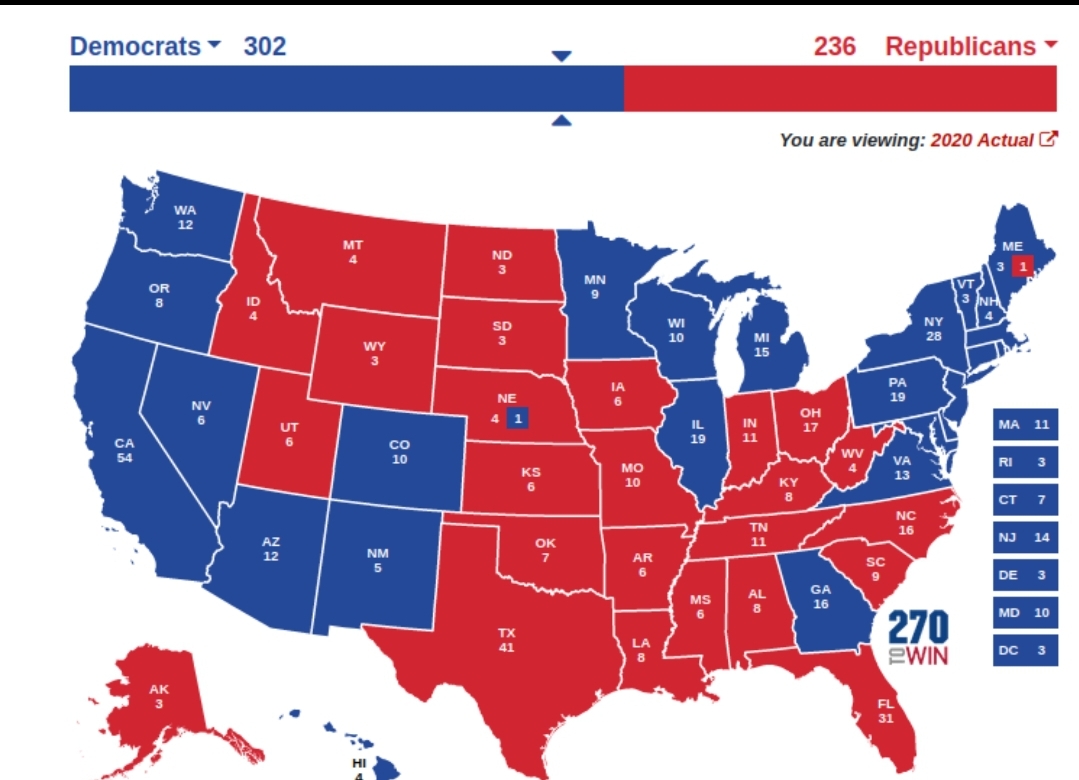
Here it is as plain as day for everyone to see. Granted, I believe like everyone else that the left used all sorts of specious means to vandalize the 2020 election, and I don’t think that Biden deserves to be regarded as the elected president of the United States.
Even so, this map underscores why, if the country ultimately breaks apart, the focus of any red-state American Republic will center around the South. Yes, parts of the Middle Atlantic states and the Midwest ultimately will align with a red state movement, but the focus of energy will remain with the South, as it essentially always has.
That is precisely why I and others have argued for years that the struggle essentially is one that has ensued since the earliest days of the Republic and has always centered around the nature of federal power – how it should be expressed.
Moreover, as I have struggled to point out time and again, if these divisions, which seem intractable at this point, lead to breakup, the South will not be re-staging Confederate States 2.0.
What emerges will be widely regarded as an American restorationist movement, not a Confederate one, despite every attempt by the Legacy (Oligarchic Lapdog) Media to depict it as such.
Indeed, this movement initially will be suspended between two stools – the left and its legions of cultural allies and the very small, very marginalized but very vocal collection of Confederate restoratonists. And to be sure, the media will exploit every act of this small faction as proof of Red State America’s “true intentions.”
That is why any broad-based movement must be begun and be led by a few seasoned, substantive political leaders who can stand above the marginalized elements.
Am I implying that this necessarily must begin as something akin to a vanguard movement? Yes, I am indeed. We simply can’t risk the possibility of this movement being hijacked by Confederate restorationists who would be indirectly aided and abetted by the Establishment media and the federal national security complex with the desire to doom it from the start.
In time, the South has the potential to regain its footing as well as a renewed identity, but it will have to be undertaken long after the initial changes of a national divorce are worked out. And it most assuredly must occur far beyond the noise of Confederate restorationism. Most important of all, a new Southern identity must factor in and come to terms with all of the changes that have occurred in the last 150 years, including the Civil Rights movement.
From my Facebook vault from 2016 – true, though, sadly. I ended a very long friendship with someone because he invariably resorted to cursing, finger pointing and charges of racism whenever I stressed that the social and political cleavages in this country were dragging us closer and closer to an impasse that ultimately could lead to a national breakup.
Five years since this post the possibility strikes me as even more likely and even prominent intellectuals on both sides of the great divide are now weighing in on this troubling trend.
Somethings I fall into the temptation of regarding myself as a bit of an amateur political prophet, though I make it a point to dispel any sort of grandiose thinking and self-regard as a matter of principle.
To re-affirm what I have stated time and again on this forum, I am a Southern nationalist. And if that doesn’t strike the average reader as strange enough, I’ll add that I am the rarest of Southern nationalists: I am one who wants to dispense with the perennial fixation with the Lost Cause and “saving Confederate money” (on the basis that “the South will rise again”). I choose instead to concentrate on the South as it exists today, more specifically, how it has changed during the last 150-plus years.
I have held to this view for the last quarter century, ever since sitting down with 40 distinguished Southerners to organize the rather ill-fated League of the South. Though I was small and marginalized voice among this august group of scholars and writers, I was certain of one thing: that the South would not rise again on the foundation of the Lost Cause, the old Confederacy. I argued instead that whatever merged from meeting should function as both a think tank and clearing house for secessionist and radical decentrist ideals. In fact, I even argued that it was not necessarily in the South’s interests to secede ahead of the other regions or, at the very least, to demand radical autonomy from the rest of the country.
Yes, the South is different enough from the rest of the nation. Yet, even then, such deep cleavages were forming between what is now known as blue and red America that a new constitutional arrangement sooner or later would have to be worked out, not only to resolve this impasse but even to avoid another civil war. And emerging reality essentially would work to free up the South to pursue its own destiny.
I essentially argued that all we had to do was to work assiduously to popularize concepts of neo-secessionism and radical decentralization. The deep cultural and political fissures forming within the country – recall the League organized shortly after the 1994 GOP congressional sweep – essentially would complete the work for us.
It wasn’t to be. There was a handful of diehard Confederate restorationists on hand who would carry the day for the Lost Cause narrative. They believed that the anger welling up over the growing assault on Confederate symbolism and heritage would supply a sufficient center of gravity for a new Southern nationalist movement.
They were proven wrong within the next 5 years.
For my part, I went along with it, albeit rather grudgingly, until 1999. Shortly thereafter, I broke with the League and developed a web presence known as “Home Rule for Dixie!” that made the strong case for the wholesale abandonment of the Confederate restorationist narrative, calling instead for an entirely new approach to Southern self-determination that factored in all the changes that had transpired since the collapse of the Confederacy in 1865.
I argued that there were legions of contemporary Southerners who never would be won over to be Lost Cause narrative but who could be persuaded that the 15 historically cultural Southern states, which included historically Unionist West Virginia, ultimately could be won over to the argument that the South represented the best of what remained of fraying American Republic. It would, over the course of time, constitute the declining Republic’s moral and cultural lifeboat.
The “Home Rule for Dixie!” concept sparked a lot of acrimonious debate in the Southern movement before its effective collapse a few years later. After concluding that my message likely was premature, I abandoned the effort in 2003.
Since the 2016 presidential election, I am now more convinced than ever that such a movement not only is viable but likely foreshadows how events will play out in the future.
One of the nation’s premiere conservative intellectuals, Victor Davis Hanson, apparently shares a similar view. Hanson, a Straussian conservative, believes that the South and the rest of Red America, far from representing the region of the country where Lost Cause rhetoric and animosities still are being nursed, now comprises the well-spring of American values and virtue and possibly even the foundation on which these values will be re-affirmed and renewed. Hanson even goes so far to argue that the “New North” has become the Old South, and the New South the Old North.
It many ways, his argument comes very close to the one I made a generation ago through the “Home Rule for Dixie!” effort.
As Hanson contends, the New North in many ways embodies the racial exclusivity, single-party hegemony and single-crop economies ascribed to the South a half century ago. And amidst all of this, a remarkable sorting-out effect is ensuing in which the South and other red states have begun to bear the hallmarks of a functional America.
As Hanson argues:
…there is a growing red state/blue state divide—encompassing an economic, cultural, social, and political totality. The public seems to sense that the blue-state model is the more hysterically neo-Confederate, and the red state the calmer and more Union-like. The former appears more unsustainable and intolerant, the latter is increasingly more livable and welcoming.
It seems that Hanson essentially has arrived at the same conclusion I did a quarter century ago: that the South, despite all its historical blemishes and setbacks, really does represent the most redeemable part of America – truly the most viable part, the moral and political lifeboat.
The South is going to rise again, albeit in a distinctly America form, though embodying those traits that, generally speaking, have set the region apart from the rest of the country: civility and unwavering devotion to faith, family and personal liberty.
Glenn Youngkin campaigning for governor of Virginia
I urge every one of the visitors to this site to read Ryan Grimm’s excellent article in The Intercept assessing the recent GOP victories in heretofore blue Virginia.
While you are at it, commit this term to memory: “cultural traditionalists.” This is the segment of voters very likely to comprise the hinge on which American electoral fortunes will turn over the next decade.
Bear in mind, too, that the article, albeit unconsciously on Ryan’s part, confirms some of the points I have struggled to make over the last generation about the future of the South within the larger American cultural and political matrix.
It may come as news, maybe even a shock, to some of my readers, but the fact remains that Abraham Lincoln won – not only the Civil bWar but also the struggle for American identity, certainly in terms of which side of the great political division that emerged during the 1788 constitutional debates would get to impose its indelible mark on this country in how it regards and governs itself and how it defines citizenship.
I have mentioned before that while I chose to label this website within the larger context of American identity, I remain a rather unrepentant Southern nationalist, though, I should stress, a maverick one.
More than a quarter century ago, I attended the founding meeting of the League of the South and was also a founding member of Southern Party as well as author of its inaugural document, the Asheville Declaration.
I don’t regret my initial association with those organizations, though I do possess regret, a deep well of regret, in fact, over the turns both organizations ultimately took. They confused low-hanging fruit for political reality and they have paid an egregiously high price for this tunnel vision.
They cast their lot with a segment of the population that is becoming increasingly more marginalized and even reviled by the national elites: for lack of a better term, Confederate memorialists.
Consequently, the League and the Southern Party effectively have been consigned to political oblivion, banned from social media and figuring prominently on left-wing watch lists, widely regarded, if they are even noticed, by many, if not most, rank-and-file Americans as white nationalist fringe groups.
As I have argued before on this forum, it didn’t have to be this way. The League of the South started out with good intentions. It aspired to function as a reservoir of intellectual talent – a think tank, of sorts – as well as a rallying point for contemporary Southerners interested in articulating a regionalist/nationalist vision for the 21st century.
It was not preordained to travel down the neo-Confederate track, and with twenty-plus years of hindsight, I am more convinced than ever that avoiding this option would have placed both efforts onto a solid political trajectory toward significant success.
The handful of academics who conceived the initial League of the South effort were spot on in one assessment. They perceived even then that the country already was in a parlous state, rife with political and cultural divisions that have since mutated into the intractable impasse that many pundits on both ends of the spectrum now characterize as Civil War II.
They should have capitalized on that; in fact, they should have focused entirely on that. It is now the pink elephant in American life that no one can ignore any longer, not even the so-called Legacy Media. Indeed, the full embrace of this hard reality a generation ago would, certainly by now, have ingratiated the movement with a much wider demographic. They would have occupied moral high ground not all that far removed from Churchill, who had expended so much political capital in the 1930’s warning about the Nazi threat.
Yet, both expended most of their precious political capital for a mess of political pottage – Confederate heritage and restorationism – fretting about heritage violations and dredging up elements of the Lost Cause canon when they should have been concentrating on the here and now, crafting a political vision for the present-day South, one fully cognizant of the changes that have swept over the region over the last 150.
All Southern partisans of whatever ideological stripe must face up to the fact that Lincoln left an indelible imprint on both American and Southern identity and culture – period. There is no getting around that and this forlorn hope of restoring the Confederacy within the defeated 11 Southern states is entirely that – a forlorn hope.
This is why if the South rises again it will occur within a distinctly American context rather than a Confederate one. To express it another way, the South will rise only when enough cultural traditionalists of whatever ideological stripe conclude that the South constitutes the only solid ground on which the American Experiment in self-government and individual liberty can be sustained.
That is why I have advocated for the last 20 years to put Confederate Lost Cause ideology aside and to build a self-determinist movement constructed from the things that define the 21st century South. The success of any future Southern regionalist movement will hinge on his well it articulates and expresses growing concerns about the fissures forming on the country’s cultural and political landscape.
Indeed, success will rest in large measure on how well such a movement assesses and acknowledges the cultural and political change that has swept across the South over the last century and a half. Such a movement will take root and thrive only when millions conclude, however painfully and reluctantly, that the South represents the American Experiment’s only viable cultural lifeboat.
Only on this foundation can we begin to build the elements of a new Southern indentity drawing both from facets of its past as well as the unavoidable realities of its present and future.
Incidentally, Ryan’s article in The Intercept constitutes a very good basis – a primer – for articulating that vision.
Speaking as one who loves American history, the thought has occurred to me time and again: We have never been as united as we think we are. It was a major concern of the constitutional framers and, apart from a few factors in history that have created the illusion of unity, we remain a very pluralistic polity, culturally and politically, and we simply have to find a way to create new political structures to ensure we remain adequately equipped against geopolitical threats such as China but that also ensure that we don’t end up beating out each other’s brains.
If you have been a frequent reader of this forum, you are likely aware that I have come to describe all what is unfolding in the United States as our very own “Gorbachev moment.” Recall that some 30 years ago the ill-fated refomer of Soviet society? Mikhail Gorbachev tried to negotiate a union treaty to hold things together but events got ahead of him. Boris Yetsin, president the Russian Soviet Republic, signed a compact with his counterparts in Byeloerussia and Ukraine that resulted the breakup of the Soviet state.
As this article attests, we seem to be approaching a similar impasse in the United States, reflected in the growing number of ordinary Americans who express an interest on secession.
For now, our leadership class remains conspicuously silent on the topic of secession. But the inevitable “the Emperor hath no clothes” moment inevitably will arise. Sooner or later, some prominent American, perhaps a governor or senator from either a blue or red state, simply will have to state frankly, “Something’s got to give.”
This is when the facade will crumble.
Then, pehaps, we can hope for some sort of modus vivendi that holds the country together to fend off geopolitical threats, though while ensuring that domestic power is returned to states or, perhaps more realistic, compacts of states, that we can be assured of sufficient insulation from our increasingly malignant and consolidating ruling class.







 Ruby Red Republic