Mainstream media’s conspicuous silence in the aftermath of Biden’s very conspicuous fall on the steps leading to Air Force One is one of the many reasons reason why I will NEVER be lectured ever again by any liberal about anything.
If you’re old enough, you recall the unrelenting fun that SNL made of Republican President Gerald Ford’s repeated stumbles.
More recently, #AmericaPravda spared no effort to analyze anything and everything associated with Trump’s presumed physical and mental decline. But that is not surprising because Mainstream Media are Establishment media. They have been in service to a narrative since at least the FDR presidency and arguably earlier.
Whatever the case, American liberalism is nothing but a sick self-parody now days, evidence of this empire’s precipitous decline on all fronts, which is significantly of liberalism’s making. #LateAmerika #BrezhnevRedux
Borrowed for purposes of illustration from the Dishcast with Andrew Sullivan
I have been intrigued with the recent behavior of Andrew Sullivan, one of the most innovative and gifted political commentators of the age.
Note in this column Michael Anton’s description of how exasperated Sullivan, an ardent NeverTrumper and self-described conservative (albeit of the wet Tory variety), became during a podcast interview in the face of interviewee Anton’s refusal to acknowledge the validity of 2020 election outcome. Sullivan would abide none of this and, over the course of the interview, kept dragging Anton back to the topic.
Personally, I think that Sullivan’s exasperation with this topic possibly provides a fascinating glimpse into the soul of the American political cognoscenti, especially those in the thinning ranks of thr centrist camp, of which Sullivan is the most conspicuous and talented member.
Anton is only one of several commentators who have pointed out the fractiousness with which Sullivan and other political commentators have treated those who have summoned the temerity to question the validity of the election outcome. But then, why wouldn’t they?
For at least the past century and a half, most Americans have regarded their country as one of humanity’s singular achievements, one built significantly, if not entirely, on the basis of ideals rather than from the Old World ingredients of language, culture and ethnicity. And this narrative typically has also encompassed the argument that this singularity has been sustained – backstopped – by governing institutions, notably an electoral system that, at least until the last few election cycles, has set a benchmark not only for every other Western constitutional democracy but also for nations that aspire to lofty standards of governance.
Singularity has comprised much of the adhesive that has held this country together for at least the past century, especially following the tidal wave of immigration from Eastern and Southern Europe in the late 19th century, which threatened to dilute the moorings that previously had connected the country to its strong Anglo-Saxon cultural and political legacies.
In the face of this rapid demographic transformation, American intellectuals began improvising an updated national identity that over time was expressed as propositional nationhood. It is grounded on the premise, foreshadowed in the Gettysburg Address, that America derives its identity from the ideals outlined in the Declaration of Independence and that these are sustained by a rigid adherence to the rule of law. Many liberals and a few conservatives would contend that this improvisation has worked reasonably well, at least, until recently.
Yet, cultural and political upheavals since the 2016 Trump election upset have drawn growing numbers of Americans on both ends of the political spectrum to question whether or not these idealistic foundations have frayed to the point of threadbareness.
While it’s impossible to discern an individual’s motives, I suspect that Sullivan is one among several in the elite punditry who harbor serious misgivings about what is unfolding in America. After all, Sullivan, a Briton by birth, is a naturalized American who has affirmed more than once in his columns and blogs how the idealistic underpinnings of American national identity ultimately inspired him to acquire citizenship.
Yet, I wonder if this enthusiasm has been beset recently with the same gnawing doubts that have gripped other Americans. Sullivan is no naif by any stretch of the imagination. He has demonstrated time and again in his commentary not only vast erudition but also a highly nuanced understanding of vitually every prevailing political trend.
Over the course of his wide reading, he’s undoubtedly encountered Czech playwright and later Czecholovakian President Vaclav Havel’s seminal essay “The Power of the Powerless,” wherein Havel likens the embattled Czecholoslovakian Communist regime and its underpinning ideology to a hermetically sealed package prone to rapid spoilage at the mere prick of the seal.
A time or two I’ve wondered if Sullivan, pondering the parlous state of American unity, has been reminded of this seminal essay and noted parallels with present-day America.
I readily confess that I have.
Sullivan undoubtedly understands that a nation such as the United States founded on and sustained largely by abstract ideals survives as a functioning constitutional democracy only so long the majority of its citizens evince faith in these ideals.
What if the spoilage described by Havel ultimately is setting into American idealism? Likewise, what happens if Americans, growing numbers of them, no longer express confidence in these ideals? What if they come to the point of openly expressing doubts that these ideas still comprise an adequate basis for America unity?
To be sure, Sullivan’s exasperation with Anton may simply have been a means of reinforcing his standing as an Establishment commentator standing at the temperate center of American elite discourse. And who can blame him? Sullivan has no incentive to run afoul of elite media,, despite that fact that it’s increasingly evincing proto-totalitarian traits. After all, where could a gay man with an Oxbridge/Ivy League educational pedigree possibly go?
Still, I doubt that I’m the only one who has closely followed Sullivan’s career and noted his recent behavior. He’s too smart and perceptive to ignore the specter that is haunting America: the increasingly evident doubt among millions of Americans of the efficacy of this nation’s ideals and as well as the institutions charged with sustaining national unity.
Maybe this accounts for Sullivan recent exasperated podcast exchange with a defiant Michael Anton.
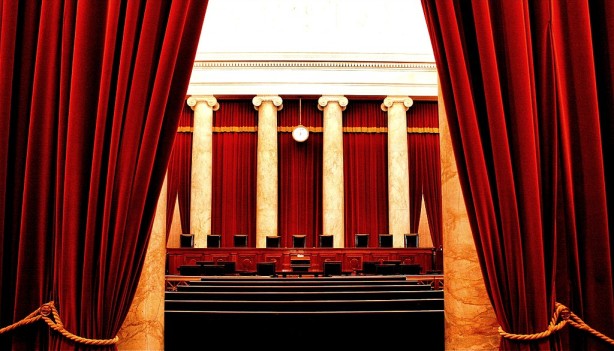
There has been a lot of chatter lately within conservative and libertarian circles about the increasing dysfunction that has set into our judicial branch, which, however ill-advisedly, now regards itself as the Union’s defender of last resort.
Lots to unpack here but I’ll return to something that I have argued before in this forum – something that was driven home to me years ago reading British constitutional scholar James Bryce’s appraisal of the American constitutional system in his classic tome The American Commonwealth, first published in 1888. Even way back then, Bryce had perceived how dysfunctional and unwieldy the federal legislative branch had become in the face of the nation’s rapid demographic and geographic expansion.
By the late 19th century it was impossible for the House of Representatives to function as a bona fide legislative assembly. Virtually all of its vital daily work was conducted via committee with all of the backroom Machiavelianism this entailed. Meanwhile, the Senate had grown far beyond its ability to function as a comparatively small, elite advisory council to the executive branch, as conceived by the constitutional framers.
By the late 19th century the judicial branch, embodied in most American minds then and now as the Supreme Court, one that was given comparatively short shrift by the Constitution by its framers, was poised for its ascent to the commanding heights of American politics and culture.
Its earliest custodians, notably Chief Justice John Marshall, had, like all elites in virtually all political systems throughout history, engineered the first tenuous steps toward an accretion of power beginning with Marbury v. Madison. But even Marshall, careful to avoid overreach and the backlash that inevitably would follow from the majority Jeffersonian camp, stepped away from one especially contentious constitutional issue of the day, conceding, however reluctantly, that the recently enacted Bill of Rights applied only the the federal government, not to the states.
The most libertarian- and constitutionalist-minded of early American statesman expressed qualms about enacting an explicit statement of rights, fearing that it ultimately would be construed by Congress or the courts as affecting state as well as federal authority.
These fears rather predictably proved prescient, following the post-Civil War passage of three constitutional amendments – the 13th, 14th and 15th – that set the Supreme Court firmly on the path toward the enunciation of the Incorporation Doctrine, which effectively worked to erode the states’ sovereignty, reducing them to de facto provinces.
Equally significant, though, is how the Supreme Court has employed the Incorporation Doctrine with many subsequent expansionist rulings in a manner that essentially has transformed it into a de facto supreme governing council – effectively, the American Union’s final arbiter.
What many observers surprisingly overlook, no doubt, intentionally in the vast majority of instances, is that the court employs enhanced powers partly to compensate for the dysfunction of the legislative branch, which the Framers regarded as the well-spring of federal policy, not to mention, the branch charged with safeguarding the balance between state sovereignty and that which had been delegated – conditionally, it should be stressed – by the states to the federal government.
The behavior and public pronouncements of the current Supreme Court Chief Justice John Roberts and and his immediate predecessors seem to reflect this fact. The case could be made that the court has been aware for decades of the role it has served, however unconstitutional, in shoring up the deep dysfunctionality of the legislative branch, one whose efficacy has been badly eroded within the past century and a half but especially in the years after World War II when the United States emerged as a global empire..
Yet, increasingly, the Court finds itself hemmed in, if not trapped, by the demographic and cultural changes overtaking the country, many of which are of its making. One recent example: It’s decision following the 2020 election not to hear the case lawsuit challenging late changes to Pennsylvania’s election process.
Despite a thunderous dissent by Justice Clarence Thomas, two justices previously regarded as being in the tank for the right, Brett Kavanaugh and Amy Comey Barrett, voted with the majority. And why should we find that at all surprising? Given the way the Mainstream Media organs characterized Thomas’ opinion as dissent bordering on sedition, it’s easy to discern why a court that they regard a majority conservative one has gotten into the habit of carefully hedging its bets.
SCOTUS, to employ one of the Orwellian Newspeak-style terms that characterizes so much of cultural and political discourse now days, is walking an increasingly thin rope. It carries on what it undoubtedly regards as a lofty and valiant struggle to safeguard not only a dysfunctional legislative branch but an increasingly divided, if not fraying, American Union. Yet, as a marginally conservative court, regarded as illegitimate by many, if not most, of our Mandarin class entirely for that reason, it imposes limits on the manner in which which it weighs in on the most pressing issues of the day.
This amounts to one of the most remarkable ironies in U.S. political history: The judicial branch that, at least for the last century, has regarded itself as the panel of last resort and that has played a major role in the sweeping changes within American society, now feels constrained and even threatened by this transformation – so threatened that is now limiting its judicial activism.
This raises a troubling question: Who mans the rudder of state, certainly during an extreme national crisis? If the legislative and judicial branches have been rendered either too dysfunctional or too threatened to step in during a major upheaval, who will?
It serves as another reminder to me and many other red heartlanders of the precarious times in which we live.
Glad to know that they’re finally closing in on New York’s bloviating cad-in-chief: Governor Nipple Ring.
Even so, this late-served comeuppance only serves to expose CNN for what it is: late America’s version of agit-prop, actually not that much different from the media apparatus that served the ruling class of the late Soviet Union. And, yes, I know all about Fox News – Yada, Yada, Yada – but there’s one big difference.
Fox lacks the backing of the culturally hegemonic segments of American society – academia, Silicon Valley, and Big Entertainment, to name a few. It may be the voice of Con, Inc. – Big (K-Street) Conservatism – but it still lacks the cultural clout of what I’ve come to call #AmericanPravda.
“As the nation reckons with its racist history, legislation calling for the removal of Confederate commemorative works from national parkland is likely to be reconsidered this year,” solemnly writes Kim O’Connell of the National Parks Traveler.
She adds that “one might be forgiven for believing that the South won, based on a reading of the monuments alone.”
In that case, I’ll never set foot on a federal park again. I’ll even go a step further by expressing my fervent hope that young Southern men and women withdraw their support of the American imperial enterprise, opting not to serve in any of the branches of the American military – yes, refusing to support the geopolitical interests of a government that resembles less a constitutional republic, more a tyranny with each passing day and, like many earlier empires, sustaining its power by pitting one cultural segment of society against another.
What is conveniently ignored by writers such as O’Connell in the midst of this proto-totalitarian woke struggle is that national unity and the ultimate construction of what amounts to a global American empire was secured through the construction of thousands of such monuments in town squares, cemeteries and, yes, national parks in every corner of the vanquished Confederacy.
It ultimately was achieved only because the Northern conquerors concluded, however half-heartedly, that post-war unity was achievable only through an acknowledgement of the bravery and sacrifices of the Confederate fighting man.
Without this acknowledgment, the South very well could have ended up as the American version of Ireland or even the Balkans, a soft, vulnerable underbelly of an aspiring empire. And given where we are heading with all of this neo-Puritanical cleansing, we may end up with something resembling Northern Ireland during the troubles or, even worse, the past Yugoslavian Balkans.
President Ronald Reagan at his inauguration in January, 1981. Shortly thereafter he made an impassioned call for returning to federalism but faced opposition even from GOP governors.
To repeat a phrase that I have employed several times in this forum, the American Empire simply is too big to succeed.
Indeed it is the reason why an awareness of the increasing likelihood of secession is becoming the proverbial elephant in the living room, certainly among the growing numbers of us ordinary Americans in the red heartland who perceive what our malignant ruling class ultimately has in store for us.
Yet, I have been intrigued by how mainstream conservative commentators, recently Podcaster Dan Bonjino, have been absolutely flummoxed by this emerging phenomenon. It undoubtedly is as readily evident to them that secessionist sentiment is spreading, yet they hold steadfastly to the same hidebound argument that a return to federal principles will resolve all of this.
Notions of American exceptionalism inevitably will die hard, but then, conservatism in America is deeply rooted in this mindset. And given that so much of what passes for conservatism on this side of the Atlantic is rooted in propositional nationhood, this really isn’t all that surprising.
Interestingly, conservatives seem to have forgotten that previous attempts to restore old-time federalism have proven futile. Incoming President Reagan, way back in 1981, undertook a concerted effort to return to bona federalism, offering to return welfare policy back to the states. Virtually all the governors balked, stressing that their states lacked the revenue base to support a safety net that dates all the way back to the New Deal and that people, blue and red alike, expect as matter of course.
That is why I am convinced that the political dynamics in this country ultimately will necessitate a secessionist movement that ultimately takes on regionalist rather than state unilateral action, as the late diplomat and political thinker George F. Kennan portended in his own writings.
We will likely see states banding into regional compacts, forming what could be described as incipient federations. These conflicts ultimately will prove essential to preserving some facet of the social safety net to which virtually every American has grown accustomed over the past century.
Whatever the case, to borrow a line from the late Betty Davis, “Fasten your seat belts – it’s going to be a bumpy ride!”
I had a conversation a few years ago with a young, very bright and exceedingly well-educated woman who was from an Afrikaans background. She had all the hallmarks of Afrikaaner ancestry, including a Dutch surname. When I asked about her heritage, she became rather indignant and dismissive, assuring me that she was not. I find this sort of thing very sad and troubling.
Indeed, the older I get the more evident it becomes to me that one simply cannot abandon one’s identity and instead should embrace it. I will always be proud to be a small-town Southerner and count it as a far, far greater influence on my life and outlook than any other influence, including being American.
As a matter of fact, I have reached a point in life where I really don’t give a tinker’s dam that some people, notably the people who purport to be our elites, regard Southern identity as some sort of historical focus of evil against which all that is lofty and sublime should be defined, including the conceptual rope of sand known as “propositional (American) nationhood.” Concepts such as this only work to perpetuate the notion there is such a thing as individualism bereft of ethnic and cultural influences.
The further I get along in life, the more this notion strikes me as just another form of intellectual snake oil.
It is intriguing and, quite frankly, heartening, that observers on both ends of the political spectrum perceive that the American Empire is in headlong decline and that something new invariably must follow, whether this occurs years or a few decades from now.
For me, this decline became increasingly evident more than a decade ago when California governors, beginning with moderate Republican Arnold Schwarzenegger, began characterizing the Golden state as a nation within a nation, possessing all the accoutrements of nationhood, including one of the world’s ten largest economies.
Now such affirmations almost seem routine. Legislators in the nation’s second largest state, Texas, are even considering putting a secession initiative on the state ballot – an effort that has earned the endorsement of the Lone Star State’s prominent GOP leaders and that even has piqued the interest of GOP leaders in other states.
Granted, formal secession from the American Empire is decried by elites, particularly when these calls eminate from red states. But the rhetorical cat is out of the bag. Growing numbers of pundits on both ends of the political spectrum no longer are overlooking the obvious: the American Empire is in terminal decline, much like its erstwhile Soviet nemesis some three decades ago.
As this article in The Nation attests, the telltale signs of decline and collapse are readily perceptible. Yes, there’s the inevitable leftist pablum through which the reader must wade to encounter some truly interesting nuggets, notably mention of the challenges of constructing a new civilization from the imperial rubble.
As many of us on the right and even a few on left see it, there is only one basis on which this civilizational reconstruction can occur: It must begin with smaller political entities rather than the oversized, lumbering, bureaucrarized white elephant we’re contending with now.
“When they come for you they will talk like social workers.”
Tucker Carlson and other pundits on the right are anticipating the oligarchy soon will undertake a wholesale rooting out of all dissident thought, speech and expression in America, though it will be undertaken via the most polite and fastidiously therapeutic language.
Yet, it’s worth pointing out that that a de facto form of censorship arguably has existed for quite some time in America. Before the end of the Fairness Doctrine and the advent of the Internet, about the only method available to any genuine dissenter was handing out mimeographed publications on a street corner or at a mass event, such as a concert or college football game. Better-funded forms of moderate dissent – the sort of dissidence regarded as palatable to the managerial liberal elites, such as William F. Buckley’s National Review – were available through U.S. Mail.
As a teenager in the mid-Seventies, I can remember regarding myself as something of a dissident simply for receiving a publication called Conservative Digest in the mail – something that caused my parents some concern because northwest Alabama was such a heavily unionized Democratic enclave at the time.
To be sure, conservatives such as William F. Buckley and James Kilpatrick, were afforded a small slice of exposure, but back then they were regarded as dissident voices in a country and culture dominated by managerial liberalism. And because the media bandwidth was so constricted and dominated at the time by managerial liberalism, elites so no harm in affording some exposure to accredited forms of dissent – after all, it aided the propaganda struggle against the Soviets.
Elites could extol free speech because all forms of genuinely threatening dissent were contained. Things changed somewhat – from the standpoint of elites, decidedly for the worse beginning in the 80’s – with the abolition of the Fairness Doctrine. Things spiraled virtually out control in the 90’s when the Internet initially developed into kind free speech Wild West. Now elites are slowly managing to rein in all of this troubling dissent. Things ultimately will return to something akin to the status quo that prevailed in the Seventies: There will be accredited venues of dissent and Establishment media organs once again will extol free speech and affirm what a singularly free nation the United States truly is.
Photo: Courtesy of By Tyler Merbler from USA, Wikimedia Commons
One of the greatest intellectual odysseys of my lifetime was reading most of the so-called “prophets of the Old Right,” who, in the years leading up to the Second World War, offered a searing critique of American interventionist intentions and all the risks to constitutional liberty that these entailed. (Incidentally, one of the best surveys of this all but forgotten circle of talented men is the late Justin Raimondo’s “Reclaiming the American Right: The Lost Legacy of the American Conservative Movement,” written roughly a quarter century ago and still, fortunately, available in electronic form.)
As this splendid column, which appeared recently in antiwar.com, observes, the American Republic, at least, key elements of it, always was predisposed toward imperial ambitions, though these aspirations, thankfully, have have always garnered substantial opposition, which seems to have reached a fever pitch as we near the end of the first quarter of the 21st century.
Honestly, given the last twenty years of U.S. geostrategic setback, is it any wonder that this union finds itself in its currently politically and economically depleted state? For that matter, is it any wonder that secessionist sentiment is on the rise in the country’s largest blue state (California) as well as red state (Texas)?
There are so many ways that 21st century America resembles the declining imperialist powers of the past, not only in the way it deals with its client states but also the way it administers domestic policy.
As self-described “radical-centrist” political commentator Michael Lind has argued, this nation’s northeastern mercantilist class, which harbored imperialist aspirations from the very beginning, has regarded most of the rest of the country as an economic outsourcing zone since this union’s inception. And today these elites retain their increasingly tenuous grasp on power by stoking tribal animosities of ordinary citizens, much as the British elites were accused of exacerbating religious division in 19th century Ireland to stave off Irish secessionist sentiment.
Meanwhile, the decline in the vast American heartland is painfully evident. For the past five years, I’ve seen it firsthand as I’ve returned to my native corner of northwest Alabama to care for ailing parents and then to close our their estate following their passing. Recently, my brother, preparing our parents’ home for sale, discussed the state of the current economy with a local man who was undertaking pest treatment on the house. He expressed surprise that neither of us had been confronted with meth addicts who typically occupy vacant homes, even in fairly upscale middle-class homes.
For now and despite the growing chorus of discontent, the empire lumbers along, but for how long? The demonstration that ultimatley resulted in temporary occupation of the U.S. Capitol,which our oligarchic class and its agit/prop predictably have portrayed as full-scale insurrection comparable to the 9/11 attacks, likely serve only as a portent of what is to come. But for now, the very classes denigrated as deplorable and irredeemable by our Mandarin class and characterized and surveilled by our national security apparatus as budding insurrectionists, in come cases, even enthusiastically, supply a vastly disproportionate share of the country’s enlisted ranks. And this raises the question: In this increasingly class-ridden juncture in history, how long will these decent young men and women continue to play along with this charade?








 Ruby Red Republic