• Introduction
  • About Ruby Red Republic
  • Contact
  • Blog

Ruby Red Republic

~ Thoughts on Red States and "Deplorables."

Ruby Red Republic

Category Archives: The Passing Scene

America’s de la Boetiean Watershed

01 Monday Mar 2021

Posted by Jim Langcuster in Geo-Politics, The Passing Scene, Uncategorized

≈ Leave a comment

Tags

Etienne de la Boetie, Iran, Islamic Revolution, Jim Langcuster, Shah Reza Pahlavi

Protesters toppling a statue of Shah Mohammad Reza in Iran in 1978.

As memory serves, I’ve mentioned French philosopher Etienne de la Boetie a time or two in this forum.

His observations about how the fortunes of government, any government, no matter how democratic or authoritarian, ultimately rest on the sentiments of its subjects, invariably remind me of the tumultuous events culminating in the overthrow of Shah Mohammad Reza during Iran’s 1979 Islamic Revolution.

The ways that tbe Shah’s besieged caretaker government under Shapour Baktiar desperately clung to power following the Shah’s hasty departure, issuing edict after edict, proclamation after proclamation, in the forlorn hope of reining in revolutionary discontent would have resounded with de la Boetie. He even coined a succinct phrase, which has been employed by paleo-libertarian writers time and again to describe those rare inflection points in history when a large segment of a society’s population simply has had enough, writing off governmental authority as utterly debased, illegitimate and unentitled to obedience, despite the potentially deadly consequences this behavior often invites. I have racked my brain for years and still can’t recall the phrase, though it brilliantly conveyed the essence of this historical inflection point, which invariably portends a abrupt, irrevocable break with the old order.

As de la Boetie would have anticipated, Bakhtiar’s efforts amounted to nothing, as millions of rank-and-file Iranians, obstinately ignoring all of them, pushed ahead with insurrection. Iran had reached an inflection point of popular discontent, one that bore close parallels to the descriptions of popular disillusionment that de la Boetie supplied in his own writings.

I was a high school student way back in 1979, too intellectually unsophisticated at the time to grasp the full implications of what was unfolding in Iran. But I possessed at least enough insight to discern that some sort of line had been crossed. And I also suspected that it marked not only a significant historical departure for ordinary Iranians but also a monumental shift in the geopolitical balance – namely, the ways the United States subsequently ordered its affairs in this tumultuous region.

Granted, most Americans of the time held no sympathy for radical Islam and knew that what followed would impose significant hardship for the Iranian people. But based on all the facts that we were able to garner at that time through broadcast and print media – this, after all, was almost a full generation before the advent of digital media – many of us knew that longstanding American support for the hated Pahlavi regime was a significant driving factor behind this uprising.

Empires, especially global ones, require client states, and the Shah’s regime served American interests in a variety of ways, despite their running counter to the aspirations of millions of ordinary Iranians, especially those in rural locales, far removed from the material prosperity unfolding in Iranian cities.

To be sure, “dark forces,” notably the Soviet Union, may have been working behind the scenes to exacerbate the these social, cultural and political cleavages, but I, for one, still believed that the raging anger of the Iranians was rooted in genuine grievance. Yet, who could ever had imagined that this conflagration ultimately would lead months later to the storming of the American Embassy in Teheran?

By that time I had graduated high school and enrolled in college to earn a political science degree. I can still recall almost verbatim how one professor described the embassy occupation as an event of profound geopolitical significance, one that likely would be remembered many years later as one of the watershed events of the post-war of the 20th century. He was right: Iran’s Islamic Revolution marked a significant reformulation  of American strategy in the Middle East, one that would be followed by an immense expenditure of American blood and wealth.

The Pahlavi regime’s collapse not only foreshadowed the erosion of American influence in that region but also of the decline of the comparatively short-lived American Empire, which had been hastily improvised little more than a quarter century earlier to fill the breach left by a beleaguered British Empire in the aftermath of World War II.

Americans were in store for a long and arduous journey, though one punctuated by the assurances of U.S. governing elites that all setbacks were only temporary and that the expenditure of American blood, wealth and geopolitical capital to contain and ultimately to reverse the viral eruption of Islamic radicalism ultimately would tip the scales, drawing us finally toward a new flourishing of the American-fostered liberal-democratic imperium, in which democracy and secularism finally would would take root and thrive in previous inhospitable Mideastern soil.

We know better now – at least, growing numbers of us do. And we also perceive  how this vast expenditure of blood and treasure in this region of the world has sapped American strength not only abroad but also at home, embodied in the decaying infrastructure and boarded store fronts as well as in the social pathology and breakdown evident on so may small cities and towns across the vast American heartland. Tens of millions also perceive how our  elites, increasingly exposed, cornered and threatened as a result of the wind they sowed decades ago, have turned to the same desperate tactics to which previous ruling classes have resorted in the face of imperial decline and rising levels of discontent.

Our rulers and their media enablers characterize the occupation of the U.S. Capitol in January essentially Qanon conspiracy fearmongering run amuck. Millions of us aren’t buying it. We even suspect that decades from now, this event very well may be recalled as an turning point, perhaps even as the harbinger of a de la Boetiean-style watershed event in America not that far removed from what transpired in Iran more than two generations ago. Indeed, for tens of millions of us, this event only served to shine a light on the perfervid anger of millions of rank-and-file Americans, not only over the rot that has set into many, if not most, of this country’s political and cultural institutions but also over the ways that our governing class and their enablers (e.g., academia, media and Silicon Valley) have contributed immensely to it.

An Increasingly Reluctant Panel of Last Resort

26 Friday Feb 2021

Posted by Jim Langcuster in American Federalism, Federalism, Imperial Decline, The Passing Scene, Uncategorized

≈ Leave a comment

Tags

Chief Justice John Marshall, Federalism, Jim Langcuster, Judicial Review, SCOTUS, State Sovereignty, U.S. Supreme Court

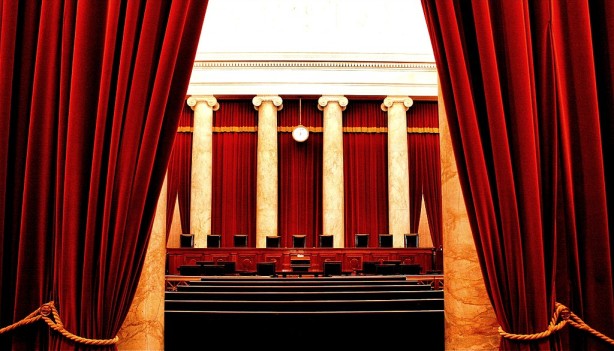
The U.S. Supreme Court Chamber

There has been a lot of chatter lately within conservative and libertarian circles about the increasing dysfunction that has set into our judicial branch, which, however ill-advisedly, now regards itself as the Union’s defender of last resort.

Lots to unpack here but I’ll return to something that I have argued before in this forum – something that was driven home to me years ago reading British constitutional scholar James Bryce’s appraisal of the American constitutional system in his classic tome The American Commonwealth, first published in 1888. Even way back then, Bryce had perceived how dysfunctional and unwieldy the federal legislative branch had become in the face of the nation’s rapid demographic and geographic expansion.

By the late 19th century it was impossible for the House of Representatives to function as a bona fide legislative assembly. Virtually all of its vital daily work was conducted via committee with all of the backroom Machiavelianism this entailed. Meanwhile, the Senate had grown far beyond its ability to function as a comparatively small, elite advisory council to the executive branch, as conceived by the constitutional framers.

By the late 19th century the judicial branch, embodied in most American minds then and now as the Supreme Court, one that was given comparatively short shrift by the Constitution by its framers, was poised for its ascent to the commanding heights of American politics and culture.

Its earliest custodians, notably Chief Justice John Marshall, had, like all elites in virtually all political systems throughout history, engineered the first tenuous steps toward an accretion of power beginning with Marbury v. Madison.  But even Marshall, careful to avoid overreach and the backlash that inevitably would follow from the majority Jeffersonian camp, stepped away from one especially contentious constitutional issue of the day, conceding, however reluctantly, that the recently enacted Bill of Rights applied only the the federal government, not to the states.

The most libertarian- and constitutionalist-minded of early American statesman expressed qualms about enacting an explicit statement of rights, fearing that it ultimately would be construed by Congress or the courts as affecting state as well as federal authority.

These fears rather predictably proved prescient, following the post-Civil War passage of three constitutional amendments – the 13th, 14th and 15th – that set the Supreme Court firmly on the path toward the enunciation of the Incorporation Doctrine, which effectively worked to erode the states’ sovereignty, reducing them to de facto provinces.

Equally significant, though, is how the Supreme Court has employed the Incorporation Doctrine with many subsequent expansionist rulings in a manner that essentially has transformed it into a de facto supreme governing council – effectively, the American Union’s final arbiter.

What many observers surprisingly overlook, no doubt, intentionally in the vast majority of instances, is that the court employs enhanced powers partly to compensate for the dysfunction of the legislative branch, which the Framers regarded as the well-spring of federal policy, not to mention, the branch charged with safeguarding the balance between state sovereignty and that which had been delegated – conditionally, it should be stressed – by the states to the federal government.

The behavior and public pronouncements of the current Supreme Court Chief Justice John Roberts and and his immediate predecessors seem to reflect this fact.  The case could be made that the court has been aware for decades of the role it has served, however unconstitutional, in shoring up the deep dysfunctionality of the legislative branch, one whose efficacy has been badly eroded within the past century and a half but especially in the years after World War II when the United States emerged as a global empire..

Yet, increasingly, the Court finds itself hemmed in, if not trapped, by the demographic and cultural changes overtaking the country, many of which are of its making. One recent example: It’s decision following the 2020 election not to hear the case lawsuit challenging late changes to Pennsylvania’s election process.

Despite a thunderous dissent by Justice Clarence Thomas, two justices previously regarded as being in the tank for the right, Brett Kavanaugh and Amy Comey Barrett, voted with the majority. And why should we find that at all surprising? Given the way the Mainstream Media organs characterized Thomas’ opinion as dissent bordering on sedition, it’s easy to discern why a court that they regard a majority conservative one has gotten into the habit of carefully hedging its bets.

SCOTUS, to employ one of the  Orwellian Newspeak-style terms that characterizes so much of cultural and political discourse now days, is walking an increasingly thin rope. It carries on what it undoubtedly regards as a lofty and valiant struggle to safeguard not only a dysfunctional legislative branch but an increasingly divided, if not fraying, American Union. Yet, as a marginally conservative court, regarded as illegitimate by many, if not most, of our Mandarin class entirely for that reason, it imposes limits on the manner in which which it weighs in on the most pressing issues of the day.

This amounts to one of the most remarkable ironies in U.S. political history: The judicial branch that, at least for the last century, has regarded itself as the panel of last resort and that has played a major role in the sweeping changes within American society, now feels constrained and even threatened by this transformation – so threatened that is now limiting its judicial activism.

This raises a troubling question: Who mans the rudder of state, certainly during an extreme national crisis? If the legislative and judicial branches have been rendered either too dysfunctional or too threatened to step in during a major upheaval, who will?

It serves as another reminder to me and many other red heartlanders of the precarious times in which we live.

Closing the Ring on Nipple Ring

26 Friday Feb 2021

Posted by Jim Langcuster in Imperial Decline, The Passing Scene

≈ Leave a comment

Tags

Andrew Cuomo, Jim Langcuster, Media Bias, Sex Scandal

New York Gov. Andrew Cuomo

Glad to know that they’re finally closing in on New York’s bloviating cad-in-chief: Governor Nipple Ring.

Even so, this late-served comeuppance only serves to expose CNN for what it is: late America’s version of agit-prop, actually not that much different from the media apparatus that served the ruling class of the late Soviet Union. And, yes, I know all about Fox News – Yada, Yada, Yada – but there’s one big difference.

Fox lacks the backing of the culturally hegemonic segments of American society – academia, Silicon Valley, and Big Entertainment, to name a few. It may be the voice of Con, Inc. – Big (K-Street) Conservatism – but it still lacks the cultural clout of what I’ve come to call #AmericanPravda.

Avoiding an Irish or Balkan Scenario

22 Monday Feb 2021

Posted by Jim Langcuster in American Federalism, Censorship, Federalism, Imperial Decline, The Passing Scene

≈ Leave a comment

Tags

Confederate monuments, cultural cleansing, national parks, wokeness

“As the nation reckons with its racist history, legislation calling for the removal of Confederate commemorative works from national parkland is likely to be reconsidered this year,” solemnly writes Kim O’Connell of the National Parks Traveler.

She adds that “one might be forgiven for believing that the South won, based on a reading of the monuments alone.”

In that case, I’ll never set foot on a federal park again. I’ll even go a step further by expressing my fervent hope that young Southern men and women withdraw their support of the American imperial enterprise, opting not to serve in any of the branches of the American military – yes, refusing to support the geopolitical interests of a government that resembles less a constitutional republic, more a tyranny with each passing day and, like many earlier empires, sustaining its power by pitting one cultural segment of society against another.

What is conveniently ignored by writers such as O’Connell in the midst of this proto-totalitarian woke struggle is that national unity and the ultimate construction of what amounts to a global American empire was secured through the construction of thousands of such monuments in town squares, cemeteries and, yes, national parks in every corner of the vanquished Confederacy.

It ultimately was achieved only  because the Northern conquerors concluded, however half-heartedly, that post-war unity was achievable only through an acknowledgement of the bravery and sacrifices of the Confederate fighting man.

Without this acknowledgment, the South very well could have ended up as the American version of Ireland or even the Balkans, a soft, vulnerable underbelly of an aspiring empire. And given where we are heading with all of this neo-Puritanical cleansing, we may end up with something resembling Northern Ireland during the troubles or, even worse, the past Yugoslavian Balkans.

Propositional Nationhood as Intellectual Snake Oil

19 Friday Feb 2021

Posted by Jim Langcuster in Imperial Decline, The Passing Scene

≈ Leave a comment

Tags

ethnicity, identity, intellectual snake oil, Jim Langcuster, propositional nationhood

I had a conversation a few years ago with a young, very bright and exceedingly well-educated woman who was from an Afrikaans background. She had all the hallmarks of Afrikaaner ancestry, including a Dutch surname. When I asked about her heritage, she became rather indignant and dismissive, assuring me that she was not. I find this sort of thing very sad and troubling.

Indeed, the older I get the more evident it becomes to me that one simply cannot abandon one’s identity and instead should embrace it. I will always be proud to be a small-town Southerner and count it as a far, far greater influence on my life and outlook than any other influence, including being American.

As a matter of fact, I have reached a point in life where I really don’t give a tinker’s dam that some people, notably the people who purport to be our elites, regard Southern identity as some sort of historical focus of evil against which all that is lofty and sublime should be defined, including the conceptual rope of sand known as “propositional (American) nationhood.” Concepts such as this only work to perpetuate the notion there is such a thing as individualism bereft of ethnic and cultural influences.

The further I get along in life, the more this notion strikes me as just another form of intellectual snake oil.

Hatred or Sycophancy?

15 Monday Feb 2021

Posted by Jim Langcuster in oligarchy, The Passing Scene, U.S. Politics

≈ Leave a comment

Tags

Censorship, First Amendment, Free Speech, Jim Langcuster, Taylor Lorenz, wokism

New York Times Tech Reporter Taylor Lorenz (Source: Wikipedia)

“Half adolescent and half malevolent” is one columnist’s description of the self-anointed left-wing “journalistic” watchdogs, a group that I personally regard as the advance guard of the America’s incipient woke capitalist Peoples Democracy.

This apt description was supplied recently by columnist Glenn Grenwald, a self-described liberal free-speech advocate, to characterize the growing legions of young “woke” journalists, notably New York Times Tech reporter Taylor Lorenz, who have undertaken a wholesale cleansing of digital venues on the basis that they harbor intolerance.

I must confess that I detest prattling little busybodies such as these more that Hell itself. Any thinking person who cherishes the manifold freedoms, notably free speech, which have been secured across centuries through a considerable expenditure of blood, should, too.

Indeed, whenever I run across horrendous accounts such as these, which, alas, are becoming increasingly frequent, I’m prompted to ask: What compels someone to trifle with such a deeply revered Anglo-Amedican tradition, one regarded on this side of the Atlantic as a constitutional right, formally enshrined in both state and federal law? For that matter, why would anyone associated with a profession that historically has regarded the First Amendment as the cornerstone of a free, open society arrogate to onself the privilege of circumventing such a elemental right? And it’s worth stressing that this is a right that has been reaffirmed generation after generation by legions of eminent jurists – legal specialists – who possess considerably more training and insight into this subject than any journalist, certainly a tech reporter such as Lorenz.

Until recently, I’ve tended to think of the wokesters, especially self-anointed Millennial watchdogs and hall monitors such as Taylor, simply as fanatics, though  writer and social critic Jim Kunstler recently offered an even more damning characterization. He believes that much of this woke zeal this is driven by sheer sadism.

“Wokery is not about principle, not even a teeny-weeny bit. It’s simply about coercion and punishment,” Kunstler contends, adding that the recent Trump impeachment trial is the first step in the setting out of a narrative through which elites will undertake the permanent persecution of the unwoke. Much of this is being driven by our elites sheer passion for vengeance, he argues.

Recently, though, the thought has occured to me that the hall-monitoring penchant evinced by Taylor and others among the oligarchy’s agit/prop apparatus stems from a social phenomenon that has garnered deepening roots within elite education for the past few decades.

Educational critic and author William Deresiewicz, a searing critic of the Ivy League, calls out all forms of elite education, particularly the Ivy League, for the way its admissions policies tend to produce apple polishers – sycophants, more commonly known as teacher’s pets.

In his book Excellent Sheep, Deresiewicz contends that the admissions policies of most highly selective universities typically emphasize two factors: stratospheric SAT scores as well as high extracurricular achievement, factors that have tended to favor the sorts of students who have perceived the advantages of attacting and endearing themselves to teachers and other authority figures.

He also contends that the marbled halls of federal power and the newsrooms of the nation’s elite media outlets teem with these sorts of people, those who feel that they not only are genetically endowed but also singled out by the people in charge to undertake lofty tasks such as ferreting out and condemning unsavory speech.

Maybe it’s this, more than a penchant for sadism, that accounts for the herd mentality among so many of the woke inquisitors, such as Lorenz.

He Should Know Better

13 Saturday Feb 2021

Posted by Jim Langcuster in Censorship, Conservatism, Mainstream Media, The Passing Scene

≈ Leave a comment

Tags

Andrew Sullivan, Censorship, Jim Langcuster, Public Intellectuals, The Left, The Ruling Class

Andrew Sullivan

I have always admired Andrew Sullivan’s erudition and rhetorical gifts and his remarkably nimble mind. I think that his self-identification as a conservative throughout his adult life is a courageous one. His book The Conservative Soul: How We Lost It, How to Get It Back was a tour de force, especially his brilliant summary of the life and legacy of Michael Oakeshott.

Yet, I am struck by how he apparently has allowed his addiction to fame and court culture acceptance to blind him to the utter debasement of the American ruling class.

Predictably, Sullivan’s worst animus is reserved for Donald J. Trump, who is now facing his second and unprecedented impeachment trial. Sullivan should know better. Granted, the 45th president is no saint. I and millions of other heartlanders find much of what the former president says to be maddening, intemperate and self-destructive. But Trump speaks on behalf of a deeply and legitimately grieved segment of American society, one whose anger and alienation is every bit as real and as legitimate as the groups that our oligarchical class has assigned accredited victimhood. To pander to a segment of society, which evinces the rankest form of hypocrisy – denigrating a deeply and increasingly alienated segment of society not only to signal its sophistication but also to preserve its own singular advantages – well, does not befit a man of Sullivan’s intellectual integrity, ethical foresight and essentially conservative convictions.

Sullivan is especially one among the cognoscenti who should know better. A quarter century ago, as editor of New Republic, he published an account of Richard Hernstein’s and Charles Murray’s “The Bell Curve.” He editorial decision was something that any responsible editor should have applauded, given that the text offered a well-reasoned, researched and entirely legitimate critique of the previous quarter century of government social policy.

That courageous but responsible decision – one that any editor in his shoes should have endorsed – has haunted his career ever since. Indeed, because of this decision, now regarded by our elites as a serious breach of etiquette, Sullivan’s career has suffered egregiously. And this should serve as a lesson to him and to any other reasonably independent-minded member of the real nature of our oligarchy as well as of the Mandarin class that sustains it.

Donald Trump may not be a pleasant man, but the elites who despise and denigrate him are the principal reason why he wields so much clout, if not adulation, among roughly half of the American electorate. Some 74 million Americans have utterly washed their hands of the regnant managerial liberal class, and the spectacular ascent of Donald Trump has been a major driving force behind this rejection. And that is why our debased ruling class, consumed by a cloying sense of virtue and entitlement and enraged by this obstreperous act of rebellious contempt, is determined to erase Trump’s legacy and, ultimately, to marginalize and silence his electoral base.

Heartlanders know who the real enemies of ordered liberty are. They’re not the bedraggled, angry protestors who breached U.S. Capitol security last month. No, the real enemies are the ones in power who have used their agit/prop arm to transform this breach into the American equivalent of the Reichstag fire.

As I said, Andrew Sullivan should know who the real enemies are.

He very likely does.

Toward a Detoxified, Humanized Federalism

28 Thursday Feb 2019

Posted by Jim Langcuster in American Federalism, Devolution, Federalism, Southern History, The Passing Scene, U.S. Politics, Uncategorized

≈ 2 Comments

Tags

Brexit, Demassification, Devolution, Federalism, Great Britain, Jim Langcuster, secession

pluribus-unumMuch like the fall of the Berlin Wall and the Tiananmen Square protests, the result of the 2016 European Union Referendum — Brexit, as it’s commonly called — will be one of those memories that stay with me the rest of my life.

Late in the night as the Leave vote amassed an insurmountable lead, I reflected on how Brexit likely would constitute a wakeup call not only for the European Union but possibly for the American Union too.

I was motivated as much as I was inspired by the results.  The next morning, I got busy setting up a devolutionary weblog as a forum for discussing how the Brexit outcome likely would affect federalism in the United States.

Reflecting weeks later on how the results of the referendum had galvanized Scottish nationalist sentiment, I also began to wonder if Britons would take up a serious discussion of drafting a constitution for a new federal British union encompassing England, Northern Ireland, Scotland and Wales. And this led me to speculate about whether such a union of sovereign states ultimately would inspire one or more American states to demand a return to the principles of state sovereignty enshrined in the Constitution, particularly in the Tenth Amendment.

Sclerotic, Dysfunctional American Federalism

Brexit should have been regarded as a wake-up call for all Americans.  Indeed, American federalism is arguably just as sclerotic and unresponsive to present-day needs as its European Union counterpart and perhaps equally as imperiled.

Challenges to American Federalism

Some of the maladies associated with American federalism date back as far as colonial times, while others have emerged considerably more recently. The deep cultural chasms stemming from the Civil Rights Movement and the Vietnam Conflict some 50 years ago certainly have contributed. But so have more recent technological advances, namely, the demassification of media that followed the expansion of cable television within the last 50 years and, more recently and significantly, digitization, particularly social media.

These new media, despite all the good that they have produced, have added an extra layer of complexity to our cultural and political discourse. For better or worse, they have enabled growing numbers of Americans to self-organize into a myriad of subcultures.

Demassification has also compounded the challenges of our current federal model. In the face of this demassification, our highly centralized and sclerotic federal system has only grown more unresponsive, unworkable and even toxic, contributing to the deep regional and cultural divisions, particularly as they are expressed at the national level.

Some readers may regard such disparaging talk about our federal system as shocking.  After all, many Americans tend to regard our Constitution and the institutions and mechanisms that developed out of it as truly singular, if not beyond reproach.  To characterize these vital components of our constitutional system not only as unresponsive but even unworkable comes off sounding, well, downright un-American, if not treasonous, to many.

Deep Cultural Cleavages

Yet, the time for a frank dialogue about the inadequacies of our federal system is long overdue.  American federalism, despite its many notable successes over the last almost quarter of a millennium, has never managed to compensate fully for the deep cultural cleavages that have challenged this country from the very beginning.

Author and columnist Michael Malice was right and, I would contend, rather courageous, to argue that one part of the country, which could be broadly described as the cultural and political heirs of Puritan New England, have spent almost a quarter of a millennium trying to impose their vision of the American Experiment on the part of the country that traces its cultural and political legacy to Jefferson and that could be broadly characterized as the South.

He even argues that America was never that united a nation in the first place. Even in those rare times when we have enjoyed a measure of ideological unity, we have seldom marched in cultural lockstep.

And why should that come as a surprise?

The Failures of Centralized Federalism

Ponder this fact for a moment: The United States now possesses a population of 300-plus million people spanning a continent-sized country, the fourth largest in the world. Yet, we are governed on the basis of a badly antiquated federal model conceived a century ago by a progressive-minded political scientist named Woodrow Wilson, our 28th president.  He and other academics concluded that the country would be better off divesting states and localities of many of their traditional responsibilities, entrusting these instead to a central government manned by technocrats steeped in the emerging insights of social science.

Even today a few proponents of this centralized model would steadfastly contend that the wisdom of these reforms were affirmed by the degree to which they guided us through two world wars, the Cold War, and the Civil Rights Movement.  In the interest of time and space, I’ll defer that topic for a later date.  Suffice it to say that this model is showing its age in the highly diffused and decentralized economic, political and cultural environment of the 21st century.

America’s Oldest Cultural Impasse

Yet, as Malice stressed in his column, the deepest and most intractable problems associated with American federalism stem from the longstanding regional rivalry and animosity between the political and cultural heirs of New England and the South, two regions with competing visions of the American Experiment.

The fact that New England emerged as the nation’s most culturally preeminent region after the Civil War should surprise no one.  Historical research has revealed that New England was the most literate region on the planet following American independence.  Its emphasis on mass education, particularly higher education, afforded the region immense intellectual and, ultimately, material advantages over the agrarian, slave-holding South and parts of the emerging American Back Country.  And even today, this region and other sections of the country directly shaped by its cultural and political vision continue to project their aspirations onto the rest of the country, particularly the South.

To be sure, the South, despite its statesmen supplying the theoretical foundations for many of the founding principles of this country, not to mention, the fact that seven of the first ten U.S. president were Southern, was encumbered by an slave-holding economic system that impeded economic diversification and, as a result of which, provided Southern political elites with less incentive to educate the region’s farming and laboring classes.

The South’s economic disadvantages proved disastrous over the long run. Following the South’s defeat and economic dispossession after the Civil War, New England and its regional offshoots emerged as the nation’s unrivaled cultural and political hegemons.

If one good thing besides the end of slavery followed this disastrous outcome, it was how defeat provided an impetus for the defeated and economically prostrate South to reinvent itself. One even could argue that the South owed its New England counterparts a debt in terms of its being forced to abandon an economic system that had sapped its intellectual and economic potential for some two centuries.

Lessons from Ireland and India

Yet the story is a bit more complicated.  The case can be made — and has time and again throughout U.S. history by Southern political leaders, academics, and writers — that certain traits bound up with the New England cultural legacy have also worked to exacerbate American unity as much as they have mitigated them.  Virtually from the founding of this country, the cultural heirs of England, many of whom comprise the core of this nation’s current ruling class, have tended to regard the South as the nation’s problem region, fit, in a manner of speaking, only to don the dunce’s cap and to sit on a stool of everlasting repentance.

As they see it, the South comprises the central, defining core of the worst aspects of the American cultural legacy, reflected in gun ownership, religious dogmatism and reactionary conservatism.  And, predictably, this animus has sparked a reciprocal reaction not only in the South but in other so-called red-states, many of which not only share significant cultural affinities with the South but also lay equally strong claims to the Jeffersonian legacy of strictly limited government.

Speaking as an amateur student of history and particularly of 20th century nationalist movements, I’ve always found it remarkable that this cultural animus never sparked enduring nationalist sentiment in the defeated, post-war South comparable to what emerged in Ireland beginning in the late 18th century — or, for that matter, India, in the 19th century.

Whatever the case, I think it behooves Southerners and, for that matter, inhabitants of other red states that share strong ties to the Jeffersonian political tradition to reflect on all of this constructively.

History has demonstrated time and again that conquest and economic dispossession are not one-way streets. Even the inhabitants of conquered lands sometime derive immense cultural, material and even political benefits over the course of time.

Many a contemporary Irish or Indian citizen would concede a considerable debt to the British colonial legacy.  Deep historical scars remain, yes, but despite all of this, they credit their former British hegemons with a few things of estimable value: a national communications and transportation infrastructure as well as a legal and parliamentary tradition, which provided both aspiring nations with critical facets of nation-building. These factors contributed immeasurably not only to a united Ireland and India but to their becoming singularly successful parliamentary democracies.

Southerners likewise owe their New England cousins a measure of debt.  New England’s intellectual and material advantages not only proved instrumental in defeating the South but also were major factors that forced the region over the course of time to undergo much needed economic diversification.  But even before the war, New England’s rich religious legacy also left an indelible mark on the South and much of the Back Country.  Indeed, much of the impetus behind the evangelical religious revivalism in the South and the rest of the American frontier were incubated in New England.

Well-Articulate, Vibrant Regional Identities

No doubt about it: Every region of the country, even the relatively disadvantaged ones, have benefited from American federalism.

Yet, this doesn’t obviate the fact that we now regard ourselves as a deeply sundered and increasingly embittered nation, increasingly divided by religion, culture and politics. Indeed, we have arguably grown even further apart within the last couple of years following Donald Trump’s electoral upset.  And this division is exacerbated by the very nature of Wilsonian model of centralized federalism.  Each side of the great political divide in American, blue and red America, still harbors hopes that they ultimately can harness this centralized federal model to impose their will on the other.

As Malice stresses, this has prompted growing numbers of us to ponder the unthinkable: the merits of breaking up this big, increasingly unwieldy federation into smaller, more manageable, and arguably more humane political entities.

Indeed, if an increasingly restive, assertive California has demonstrated one thing , it is that the South’s preeminent Founding fathers, Thomas Jefferson and James Madison, were right all along.  Even at a time when America was overwhelmingly Protestant and culturally British and thoroughly wedded to a single language, these two men categorically rejected centralized federalism on the basis that a country as large and diverse as the United States simply could not be managed centrally.  For his part, Jefferson even occasionally wondered out loud whether liberty ultimately would be best secured across this vast continent through an aggregation of smaller republics, all sharing common cultural and political affinities, all pledged to securing the blessings of prosperity and liberty for their citizens.

In the midst of all these wrenching, seemingly intractable divisions, we are being challenged to return to questions that once preoccupied our Founding Fathers.

We are being called upon to search for ways to detoxify and humanize our federal system. But how?  How do we best govern ourselves in an age of sweeping media demassification?  What political relations are best suited to securing liberty and fraternity among Americans of diverse backgrounds stretched across a vast distance?  Are these relations best secured by some version of Madisonian federalism — a large republic encompassing smaller republics — or are the times calling for a more radicalized, Jeffersonian view?  Has our current political union grown so large, so diverse and so ungovernable that we would be better off living in smaller federations, each of which arguably would be better designed and equipped to serve human needs?

Some readers may regard this last question as needlessly cynical and unpatriotic, if not downright treasonous.  But I would argue that engaging in a frank discussion now about the future of our political association may better ensure that we avoid a disastrous impasse, if not a breakup, further down the road.

Yes, I believe that the cultural and political divisions in this country really are that deep and wrenching.

We must find a way not only to detoxify American federalism but also to humanize it.


What An Irish Phenotype and an Ivy League Education Will Buy You in 21st Century America

09 Friday Nov 2018

Posted by Jim Langcuster in The Passing Scene, Uncategorized

≈ Leave a comment

Tags

2018 Mid-Term Elections, Beta O'Roarke, Camelot, JFK, Liberalism, RFK

BetoMan

Beto O’Roarke (Photo: Courtesy of Wikipedia.)

I am not a frequent listener of talk radio, though I readily concede that conservative talk show commentator Rush Limbaugh frequently offers pungent and even prescient criticism of the American ruling class.

I was especially struck by a recent observation.

Speaking at the Trump rally in Cape Girardeau, Missouri, Limbaugh observed that the hatred associated with the 45th president stems from boundless jealousy among our political class, haunted by the knowledge that not one of them — not Biden, not even the sainted Barack — can approximate the Trump’s star appeal.

Limbaugh’s observation was spot on, though I would argue that this observation, insightful as it is, doesn’t go deep enough.

The jealousy and enmity for Donald Trump run much deeper. And I’m convinced that this liberal disdain stems from a deep well of narcissism, which is reflected in the way that liberals — elite liberals, at least — both view themselves and their place within the American cultural and political context.

At the risk of oversimplifying the issue, I would even go as far to say that liberalism has always been less about ideals, more about perpetuating an image:  one in which the bold and elite-educated beautiful — the heirs of FDR, JFK and RFK —  are entitled by birth and intellect to be held in breathless veneration by the masses.

American liberalism has been bound up in this narrative for most of the past century.  It started with FDR, a handsome, polished scion of the American ruling class who, despite his physical infirmity, selflessly marshaled the slumbering masses toward a greater vision of themselves and the country.  But the young, telegenic Irish-American hero, John F. Kennedy, brought this narrative to the peak of refinement.  In fact, an aspiring professional historian could write a dissertation about how Kennedy’s assassination and subsequent martyrdom has driven this liberal narrative.

There has been a deep hunger among liberals ever since to find someone, some charismatic, Kennedyesque figure to modernize and carry forth this lofty narrative. A new movie scheduled for release on Nov. 21 explores the stellar rise and ignominious fall of the presumptive heir of JFK’s mantle, Gary Hart. But a string of other successful and unsuccessful Democratic contenders have also competed to fill this void: Bill Clinton, John Kerry, and John Edwards.  Once upon a time, a few people even compared Jimmy Carter to JFK.

That is why the recent political phenomenon of Betomania is very instructive.  Indeed, it’s not all that surprising that Beto O’Roarke, notwithstanding this week’s defeat, already is being touted as a hot Democratic presidential prospect in 2020. He underscores how far a tall, lean frame, an Irish phenotype, an Ivy League diploma, and a reasonably aristocratic pedigree will take you in modern America, of course, providing that you’re willing to subject yourself all the outrageous indignities and misfortunes of modern America politics.

O’Roarke, in fact, seems right out of central casting: a fourth-generation Irish American possessing an almost an uncanny physical resemblance to the late Robert F. Kennedy — a dynast from an old El Paso political family that can even point to modest links to the Kennedy clan.  Even better, he hails from the deepest reaches of red America in a region of the country likely on the verge of being flipped purple, if not  blue. And to top it off, he’s nicknamed Beto, which affords something akin to an ersatz Hispanic identity at a time when ethnic ties to rising demographic groups are at a premium.

Indeed, we’re likely to see many different permutations of Betomania in an era when liberalism, beset with disillusionment and division, seems more bereft of ideological substance than ever its history.  In such a context, form will always trump substance.

The changes in American elite education that have occurred over the last few decades will only contribute to this. Earlier American elites such as FDR and JFK arguably felt a sense of noblesse oblige, partly stemming from a sense of guilt that their status was largely unearned.  Way back then, elite universities on both sides of the Atlantic functioned as extensions of Eton, Harrow and Groton.  FDR, described as a man of “third class intellect but first-class temperament,” was typical of his class.

Yet, elite education has undergone a sea change in recently years, becoming far more meritocratic, far more SAT-driven.  And the people who pass through these elite institutions now fit a wholly different set of criteria, conforming very closely to the products described by William Dereciewicz in Excellent Sheep: The Miseducation of the American Elite.

Having clawed their way up to these to these stratospheric heights, they expect a payoff.  Even more than the old guilt-ridden WASP elites, they regard themselves as people worthy of deep respect, if not a healthy degree of adulation.  Many regard themselves as anointed by genetics to rule and to think on every else’s behalf.  And, oddly enough, this has only worked to reinforce the old elite liberal narrative.  Granted, many of them are not as poised and physically attractive as Roosevelts or Kennedys, but the old liberal elite narrative nonetheless resounds among them.

If you doubt this:  Consider what is unfolding even now in Silicon Valley as tech moguls arrogate to themselves the task of reengineering of a basic tenet of American liberty, free speech, simply on the basis that they have conceived something better.  Never mind the corpus of judicial rulings on free speech that have been handed down over the past quarter of a  millennium; they know better.

Simply put, the liberal narrative is undergoing significant revision, becoming even more virulently narcissistic as a new generation of meritocrats rise to assume the place of older elites.

Back to Trump.  He’s not one of them.  He openly mocks their pretensions to power.  Even worse, he even has inspired millions of ordinary Americans to turn their backs on them, the anointed, the heirs of this lofty narrative.

Small wonder why they hate him.


The Implacable Left

25 Monday Jun 2018

Posted by Jim Langcuster in American Federalism, Conservatism, Devolution, The Passing Scene, Uncategorized

≈ 1 Comment

Tags

Civil War II, Hard Left, Kirstjen Nielsen, Leftist Intolerance, Sarah Huckabee Sanders

leftist-protesters

Leftist Protesters in Washington, D.C.  Photo Courtesy of James McNellis. 

A close friend just passed along this fascinating piece.

It takes me back to an exchange I had with an old Sigma Chi brother a few days ago. In a previous social media exchange with another Sig brother, I bemoaned the divisive trends unfolding in America and offered pretty much the same view outlined in this article: namely, that these divisions seem irreconcilable over the long term. The old fraternity brother, a D.C operative who has been burnishing his liberal credentials and virtue signaling skills for decades, weighed in to decry the breakdown of American civil discourse, harkening back to those halcyon days of political discourse the Sigma Chi House when all of us discussed politics freely and openly.

Here’s the interesting part: He followed these plaintive remarks with a litany of reasons why he deemed conservatism a threat to democracy, engaging in the usual right-wing stereotyping.

In other words, we’re not complying with HIS expectations. And that’s the part that really fascinates me about the modern left. As I’ve stated before, most hard leftists secretly pine to run this country like an old-style Eastern Bloc peoples democracy. They’re all for political opposition, but only so long as it conforms with basic leftist precepts.

The very same rhetoric is evident in this article: If the left doesn’t succeed in the mid-term elections, the country will have hell to pay. As the columnist stresses, major Hollywood events have now become a means of rallying Blue America and disparaging the values and leaders of its red counterpart.

That’s the part about the left I find simultaneously remarkable, maddening and TERRIFYING. They will be happy only when the rest of the country hews to their expectations – only when the right capitulates, in other words.

I’ve read too much history not to know where this is heading. And that is why I remain a fervent proponent of radical devolution and barring that, peaceful secession.

But, to be sure, the left is not going to let us go easily, I know that.
← Older posts
Newer posts →

Subscribe

  • Entries (RSS)
  • Comments (RSS)

Archives

  • December 2023
  • November 2023
  • July 2023
  • June 2023
  • January 2022
  • December 2021
  • November 2021
  • October 2021
  • September 2021
  • May 2021
  • April 2021
  • March 2021
  • February 2021
  • October 2020
  • September 2020
  • August 2020
  • February 2019
  • December 2018
  • November 2018
  • June 2018
  • March 2018
  • December 2017
  • November 2017
  • October 2017
  • February 2017
  • December 2016
  • November 2016

Categories

  • Alabama History
  • American Education
  • American Federalism
  • American History
  • Brexit
  • Censorship
  • Christianity
  • Conservatism
  • Devolution
  • Federalism
  • Geo-Politics
  • Imperial Decline
  • Localism
  • Mainstream Media
  • Nullification
  • oligarchy
  • Patriotism
  • Red-State Faith
  • secession
  • Secularism
  • Southern Athletics
  • Southern History
  • The Passing Scene
  • U.S. Politics
  • Uncategorized

Meta

  • Create account
  • Log in

Website Powered by WordPress.com.

  • Subscribe Subscribed
    • Ruby Red Republic
    • Join 27 other subscribers
    • Already have a WordPress.com account? Log in now.
    • Ruby Red Republic
    • Subscribe Subscribed
    • Sign up
    • Log in
    • Report this content
    • View site in Reader
    • Manage subscriptions
    • Collapse this bar
 

Loading Comments...