• Introduction
  • About Ruby Red Republic
  • Contact
  • Blog

Ruby Red Republic

~ Thoughts on Red States and "Deplorables."

Ruby Red Republic

Tag Archives: American Federalism

Our Decaying National Identity

17 Sunday Dec 2023

Posted by Jim Langcuster in Censorship, Imperial Decline, Southern History, The Passing Scene

≈ Leave a comment

Tags

American Empire, American Federalism, American History, American National Identity, Arlington National Cemetery, Confederate Memorial, Jim Langcuster

A portion of the Confederate Memorial at Arlington National Cemetery

I can’t say that the removal of the Confederate Memorial in Arlingtin National Cemetery was my last straw. For some thirty years, I have grown increasingly ambivalent about the United States, its greedy, morally debased government class, its declining empire and, frankly, the whole concept of being American, playing into the idea of Lincoln’s propositional nationhood as it was initially espoused by him and subsequently has been refined and updated by succeeding presidents and sundry public intellectuals.

In fact, reflecting back across the veil of time, which, as I should stress is exceedingly thick at this juncture in my life, I recall one especially jarring encounter on a chartered bus in June, 1977, en route to West Point after a daylong tour of New York City. We were on the bus with other families whose husbands and fathers, all Reserve Army officers, served as recruiters for the military academy.

During the ride back, a neatly coiffed, very refined young lady approached my mother, an equally attractive and refined lady, apparently on the basis of my mother’s very noticeable Southern drawl. Upon learning that we were Alabamians, she proceeded to heap scorn on Alabama and my mother, apparently simply for her summoning the temerity to live and to raise her sons in such a despicable place.

My mother, who played classical piano, and quoted and wrote reams of poetry and who also held a graduate degree, handled it with her characteristic grace.

For my part, I never forgot it, and it was my first lesson in propositional nationalism – how such a weak form of nationalism necessarily requires a foil and how the South necessarily has supplied this foil.

Perhaps my rambling here is somewhat fraught with irony. As I have pointed out before, the bulk of my forebears were Southern Unionists and even Southern Unionist soldiers, one of whom even had a hand in the burning of Atlanta.

While I readily identify far more as an Alabamian and a Southerner than an American, I am not driven by any burning desire to resurrect the old Confederacy. Yes, I remain a steadfast admirer of the Permanent Confederate Constitution for how it further refined the role of the general government and safeguarded the role of states and even introduced some aspects of the British Westminster Model to the American constitutional system. Yet, despite my strong Southern cultural and political proclivities, I harbor no intention of raising the Stainless Banner above Richmond.

Yet, the fact cannot be denied that this country was rebuilt and a measure of national unity established on the basis of the valor of the Southern fighting man and the post-bellum U.S. Government’s determimation, however initially reluctant, to honor this valor, even as the plutocrats who took the reins after Appomattox succeeded in turning the South into a huge resource-extraction zone as well as capitalizing on Southern martial traditions to build the rudiments of what has become, certainly within the last generation, a corrupt empire.

What we are witnessing today with this monument removal and the widely reported removal and incineration of the Lee Monument is the foreshadowing of a reckoning, which some of the left have likened to the unconditional surrender imposed on Nazi Germany and Imperial Japan in 1945.

This only serves to underscore the degree to which the cultural and political elites who run this regime despise the South and the rest of the red heartland with which this region shares so many cultural and historical affinities.

These are all reasons why I and growing numbers of Southerners and other residents of the vast red heartland have grown increasingly sympathetic to some form of national divorce.

We are governed by a morally-debased corrupt plutocracy that, in employing empty terms such as “our democracy,” simply serve to underscore how the snake oil of propositional nationalism no longer supplies any form of national palliative. What remains of American national identity is squeaking under the strain of wokeness and leftist rot in general, and it behooves us to begin imagining what must follow, which, hopefully will, to one degree or another, harken back to the vision of our Founding Founders.


“Until We’re Blue in the Face”

21 Tuesday Nov 2023

Posted by Jim Langcuster in Geo-Politics, secession, The Passing Scene

≈ Leave a comment

Tags

American Empire, American Federalism, Calexit, California Independence, Great Britain, Jim Langcuster

One of the more stark images of the Berlin Wall and of post-war German division.

I never thought 35 years ago that I world evince any sympathy for eastern German identity. Yet, I, as a Southerner, could relate to this account at a basic level. We, somewhat like the eastern Germans vis-a-vis the former West Germans, have always served as the foils of American national identity.

We can prattle on all we want about American identity, but it always has sought to impose something that really is unattainable: a common identity on a continental-sized polity.

The Framers perceived the Federal Union simply as a means of providing mutual support and protection to thirteen separate republics who constituted 13 distinct cultural communities representing populations drawn from very distinct regions of the British Isles and even the German Palatinate. Those templates were set long before the Revolution and persist today – I am happy to acknowledge in increasingly obstreporous forms.

The fact that there are vocal and growing secessionist movements encompassing both ends of the political spectrum – Calexit and Texit – and secessionist sentiment now comprises sizeable pluralities in every region of the country only attests to the fact that Jefferson was right when he argued that this continent likely would be better off comprised of smaller republics sharing a measure of cultural and political affinity.

I have got to concede that I was heartened today reading an article on Scottish nationalism, wherein the writer asserted: “You can call me ‘British’ until you’re blue in the face, but that doesn’t make “British” a thing.”

The Weathered American Experiment.

04 Tuesday Jul 2023

Posted by Jim Langcuster in American Federalism, American History, Devolution, Federalism, Imperial Decline, Patriotism, secession, The Passing Scene

≈ Leave a comment

Tags

American Breakup, American Empire, American Federalism, American Future, American National Identity, American Restorationism, American Unity

I wrote this tribute to American independence some nine years ago, and reflecting on it today it doesn’t seem to have weathered all that well.

Indeed, with each passing year in the face of an obstinate and utterly corrupt ruling class that stands at the commanding cultural heights and that stares down with withering contempt at the deplorables, the ancestors of whom caused the previous proprietors, the British nobility, a measure of heartache, I wonder how much time remains for the American enteprise, long regared as history’s most conspicuous experiment in self-government.

This hard truth has left me with a resolve to offer what aid I can toward preserving a saving remnant of the the American project – the sprawling American heartland – what I have come to call the “Ruby-Red Republic.”

As the British surrendered at Yorktown, they played “A World Turned Upside Down,” apparently to underscore their disbelief that a ragtag league of states comprised of provincials and peasants could defeat an army of the greatest empire in the world.

Indeed, for a very long time, Britain and the other great empires of the earth did not consider this feuding aggregation of post-colonial states a nation in any real sense. During a hot, sultry summer in Philadelphia, these provincials rather reluctantly convened to forge an agreement to unite their cantankerous states, one that ultimately worked not only to secure unimaginable levels of freedom and material prosperity for citizens but that has also been emulated to one degree or another by nations throughout the world.

Today this union of states holds the fortunes of an entire planet in its hands. To be sure, its immense power and cultural influence invokes jealously, resentment and, in not a few cases, hatred in some quarters of the world. But after almost a quarter of a millennium, it continues to inspire countless millions of people of all races, nationalities and creeds. It remains the world’s indispensable nation. Happy Birthday to the United States of America.

Happy Pride Month!

03 Monday Jul 2023

Posted by Jim Langcuster in American History, Devolution, Federalism, Localism, Patriotism, secession, Southern History, The Passing Scene

≈ Leave a comment

Tags

American Federalism, American Future, American Restorationism, American secession, dissidence, Flyover Country, Red States

Displaying my pride flag during American pride month in July to commemorate Secession Day, July 4, and to remind my friends that on that date in 1776 the thirteen former colonies issued a joint declaration affirming the independence of “Free and Independent States.”

We forget that the author of this declaration, Thomas Jefferson, the third president, later expressed serious misgivings that a union of states destined to become a continent-sized country could continue to secure effective self-government among its citizens and even speculated that Americans sooner or would be better off governed by smaller polities, though which continued to share common cultural and republican affinities.

Today, almost a quarter millennium later, academics and public intellectuals on both ends of the political spectrum – and I can name them if you doubt me – have posited some form of peaceful separation, whether in the form of a full-blown parting of the ways or some looser confederative arrangement.

Franky, our present path is unsustainable over the long haul. That is why I personally feel compelled to affirm the Jeffersonian principles of radical decentrism and self-governnance every year on July 4, which the vast majority of Americans have forgotten marked the secession of 13 former colonies from the British Empire.

American Dumpster-Fire Culture

31 Monday Jan 2022

Posted by Jim Langcuster in American Federalism, Devolution, Federalism, secession, The Passing Scene

≈ Leave a comment

Tags

American Empire, American Federalism, American identity, American secession

Quite frankly, David Brooks’ recent column on the ways in which American culture appears to be coming apart is why I now identify exclusively as a Southerner and not as an American.

The South, despite its historical baggage, always has incorporated a sense of propriety, connectedness and reciprocity in its culture – that goes for black and white Southerners alike.

Much of what we are dealing with now is bound up in the pathologies of an increasingly deracinated American national culture, which really could be likened to a dumpster fire.

To those, such as the Biden regime and the rest of the left who would characterize such talk as sedition, I readily concede that the South has secured a measure of economic and material progress through its unity with a larger polity – certainly in the aftermath of World War II. And I am thankful for the progress black Southerners have made in the last 50 years, and I readily acknowledge that this could not have been achieved but for landmark civil rights legislation.

On the other hand, I think that many Southerners are entirely unaware of the extent to which Southern history resembles Irish history in many ways – at least, in the way that the Irish have long regarded their association with Britain and how the region long functioned as a kind of economic extraction zone. Moreover, I do resent deeply how we continue to be regarded as the national foils – how everything that is f*cked up naturally has to be Southern. Moreover, I resent the extent to which the South, derided as the problem child of the American Experiment, continues to supply a disproportionate share of the manpower to advance the regime’s foreign policy, much of which, as the debacle in Ukraine so richly illustrates, is entirely ill-conceived and inimical to the interests of rank-and-fill Southerners and other red state citizens.

Someone on a conservative forum to which I belong, apparently quoting someone else, said that the North was responsible for saving the Union in the 19th century, just as the South will be in the 21st. There are many ways to read this. I think that the brilliant classicist and commentator Victor Davis Hanson recently expressed the issue brilliantly. In a recent column he argued that the things that have historically defined America – the commitment to the rule of law, colorblindedness in the application of law and a genuine openness to debate and discourse is increasingly being expressed in the South as opposed to the purportedly more sophisticated cultural enclaves of the Northeast and West Coasts.

My argument for the past 25 or so years has been that the Union serve us only to the degree that it secures our freedoms and material prosperity while insulating us against the encroachment of an all-powerful state. As far as I am concerned the apparatus that functions in D.C. no longer is a government in any real sense but rather a regime. One prime example of this regime’s dysfunction: It insists on preserving the borders of a second world country (i.e., Ukraine) on the periphery of Eastern Europe, though it can’t even summon the will to preserve one of the most basic functions of sovereignty, which is preserving the integrity of U.S. borders.

And now, increasingly, the left and its operatives in the bureaucracy and the major institutions are working to silence any form of dissent. Call me paranoid and antigovement, but this seems as plain to me and millions of other people as the keyboard on which I am typing this response.

In many respects the pathologies of American culture are utterly inimical to to Southern culture as it historically has been understood. Yet, day by day, week by week, this dumpster-fire national culture is infecting to one degree or another the entire country, and, frankly, I don’t want to see my culture brought down by these pathologies.

A Graphic Worth a Thousand Words

21 Friday Jan 2022

Posted by Jim Langcuster in Federalism, Southern History, The Passing Scene, secession

≈ Leave a comment

Tags

Jim Langcuster, American nationalism, American Federalism, Alabama Politics, American Breakup, American secession, American Future

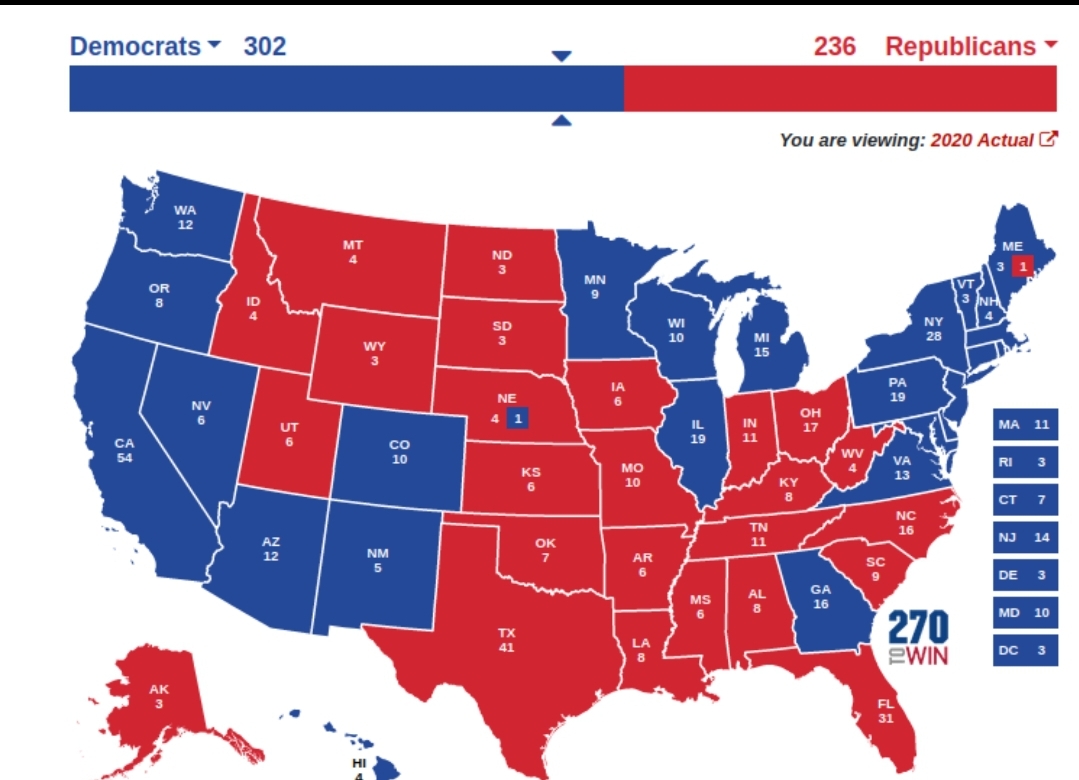
Here it is as plain as day for everyone to see. Granted, I believe like everyone else that the left used all sorts of specious means to vandalize the 2020 election, and I don’t think that Biden deserves to be regarded as the elected president of the United States.

Even so, this map underscores why, if the country ultimately breaks apart, the focus of any red-state American Republic will center around the South. Yes, parts of the Middle Atlantic states and the Midwest ultimately will align with a red state movement, but the focus of energy will remain with the South, as it essentially always has.

That is precisely why I and others have argued for years that the struggle essentially is one that has ensued since the earliest days of the Republic and has always centered around the nature of federal power – how it should be expressed.

Moreover, as I have struggled to point out time and again, if these divisions, which seem intractable at this point, lead to breakup, the South will not be re-staging Confederate States 2.0.

What emerges will be widely regarded as an American restorationist movement, not a Confederate one, despite every attempt by the Legacy (Oligarchic Lapdog) Media to depict it as such.

Indeed, this movement initially will be suspended between two stools – the left and its legions of cultural allies and the very small, very marginalized but very vocal collection of Confederate restoratonists. And to be sure, the media will exploit every act of this small faction as proof of Red State America’s “true intentions.”

That is why any broad-based movement must be begun and be led by a few seasoned, substantive political leaders who can stand above the marginalized elements.

Am I implying that this necessarily must begin as something akin to a vanguard movement? Yes, I am indeed. We simply can’t risk the possibility of this movement being hijacked by Confederate restorationists who would be indirectly aided and abetted by the Establishment media and the federal national security complex with the desire to doom it from the start.

In time, the South has the potential to regain its footing as well as a renewed identity, but it will have to be undertaken long after the initial changes of a national divorce are worked out. And it most assuredly must occur far beyond the noise of Confederate restorationism. Most important of all, a new Southern identity must factor in and come to terms with all of the changes that have occurred in the last 150 years, including the Civil Rights movement.

History Does Repeat Itself

16 Tuesday Mar 2021

Posted by Jim Langcuster in American History, Federalism, The Passing Scene

≈ Leave a comment

Tags

American Federalism, Jim Langcuster, State Sovereignty, States Rights

Oregon State Capitol in Olympia

Way back in the mid-1970’s, I and my fellow classmates at Russellville Junior High School were blessed with an unusually gifted and dedicated 8th grade history teacher named Mary Alexander.

Mrs. Alexander, now long deceased, loved pointing out the irony of history, particularly in terms of how facets of it – whether these happened to be political or cultural  ideals or ways of doing things – often re-expressed themselves at times when we least expected them, even when we thought that they had become discredited or simply had played out.

I never forgot her lesson. Indeed as an avid reader of history I am reminded of this on a frequent basis. Just when we think that some ideas have been discredited or forgotten and, consequently, consigned to history’s ashbin, they return with a vengeance, even with the sense of vibrancy and relevance that had distinguished them in previous decades or even centuries. 

The rekindling of American federalism and even, perish thought, states rights, serves as an unusually timely example. I grew up at a time when federalism expressed as states sovereignty seemed throughly discredited.  What seemed to have been an inexorable march toward human progress, LBJ’s Great Society programs, locked arm and arm with the civil rights struggle and the federal courts’ efforts to expunge the stigma of racial discrimination, seemed to have dealt, if not a fatal blow to states rights, at least a searing defeat that would leave this constitutional doctrine in what amounted to a semi-comatose state.

We were assured by teachers at every level of public education that states rights was a relic of the past – not just a quaint but even a disquieting one. I recall several political science courses in which the professor, a Great Society liberal, likened federalism to a marbled cake.  The federal government was the cake, though states provided measure of enhancement, sort of like chocolate marbling.

Yet, history seems to be repeating itself with a vengeance. In the face of American federal impasse and national division, states, large and small alike, are reasserting the themselves. As I have pointed out on numerous occasions on this forum, it started more than a decade ago when then-California Gov. Arnold Schwarzenegger began characterizing his state as something resembling a nation within a nation. He successor, Jerry Brown, even began conducting a kind of incipient foreign policy related to climate change.

Recently, a prominent GOP leader, Allen West, has lobbied for a secession vote in the Texas State Assembly, a move that at least one GOP leader in another Western state characterizes not only as a positive move but also one that bears close watching.

More recently in Oregon, state Sen. Jeff Golden (D-Ashland) has proposed legislation that would reintroduce a state bank concept for Oregon, primarily with the aim of serving as a backstop for community banks and credit unions.

Golden holds up the Bank of North Dakota as the model for his efforts, stressing the role that this bank played in minimizing foreclosures during the Great Recession.

The Washington Post reports that small businesses in North Dakota, compared with their counterparts in other states, were ably served by this model. In fact, they secured more Paycheck Protection Program (PPP) loans relative to the state’s workforce than other states, with more than $5,000 per private-sector worker as of May 8, 2020.

Yet, why is all of this surprising? States, by their very nature, possess the accoutrements of nationhood. And this is as much a matter of practicality as a historical fact.

As a student of constitutional history, I not only find this fascinating but also instructional in terms of how it underscores the increasing inefficiency of centralized federalism. If developments  such as these demonstrate one thing, it’s that no central government, certainly one so big, bloated and overextended  as the imperial behemoth in Washington, possesses the omnicompetence to manage a polity of the scale of the United States.

The late Mrs. Alexander was spot on: History does repeat itself.

Flummoxed by Secessionism

20 Saturday Feb 2021

Posted by Jim Langcuster in American Federalism, Federalism, Imperial Decline, secession

≈ 1 Comment

Tags

American Breakup, American Empire, American Federalism, Conservatism, Dan Bongino, Jim Langcuster, Ronald Reagan, secessionism

President Ronald Reagan at his inauguration in January, 1981. Shortly thereafter he made an impassioned call for returning to federalism but faced opposition even from GOP governors.

To repeat a phrase that I have employed several times in this forum, the American Empire simply is too big to succeed.

Indeed it is the reason why an awareness of the increasing likelihood of secession is becoming the proverbial elephant in the living room, certainly among the growing numbers of us ordinary Americans in the red heartland who perceive what our malignant ruling class ultimately has in store for us.

Yet, I have been intrigued by how mainstream conservative commentators, recently Podcaster Dan Bonjino, have been absolutely flummoxed by this emerging  phenomenon. It undoubtedly is as readily evident to them that secessionist sentiment is spreading, yet they hold steadfastly to the same hidebound argument that a return to federal principles will resolve all of this.

Notions of American exceptionalism inevitably will die hard, but then, conservatism in America is deeply rooted in this mindset. And given that so much of what passes for conservatism on this side of the Atlantic is rooted in propositional nationhood, this really isn’t all that surprising.

Interestingly, conservatives seem to have forgotten that previous attempts to restore old-time federalism have proven futile. Incoming President Reagan, way back in 1981, undertook a concerted effort to return to bona federalism, offering to return welfare policy back to the states. Virtually all the governors balked, stressing that  their states lacked the revenue base to support a safety net that dates all the way back to the New Deal and that people, blue and red alike, expect as matter of course.

That is why I am convinced that the political dynamics in this country ultimately will necessitate a secessionist movement that ultimately takes on regionalist rather than state unilateral action, as the late diplomat and political thinker George F. Kennan portended in his own writings.

We will likely see states banding into regional compacts, forming what could be described as incipient federations. These conflicts ultimately will prove essential to preserving some facet of the social safety net to which virtually every American has grown accustomed over the past century.

Whatever the case, to borrow a line from the late Betty Davis, “Fasten your seat belts – it’s going to be a bumpy ride!”

Negotiating the American “Gorbachev Moment.”

31 Monday Aug 2020

Posted by Jim Langcuster in Uncategorized

≈ 1 Comment

Tags

American Federalism, American secession, Gorbachev, secession, Soviet Coup

Thousands rallying sound the Russian “White House” in Moscow in defense of Russian sovereignty during the post-Soviet “August Coup” in 1991.

A perversely interesting read, and, frankly, I find it fascinating that this scholar made no mention of Mikhail Gorbachev’s furious efforts to negotiate a new union treaty that would have transformed the post-communist Soviet Union into a union of sovereign states.

The fact is, the United States is also fast approaching a similar inflection point – its own Gorbachev moment – the point at which it dawns on most everyone that existing constitutional arrangements simply are not equipped to handle the stressors playing out around the country. This partly stems from the fact that the hard left is banking on full-blown hegemony and has little use for the Madisonian protects that once safeguarded American liberties.


Meanwhile, the right, for it’s part, is so invested in flag waving and nationalist rhetoric that it can’t summon the courage to admit that everything is falling apart and that the most viable solution lies in the radical decentralization of federal power that would better address all of the cultural rifts playing out in this country. So what we face, as a result, is an impasse, a dangerous impasse, that resembles in some respects the late Soviet Union. Either we find some constitutional means of dealing with these cleavages, namely by returning power to regions of the country with strong cultural and historical affinities, or we face something even more horrendous: authoritarian leftist political and cultural hegemony or civil war or outright dissolution, with all the domestic and geopolitical upheaval this entails.


Yet, I would venture to day that most of us on this group are roundly convinced that the feds will never acceded to this, so the ultimately solution will be states, clusters of states, acting unilaterally, much as they did in 1776,

If California Wants to Go, Let It Go

23 Monday Oct 2017

Posted by Jim Langcuster in Devolution, Federalism, The Passing Scene, Uncategorized

≈ 2 Comments

Tags

American Federalism, Calexit, California secession, Jim Langcuster, South Carolina Nullification, Stephen Bannon, Xavier Becerra

Yes_CaliforniaA year or so ago a liberal friend of mine implied that I was a right-wing kook and crypto-racist for even broaching the idea of disaffected states one day seeking a path out of the Union.

Just this weekend, though, none other than the chief legal officer of the nation’s largest state, California Attorney General Xavier Becerra, offered a remarkably tepid response regarding California’s continued formal ties with the American Union.

“California is the economic engine of the United States of America, we on our own, as a state, could be the sixth economic power in the world,” Becerra stated yesterday in a Fox News Sunday interview.

“The U.S. needs California as much as I believe California needs to be part of the United States.”

Talk about a full-throated endorsement of American unity!  It sounded to me more like a Catalan official affirming unity with Spain.

If Bercerra’s statements aren’t intriguing enough, consider the yawning apathy all of this California separatist talk has generated in the nation’s broad red-state hinterland.  More than one friend of mine has stated they they would stand at the Nevada border happily waving off a new California Republic.

I think that goes for a lot of us here in the red heartland.  If our experience with rising levels of divorce over the past 50 years has driven home one thing, it’s that acrimonious marriages are better off terminated.  And, frankly, these federal bonds, which Lincoln extolled as “mystic chords of memory, stretching from every battlefield and patriot grave to every living heart and hearthstone all over this broad land,” seem increasingly and irreparably frayed.

America is coming to resemble a bad marriage, marked increasingly by acrimony and recrimination.

And all of this is likely to get even more complicated. Indeed, political activist and former presidential Chief of Staff Stephen Bannon is right to compare this growing secessionist sentiment in California with the South Carolina nullification crisis of the 1830’s.

Bannon recently argued that if the federal government fails to stop California’s sanctuary state efforts, California’s leftist leaders  “are going to try to secede from the union” in the next decade to 15 years.

While we may have thought this vexing issue was settled more than 150 years ago, California may be serving up a 2.0 version of secession. We really seem to be closing a very wide and contentious historical circle.  And contrary to my liberal friend’s fulminating, I really think that California may be the portent of a cascading effect among several states.

California presents this union with a special set of challenges- it arguably always has.  We’re talking about a state with several unique characteristics: for starters, its longstanding geographical separation from the other major population centers of the United States  and its location on the Pacific Rim, facing the region of the world where the overwhelming bulk of global economic growth is likely to occur over the next few decades.  Add to that California’s demographic transformation, one factor among many driving its return to its historical legacy as a region intimately linked with the cultural and economic the fortunes of Mexico and Latin America.

Under the circumstances, should we be surprised that California is evolving its own views of law and governance and that it’s begun to strain at its federal leash?

If California wants to go at some point,  let it go peacefully.  And that goes for any other state where a significant segment of the population has concluded that they are better off separate from than a part of the American Union.

Freedom of association should characterize our federal relations every bit as much as it should other facets of American life.   It is integrally bound up with living in a free society.

Subscribe

  • Entries (RSS)
  • Comments (RSS)

Archives

  • December 2023
  • November 2023
  • July 2023
  • June 2023
  • January 2022
  • December 2021
  • November 2021
  • October 2021
  • September 2021
  • May 2021
  • April 2021
  • March 2021
  • February 2021
  • October 2020
  • September 2020
  • August 2020
  • February 2019
  • December 2018
  • November 2018
  • June 2018
  • March 2018
  • December 2017
  • November 2017
  • October 2017
  • February 2017
  • December 2016
  • November 2016

Categories

  • Alabama History
  • American Education
  • American Federalism
  • American History
  • Brexit
  • Censorship
  • Christianity
  • Conservatism
  • Devolution
  • Federalism
  • Geo-Politics
  • Imperial Decline
  • Localism
  • Mainstream Media
  • Nullification
  • oligarchy
  • Patriotism
  • Red-State Faith
  • secession
  • Secularism
  • Southern Athletics
  • Southern History
  • The Passing Scene
  • U.S. Politics
  • Uncategorized

Meta

  • Create account
  • Log in

Website Powered by WordPress.com.

  • Subscribe Subscribed
    • Ruby Red Republic
    • Join 27 other subscribers
    • Already have a WordPress.com account? Log in now.
    • Ruby Red Republic
    • Subscribe Subscribed
    • Sign up
    • Log in
    • Report this content
    • View site in Reader
    • Manage subscriptions
    • Collapse this bar
 

Loading Comments...