• Introduction
  • About Ruby Red Republic
  • Contact
  • Blog

Ruby Red Republic

~ Thoughts on Red States and "Deplorables."

Ruby Red Republic

Tag Archives: American National Identity

Our Decaying National Identity

17 Sunday Dec 2023

Posted by Jim Langcuster in Censorship, Imperial Decline, Southern History, The Passing Scene

≈ Leave a comment

Tags

American Empire, American Federalism, American History, American National Identity, Arlington National Cemetery, Confederate Memorial, Jim Langcuster

A portion of the Confederate Memorial at Arlington National Cemetery

I can’t say that the removal of the Confederate Memorial in Arlingtin National Cemetery was my last straw. For some thirty years, I have grown increasingly ambivalent about the United States, its greedy, morally debased government class, its declining empire and, frankly, the whole concept of being American, playing into the idea of Lincoln’s propositional nationhood as it was initially espoused by him and subsequently has been refined and updated by succeeding presidents and sundry public intellectuals.

In fact, reflecting back across the veil of time, which, as I should stress is exceedingly thick at this juncture in my life, I recall one especially jarring encounter on a chartered bus in June, 1977, en route to West Point after a daylong tour of New York City. We were on the bus with other families whose husbands and fathers, all Reserve Army officers, served as recruiters for the military academy.

During the ride back, a neatly coiffed, very refined young lady approached my mother, an equally attractive and refined lady, apparently on the basis of my mother’s very noticeable Southern drawl. Upon learning that we were Alabamians, she proceeded to heap scorn on Alabama and my mother, apparently simply for her summoning the temerity to live and to raise her sons in such a despicable place.

My mother, who played classical piano, and quoted and wrote reams of poetry and who also held a graduate degree, handled it with her characteristic grace.

For my part, I never forgot it, and it was my first lesson in propositional nationalism – how such a weak form of nationalism necessarily requires a foil and how the South necessarily has supplied this foil.

Perhaps my rambling here is somewhat fraught with irony. As I have pointed out before, the bulk of my forebears were Southern Unionists and even Southern Unionist soldiers, one of whom even had a hand in the burning of Atlanta.

While I readily identify far more as an Alabamian and a Southerner than an American, I am not driven by any burning desire to resurrect the old Confederacy. Yes, I remain a steadfast admirer of the Permanent Confederate Constitution for how it further refined the role of the general government and safeguarded the role of states and even introduced some aspects of the British Westminster Model to the American constitutional system. Yet, despite my strong Southern cultural and political proclivities, I harbor no intention of raising the Stainless Banner above Richmond.

Yet, the fact cannot be denied that this country was rebuilt and a measure of national unity established on the basis of the valor of the Southern fighting man and the post-bellum U.S. Government’s determimation, however initially reluctant, to honor this valor, even as the plutocrats who took the reins after Appomattox succeeded in turning the South into a huge resource-extraction zone as well as capitalizing on Southern martial traditions to build the rudiments of what has become, certainly within the last generation, a corrupt empire.

What we are witnessing today with this monument removal and the widely reported removal and incineration of the Lee Monument is the foreshadowing of a reckoning, which some of the left have likened to the unconditional surrender imposed on Nazi Germany and Imperial Japan in 1945.

This only serves to underscore the degree to which the cultural and political elites who run this regime despise the South and the rest of the red heartland with which this region shares so many cultural and historical affinities.

These are all reasons why I and growing numbers of Southerners and other residents of the vast red heartland have grown increasingly sympathetic to some form of national divorce.

We are governed by a morally-debased corrupt plutocracy that, in employing empty terms such as “our democracy,” simply serve to underscore how the snake oil of propositional nationalism no longer supplies any form of national palliative. What remains of American national identity is squeaking under the strain of wokeness and leftist rot in general, and it behooves us to begin imagining what must follow, which, hopefully will, to one degree or another, harken back to the vision of our Founding Founders.
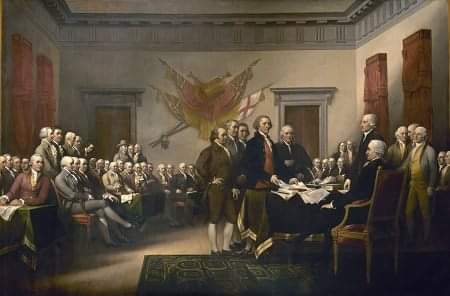
The Weathered American Experiment.

04 Tuesday Jul 2023

Posted by Jim Langcuster in American Federalism, American History, Devolution, Federalism, Imperial Decline, Patriotism, secession, The Passing Scene

≈ Leave a comment

Tags

American Breakup, American Empire, American Federalism, American Future, American National Identity, American Restorationism, American Unity

I wrote this tribute to American independence some nine years ago, and reflecting on it today it doesn’t seem to have weathered all that well.

Indeed, with each passing year in the face of an obstinate and utterly corrupt ruling class that stands at the commanding cultural heights and that stares down with withering contempt at the deplorables, the ancestors of whom caused the previous proprietors, the British nobility, a measure of heartache, I wonder how much time remains for the American enteprise, long regared as history’s most conspicuous experiment in self-government.

This hard truth has left me with a resolve to offer what aid I can toward preserving a saving remnant of the the American project – the sprawling American heartland – what I have come to call the “Ruby-Red Republic.”

As the British surrendered at Yorktown, they played “A World Turned Upside Down,” apparently to underscore their disbelief that a ragtag league of states comprised of provincials and peasants could defeat an army of the greatest empire in the world.

Indeed, for a very long time, Britain and the other great empires of the earth did not consider this feuding aggregation of post-colonial states a nation in any real sense. During a hot, sultry summer in Philadelphia, these provincials rather reluctantly convened to forge an agreement to unite their cantankerous states, one that ultimately worked not only to secure unimaginable levels of freedom and material prosperity for citizens but that has also been emulated to one degree or another by nations throughout the world.

Today this union of states holds the fortunes of an entire planet in its hands. To be sure, its immense power and cultural influence invokes jealously, resentment and, in not a few cases, hatred in some quarters of the world. But after almost a quarter of a millennium, it continues to inspire countless millions of people of all races, nationalities and creeds. It remains the world’s indispensable nation. Happy Birthday to the United States of America.

The “Gorbachev Moment” Approacheth

07 Sunday Nov 2021

Posted by Jim Langcuster in Alabama History, American Federalism, Federalism, Localism, secession, The Passing Scene

≈ Leave a comment

Tags

American Breakup, American identity, American National Identity, Civil War II, Gorbachev moment, Jim Langcuster, secession

Mikhail Gorbachev

Speaking as one who loves American history, the thought has occurred to me time and again: We have never been as united as we think we are. It was a major concern of the constitutional framers and, apart from a few factors in history that have created the illusion of unity, we remain a very pluralistic polity, culturally and politically, and we simply have to find a way to create new political structures to ensure we remain adequately equipped against geopolitical threats such as China but that also ensure that we don’t end up beating out each other’s brains.

If you have been a frequent reader of this forum, you are likely aware that I have come to describe all what is unfolding in the United States as our very own  “Gorbachev moment.” Recall that some 30 years ago the ill-fated refomer of Soviet society? Mikhail Gorbachev tried to negotiate a union treaty to hold things together but events got ahead of him. Boris Yetsin, president the Russian Soviet Republic, signed a compact with his counterparts in Byeloerussia and Ukraine that resulted the breakup of the Soviet state.

As this article attests, we seem to be approaching a similar impasse in the United States, reflected in the growing number of ordinary Americans who express an interest on secession.

For now, our leadership class remains conspicuously silent on the topic of secession. But the inevitable “the Emperor hath no clothes” moment inevitably will arise. Sooner or later, some prominent American, perhaps a governor or senator from either a blue or red state, simply will have to state frankly, “Something’s got to give.”

This is when the facade will crumble.

Then, pehaps, we can hope for some sort of modus vivendi that holds the country together to fend off geopolitical threats, though while ensuring that domestic  power is returned to states or, perhaps more realistic, compacts of states, that we can be assured of sufficient insulation from our increasingly malignant and consolidating ruling class.

Jefferson as Post-National Prophet

15 Thursday Mar 2018

Posted by Jim Langcuster in American Federalism, American History, Devolution, Federalism, The Passing Scene, Uncategorized

≈ 2 Comments

Tags

American National Identity, American nationalism, American Unity, Identity Politics, Jim Langcuster, Socialism, The American Left

Jefferson-Memorial

The Jefferson Memorial (Photo: Courtesy of SamsonSimpson20)

A recent column in Vox explores the decline of dominant American identity and the ways that this identity could be rebuilt amid widespread demographic division and economic distress.

Ezra Klein, the author, contends that the vibrant, effusive American identity that prevailed throughout the 20th century was forged primarily on the basis of two world wars and the 70-year threat of Soviet communism.

I’m inclined to take a slightly different view. The modest imperial standing America acquired in the aftermath of the Spanish-American War formed a critical component of 20th century America identity too. Millions of Americans were carried on a wave of imperial euphoria, confident that the acquisition of a modest, backwater empire heralded our virtually unimpeded ascent to national greatness. And much of this was bound up in the war’s success in re-enlisting the defeated South in nation- and empire-building that followed in the aftermath of this war.

Up to that time, many people in the former Confederate states spent the Fourth of July commemorating the fall of Vicksburg rather than celebrating American Independence.

At the turn of century, some 35 years after one of the bloodiest struggles in history, the South reasoned that if it couldn’t have its own nation, it at least could participate in the building of a nation destined to ascend to the front ranks of global leadership.

This was a fortuitous turn of events for the American national enterprise: The post-Civil War South ended up supplying this nation not only with a significant share of its patriotic ballast but also a generous portion of men and women to guard the outposts of the global American empire that emerged after World War II.

Yet, we seem to be reaching an critical juncture, if not a major impasse, in defining American identity. And one wonders: How much practical value is derived from doubling down on one-nation rhetoric and insisting on more dialogue?

In the view of a growing number of heartland Americans, the only rhetoric deemed unifying by our ruling classes is that which conforms to the agenda of the left.

Moreover, another vital adhesive of American identity, centralized federalism, seems to be losing its efficacy too. Americans seem less inclined than ever to operate off the same page on issues that were once seen as vital to national security, such as regulating immigration and guarding our borders. Some on the left are even calling for the elimination of the Immigration and Customs Service (ICE).

Perhaps most disturbing of all, though, we seem to be rapidly approaching a cultural impasse that surprisingly few pundits have considered: namely, how this country will manage to soldier on when it is no longer regarded by ordinary Americans as standing at the pinnacle of the world’s most successful and exceptional nations.

So much of American unity and national identity is bound up with its perceived greatness and singularity.

A recent study ranked tiny Finland and several of the other Scandinavian countries as the world’s happiest, although the United States failed to rank in the top ten. Indeed, the results of the study point out a remarkable anomaly: Despite the United States possessing the world’s largest economy, millions of its citizens grapple with rising levels of obesity, substance abuse and high rates of depression, not unlike the problems that plagued the Soviet Union in the years leading up to its collapse.

Some on the left have expressed a desire to build a new national identity on the basis of socialism and identitarian politics, with the long-term goal of ridding the country of what they characterize as a historically evil and malignant white patrimony that has existed since the nation’s founding.

Given all these deep divisions over how to define the American enterprise in the future, perhaps we will return to some version of Thomas Jefferson’s 18th century vision of an American Empire: a continent of smaller states, either loosely tied or wholly independent of each other, sharing some degree of historical and cultural affinity.

Jefferson, it seems, may prove to a prophet of post-national American unity. At least, one can hope, amid all of this national division and rancor, that we can muster some semblance of mutual affinity and continental unity.

Whatever the case, a socialist, identitarian America should hold no appeal for any decent person, irrespective of race or ethnicity, who cherishes ordered liberty and constitutional government.

But if, God forbid, such an America emerges in the next 30 years, I suppose I’ll be one of those passing my autumn and winter years in a socialist gulag, at least, deriving a measure of solace that I will be living among what remains of sane people in America.

Subscribe

  • Entries (RSS)
  • Comments (RSS)

Archives

  • December 2023
  • November 2023
  • July 2023
  • June 2023
  • January 2022
  • December 2021
  • November 2021
  • October 2021
  • September 2021
  • May 2021
  • April 2021
  • March 2021
  • February 2021
  • October 2020
  • September 2020
  • August 2020
  • February 2019
  • December 2018
  • November 2018
  • June 2018
  • March 2018
  • December 2017
  • November 2017
  • October 2017
  • February 2017
  • December 2016
  • November 2016

Categories

  • Alabama History
  • American Education
  • American Federalism
  • American History
  • Brexit
  • Censorship
  • Christianity
  • Conservatism
  • Devolution
  • Federalism
  • Geo-Politics
  • Imperial Decline
  • Localism
  • Mainstream Media
  • Nullification
  • oligarchy
  • Patriotism
  • Red-State Faith
  • secession
  • Secularism
  • Southern Athletics
  • Southern History
  • The Passing Scene
  • U.S. Politics
  • Uncategorized

Meta

  • Create account
  • Log in

Website Powered by WordPress.com.

  • Subscribe Subscribed
    • Ruby Red Republic
    • Join 27 other subscribers
    • Already have a WordPress.com account? Log in now.
    • Ruby Red Republic
    • Subscribe Subscribed
    • Sign up
    • Log in
    • Report this content
    • View site in Reader
    • Manage subscriptions
    • Collapse this bar
 

Loading Comments...