• Introduction
  • About Ruby Red Republic
  • Contact
  • Blog

Ruby Red Republic

~ Thoughts on Red States and "Deplorables."

Ruby Red Republic

Category Archives: American Federalism

An Ignoble Relic or an Instructive One?

15 Monday Mar 2021

Posted by Jim Langcuster in Alabama History, American Federalism, American History, Censorship, Nullification, The Passing Scene, Uncategorized

≈ Leave a comment

Tags

Cancel Culture, Censorship, Interposition, Jeffersonian School, Jim Langcuster, Journalism, Nullification, States Rights, The Confederate Constitution, wokeness
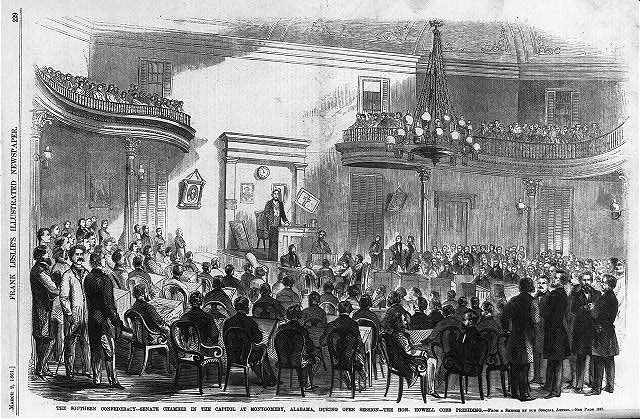
Confederate Provisional Congress Meeting in Montgomery, AL, in 1861

I wondered how much longer it would be before the Confederate Constitution, much like Confederate statues, would fall victim to cancel culture. Quite honestly, though, I don’t know what is more maddening: cancel culture or the intellectual laziness evinced by journalists, even relatively elite ones, who, either intentionally or unintentionally, aid and abet this malignant cultural trend.

AP journalist Jay Reeves characterizes the Confederate Constitution, which, incidentally, was debated and drafted in the Capitol in Montgomery in my native state of Alabama, as a vestige of white supremacy without even bothering to  consider the document within its full historical context. And let’s make no mistake here: The Permanent Confederate Constitution was conceived within a wide intellectual and historical Anglo-American constitutional context and, for that reason alone, is worthy of serious discussion, despite its provisions safeguarding the institution of slavery.

It is appalling to me that Reeves never even bothered to explore this unusually rich context, which would have been standard practice among journalists as recently as a decade ago.

A Watershed Document

Before public discourse became so poisoned, the Confederate Constitution, despite the controversy associated with it, would have been characterized by some writers and academics as a watershed document, one that represented the outcome of a protracted, intense and often acrimonious debate on the nature and scope of federal power that began immediately following the drafting of the U.S. Constitution in 1789.

The Permanent Confederate Constitution could be accurately characterized as embodying the Jeffersonian School  argument, which maintains that the federal government – the “general government,” as it was characterized by many in the decades following constitutional ratification  – simply functioned as the agent of the contracting sovereign states. This was underscored by  the Confederate Constitution’s preamble, which affirmed that each state, in ratifying the document, was acting  in its “sovereign and independent character.”

Aside from reaffirming the Jeffersonian view of federal power, this revised constitution also introduced some remarkable innovations that not only are instructive today but that still hold currency as contemporary Americans struggle to rein in federal power and  even more significant, contend with mounting interest in sectionalism and even secession. Indeed, the case could be made that these innovations are especially relevant today amid new sectional divisions pitting predominantly liberal blue-coastal states against predominantly and implacably conservative  red heartland states – issues not all that different from the ones that plagued federal relations in the early 19th century.

A Six-Year Presidency and a Line-Item Veto

One notable innovation was how the Confederate framers altered the office of the presidency, both limiting and strengthening it. While restricting the chief executive to a single 6-year term, the Confederate Constitution also empowered him with line-item veto power. Such a constitutional prerogative potentially would have gone a long way toward reining in the Leviathan federal state, one that not only extends its hand into increasing facets of American life but even holds tremendous sway over the affairs of nations in far-fling corners of the world.  Moreover, with such a constitutional safeguard, we likely wouldn’t be contending today with a $20-million deficit.

The constitution also prohibited Congress from levying protective tariffs that tended to benefit one section of the country over others, an issue that proved contentious in the formative stages of the young American Republic and that virtually rent it apart in the early 1830’s.

The long-term effects of protective tariffs arguably have had an especially deleterious effect on the fortunes of American development and national cohesiveness,  not only by allowing one section of the country, namely, the mercantile Northeast, to grow rich at the expense of most of the others but also by enabling it to transform much of the rest of the country, notably the war-ravaged, economically prostrate post-Civil War South, into an economic extraction zone.

Reining in Federal Judicial Power

In what arguably could be regarded as the most noteworthy innovation of them all,  state legislatures were entitled to remove corrupt or constitutionally unscrupulous federal judges living in their states by a two-thirds vote of both houses. Ponder for a moment all of the contentious 21st century issues that could have been resolved by this provision. It would have obviated the need for state legislatures to resort to strategies such as interposition and nullification that contributed significantly to two serious constitutional crises stemming from passage of the Alien and Sedition Acts in 1798 and the Tariff Act of 1828. Each of these contributed significantly to the protracted political impasse that culminated in a national breakup in 1861. Even more significant, though, such a constitutional safeguard likely would have contributed significantly not only to higher levels of restraint in the judicial branch but also in the federal legislative branch, as lawmakers would been more cognizant of the futility of passing laws that encroached on state sovereignty.

Yes, the Confederate Constitution was both an innovative and instructive, one among a long line of written constitutions within the Anglo-American tradition, one that also incorporates those of Commonwealth realms. And that is why it, along with others, should figure in prominently in any undergraduate or graduate coursework dealing with the protracted historical debate about the nature and scope of central power within a federal system. But like so much else in woke 21st century America, the Confederate States Constitution is now so thoroughly tainted by the stigma of white supremacy that it can never be regarded as anything more than a “forgotten relic of an ignoble cause,” borrowing Reeves’ description, and, consequently should remain locked away in archive and forgotten.

This only ensures that substantive debate in this country will grow even more constrained.  But, of course, by now it should have dawned on most of us that this is one of the underlying aims of wokeness and cancel culture, which aren’t so much about fairness and inclusiveness as they are about stigmatizing views that threaten their hegemonic standing within American politics and culture.

Reeves’ article only served to underscore that we no longer function aa vibrant, open and free society, only one that pretends to be. And many of us are beginning to wonder how much longer elites, increasingly confident of the political and cultural power they increasingly wield, will bother with maintaining this pretension.
An Increasingly Reluctant Panel of Last Resort

26 Friday Feb 2021

Posted by Jim Langcuster in American Federalism, Federalism, Imperial Decline, The Passing Scene, Uncategorized

≈ Leave a comment

Tags

Chief Justice John Marshall, Federalism, Jim Langcuster, Judicial Review, SCOTUS, State Sovereignty, U.S. Supreme Court

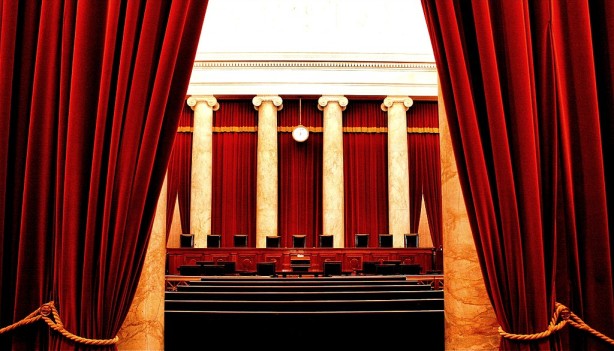
The U.S. Supreme Court Chamber

There has been a lot of chatter lately within conservative and libertarian circles about the increasing dysfunction that has set into our judicial branch, which, however ill-advisedly, now regards itself as the Union’s defender of last resort.

Lots to unpack here but I’ll return to something that I have argued before in this forum – something that was driven home to me years ago reading British constitutional scholar James Bryce’s appraisal of the American constitutional system in his classic tome The American Commonwealth, first published in 1888. Even way back then, Bryce had perceived how dysfunctional and unwieldy the federal legislative branch had become in the face of the nation’s rapid demographic and geographic expansion.

By the late 19th century it was impossible for the House of Representatives to function as a bona fide legislative assembly. Virtually all of its vital daily work was conducted via committee with all of the backroom Machiavelianism this entailed. Meanwhile, the Senate had grown far beyond its ability to function as a comparatively small, elite advisory council to the executive branch, as conceived by the constitutional framers.

By the late 19th century the judicial branch, embodied in most American minds then and now as the Supreme Court, one that was given comparatively short shrift by the Constitution by its framers, was poised for its ascent to the commanding heights of American politics and culture.

Its earliest custodians, notably Chief Justice John Marshall, had, like all elites in virtually all political systems throughout history, engineered the first tenuous steps toward an accretion of power beginning with Marbury v. Madison.  But even Marshall, careful to avoid overreach and the backlash that inevitably would follow from the majority Jeffersonian camp, stepped away from one especially contentious constitutional issue of the day, conceding, however reluctantly, that the recently enacted Bill of Rights applied only the the federal government, not to the states.

The most libertarian- and constitutionalist-minded of early American statesman expressed qualms about enacting an explicit statement of rights, fearing that it ultimately would be construed by Congress or the courts as affecting state as well as federal authority.

These fears rather predictably proved prescient, following the post-Civil War passage of three constitutional amendments – the 13th, 14th and 15th – that set the Supreme Court firmly on the path toward the enunciation of the Incorporation Doctrine, which effectively worked to erode the states’ sovereignty, reducing them to de facto provinces.

Equally significant, though, is how the Supreme Court has employed the Incorporation Doctrine with many subsequent expansionist rulings in a manner that essentially has transformed it into a de facto supreme governing council – effectively, the American Union’s final arbiter.

What many observers surprisingly overlook, no doubt, intentionally in the vast majority of instances, is that the court employs enhanced powers partly to compensate for the dysfunction of the legislative branch, which the Framers regarded as the well-spring of federal policy, not to mention, the branch charged with safeguarding the balance between state sovereignty and that which had been delegated – conditionally, it should be stressed – by the states to the federal government.

The behavior and public pronouncements of the current Supreme Court Chief Justice John Roberts and and his immediate predecessors seem to reflect this fact.  The case could be made that the court has been aware for decades of the role it has served, however unconstitutional, in shoring up the deep dysfunctionality of the legislative branch, one whose efficacy has been badly eroded within the past century and a half but especially in the years after World War II when the United States emerged as a global empire..

Yet, increasingly, the Court finds itself hemmed in, if not trapped, by the demographic and cultural changes overtaking the country, many of which are of its making. One recent example: It’s decision following the 2020 election not to hear the case lawsuit challenging late changes to Pennsylvania’s election process.

Despite a thunderous dissent by Justice Clarence Thomas, two justices previously regarded as being in the tank for the right, Brett Kavanaugh and Amy Comey Barrett, voted with the majority. And why should we find that at all surprising? Given the way the Mainstream Media organs characterized Thomas’ opinion as dissent bordering on sedition, it’s easy to discern why a court that they regard a majority conservative one has gotten into the habit of carefully hedging its bets.

SCOTUS, to employ one of the  Orwellian Newspeak-style terms that characterizes so much of cultural and political discourse now days, is walking an increasingly thin rope. It carries on what it undoubtedly regards as a lofty and valiant struggle to safeguard not only a dysfunctional legislative branch but an increasingly divided, if not fraying, American Union. Yet, as a marginally conservative court, regarded as illegitimate by many, if not most, of our Mandarin class entirely for that reason, it imposes limits on the manner in which which it weighs in on the most pressing issues of the day.

This amounts to one of the most remarkable ironies in U.S. political history: The judicial branch that, at least for the last century, has regarded itself as the panel of last resort and that has played a major role in the sweeping changes within American society, now feels constrained and even threatened by this transformation – so threatened that is now limiting its judicial activism.

This raises a troubling question: Who mans the rudder of state, certainly during an extreme national crisis? If the legislative and judicial branches have been rendered either too dysfunctional or too threatened to step in during a major upheaval, who will?

It serves as another reminder to me and many other red heartlanders of the precarious times in which we live.

Avoiding an Irish or Balkan Scenario

22 Monday Feb 2021

Posted by Jim Langcuster in American Federalism, Censorship, Federalism, Imperial Decline, The Passing Scene

≈ Leave a comment

Tags

Confederate monuments, cultural cleansing, national parks, wokeness

“As the nation reckons with its racist history, legislation calling for the removal of Confederate commemorative works from national parkland is likely to be reconsidered this year,” solemnly writes Kim O’Connell of the National Parks Traveler.

She adds that “one might be forgiven for believing that the South won, based on a reading of the monuments alone.”

In that case, I’ll never set foot on a federal park again. I’ll even go a step further by expressing my fervent hope that young Southern men and women withdraw their support of the American imperial enterprise, opting not to serve in any of the branches of the American military – yes, refusing to support the geopolitical interests of a government that resembles less a constitutional republic, more a tyranny with each passing day and, like many earlier empires, sustaining its power by pitting one cultural segment of society against another.

What is conveniently ignored by writers such as O’Connell in the midst of this proto-totalitarian woke struggle is that national unity and the ultimate construction of what amounts to a global American empire was secured through the construction of thousands of such monuments in town squares, cemeteries and, yes, national parks in every corner of the vanquished Confederacy.

It ultimately was achieved only  because the Northern conquerors concluded, however half-heartedly, that post-war unity was achievable only through an acknowledgement of the bravery and sacrifices of the Confederate fighting man.

Without this acknowledgment, the South very well could have ended up as the American version of Ireland or even the Balkans, a soft, vulnerable underbelly of an aspiring empire. And given where we are heading with all of this neo-Puritanical cleansing, we may end up with something resembling Northern Ireland during the troubles or, even worse, the past Yugoslavian Balkans.

Flummoxed by Secessionism

20 Saturday Feb 2021

Posted by Jim Langcuster in American Federalism, Federalism, Imperial Decline, secession

≈ 1 Comment

Tags

American Breakup, American Empire, American Federalism, Conservatism, Dan Bongino, Jim Langcuster, Ronald Reagan, secessionism

President Ronald Reagan at his inauguration in January, 1981. Shortly thereafter he made an impassioned call for returning to federalism but faced opposition even from GOP governors.

To repeat a phrase that I have employed several times in this forum, the American Empire simply is too big to succeed.

Indeed it is the reason why an awareness of the increasing likelihood of secession is becoming the proverbial elephant in the living room, certainly among the growing numbers of us ordinary Americans in the red heartland who perceive what our malignant ruling class ultimately has in store for us.

Yet, I have been intrigued by how mainstream conservative commentators, recently Podcaster Dan Bonjino, have been absolutely flummoxed by this emerging  phenomenon. It undoubtedly is as readily evident to them that secessionist sentiment is spreading, yet they hold steadfastly to the same hidebound argument that a return to federal principles will resolve all of this.

Notions of American exceptionalism inevitably will die hard, but then, conservatism in America is deeply rooted in this mindset. And given that so much of what passes for conservatism on this side of the Atlantic is rooted in propositional nationhood, this really isn’t all that surprising.

Interestingly, conservatives seem to have forgotten that previous attempts to restore old-time federalism have proven futile. Incoming President Reagan, way back in 1981, undertook a concerted effort to return to bona federalism, offering to return welfare policy back to the states. Virtually all the governors balked, stressing that  their states lacked the revenue base to support a safety net that dates all the way back to the New Deal and that people, blue and red alike, expect as matter of course.

That is why I am convinced that the political dynamics in this country ultimately will necessitate a secessionist movement that ultimately takes on regionalist rather than state unilateral action, as the late diplomat and political thinker George F. Kennan portended in his own writings.

We will likely see states banding into regional compacts, forming what could be described as incipient federations. These conflicts ultimately will prove essential to preserving some facet of the social safety net to which virtually every American has grown accustomed over the past century.

Whatever the case, to borrow a line from the late Betty Davis, “Fasten your seat belts – it’s going to be a bumpy ride!”

Toward a Detoxified, Humanized Federalism

28 Thursday Feb 2019

Posted by Jim Langcuster in American Federalism, Devolution, Federalism, Southern History, The Passing Scene, U.S. Politics, Uncategorized

≈ 2 Comments

Tags

Brexit, Demassification, Devolution, Federalism, Great Britain, Jim Langcuster, secession

pluribus-unumMuch like the fall of the Berlin Wall and the Tiananmen Square protests, the result of the 2016 European Union Referendum — Brexit, as it’s commonly called — will be one of those memories that stay with me the rest of my life.

Late in the night as the Leave vote amassed an insurmountable lead, I reflected on how Brexit likely would constitute a wakeup call not only for the European Union but possibly for the American Union too.

I was motivated as much as I was inspired by the results.  The next morning, I got busy setting up a devolutionary weblog as a forum for discussing how the Brexit outcome likely would affect federalism in the United States.

Reflecting weeks later on how the results of the referendum had galvanized Scottish nationalist sentiment, I also began to wonder if Britons would take up a serious discussion of drafting a constitution for a new federal British union encompassing England, Northern Ireland, Scotland and Wales. And this led me to speculate about whether such a union of sovereign states ultimately would inspire one or more American states to demand a return to the principles of state sovereignty enshrined in the Constitution, particularly in the Tenth Amendment.

Sclerotic, Dysfunctional American Federalism

Brexit should have been regarded as a wake-up call for all Americans.  Indeed, American federalism is arguably just as sclerotic and unresponsive to present-day needs as its European Union counterpart and perhaps equally as imperiled.

Challenges to American Federalism

Some of the maladies associated with American federalism date back as far as colonial times, while others have emerged considerably more recently. The deep cultural chasms stemming from the Civil Rights Movement and the Vietnam Conflict some 50 years ago certainly have contributed. But so have more recent technological advances, namely, the demassification of media that followed the expansion of cable television within the last 50 years and, more recently and significantly, digitization, particularly social media.

These new media, despite all the good that they have produced, have added an extra layer of complexity to our cultural and political discourse. For better or worse, they have enabled growing numbers of Americans to self-organize into a myriad of subcultures.

Demassification has also compounded the challenges of our current federal model. In the face of this demassification, our highly centralized and sclerotic federal system has only grown more unresponsive, unworkable and even toxic, contributing to the deep regional and cultural divisions, particularly as they are expressed at the national level.

Some readers may regard such disparaging talk about our federal system as shocking.  After all, many Americans tend to regard our Constitution and the institutions and mechanisms that developed out of it as truly singular, if not beyond reproach.  To characterize these vital components of our constitutional system not only as unresponsive but even unworkable comes off sounding, well, downright un-American, if not treasonous, to many.

Deep Cultural Cleavages

Yet, the time for a frank dialogue about the inadequacies of our federal system is long overdue.  American federalism, despite its many notable successes over the last almost quarter of a millennium, has never managed to compensate fully for the deep cultural cleavages that have challenged this country from the very beginning.

Author and columnist Michael Malice was right and, I would contend, rather courageous, to argue that one part of the country, which could be broadly described as the cultural and political heirs of Puritan New England, have spent almost a quarter of a millennium trying to impose their vision of the American Experiment on the part of the country that traces its cultural and political legacy to Jefferson and that could be broadly characterized as the South.

He even argues that America was never that united a nation in the first place. Even in those rare times when we have enjoyed a measure of ideological unity, we have seldom marched in cultural lockstep.

And why should that come as a surprise?

The Failures of Centralized Federalism

Ponder this fact for a moment: The United States now possesses a population of 300-plus million people spanning a continent-sized country, the fourth largest in the world. Yet, we are governed on the basis of a badly antiquated federal model conceived a century ago by a progressive-minded political scientist named Woodrow Wilson, our 28th president.  He and other academics concluded that the country would be better off divesting states and localities of many of their traditional responsibilities, entrusting these instead to a central government manned by technocrats steeped in the emerging insights of social science.

Even today a few proponents of this centralized model would steadfastly contend that the wisdom of these reforms were affirmed by the degree to which they guided us through two world wars, the Cold War, and the Civil Rights Movement.  In the interest of time and space, I’ll defer that topic for a later date.  Suffice it to say that this model is showing its age in the highly diffused and decentralized economic, political and cultural environment of the 21st century.

America’s Oldest Cultural Impasse

Yet, as Malice stressed in his column, the deepest and most intractable problems associated with American federalism stem from the longstanding regional rivalry and animosity between the political and cultural heirs of New England and the South, two regions with competing visions of the American Experiment.

The fact that New England emerged as the nation’s most culturally preeminent region after the Civil War should surprise no one.  Historical research has revealed that New England was the most literate region on the planet following American independence.  Its emphasis on mass education, particularly higher education, afforded the region immense intellectual and, ultimately, material advantages over the agrarian, slave-holding South and parts of the emerging American Back Country.  And even today, this region and other sections of the country directly shaped by its cultural and political vision continue to project their aspirations onto the rest of the country, particularly the South.

To be sure, the South, despite its statesmen supplying the theoretical foundations for many of the founding principles of this country, not to mention, the fact that seven of the first ten U.S. president were Southern, was encumbered by an slave-holding economic system that impeded economic diversification and, as a result of which, provided Southern political elites with less incentive to educate the region’s farming and laboring classes.

The South’s economic disadvantages proved disastrous over the long run. Following the South’s defeat and economic dispossession after the Civil War, New England and its regional offshoots emerged as the nation’s unrivaled cultural and political hegemons.

If one good thing besides the end of slavery followed this disastrous outcome, it was how defeat provided an impetus for the defeated and economically prostrate South to reinvent itself. One even could argue that the South owed its New England counterparts a debt in terms of its being forced to abandon an economic system that had sapped its intellectual and economic potential for some two centuries.

Lessons from Ireland and India

Yet the story is a bit more complicated.  The case can be made — and has time and again throughout U.S. history by Southern political leaders, academics, and writers — that certain traits bound up with the New England cultural legacy have also worked to exacerbate American unity as much as they have mitigated them.  Virtually from the founding of this country, the cultural heirs of England, many of whom comprise the core of this nation’s current ruling class, have tended to regard the South as the nation’s problem region, fit, in a manner of speaking, only to don the dunce’s cap and to sit on a stool of everlasting repentance.

As they see it, the South comprises the central, defining core of the worst aspects of the American cultural legacy, reflected in gun ownership, religious dogmatism and reactionary conservatism.  And, predictably, this animus has sparked a reciprocal reaction not only in the South but in other so-called red-states, many of which not only share significant cultural affinities with the South but also lay equally strong claims to the Jeffersonian legacy of strictly limited government.

Speaking as an amateur student of history and particularly of 20th century nationalist movements, I’ve always found it remarkable that this cultural animus never sparked enduring nationalist sentiment in the defeated, post-war South comparable to what emerged in Ireland beginning in the late 18th century — or, for that matter, India, in the 19th century.

Whatever the case, I think it behooves Southerners and, for that matter, inhabitants of other red states that share strong ties to the Jeffersonian political tradition to reflect on all of this constructively.

History has demonstrated time and again that conquest and economic dispossession are not one-way streets. Even the inhabitants of conquered lands sometime derive immense cultural, material and even political benefits over the course of time.

Many a contemporary Irish or Indian citizen would concede a considerable debt to the British colonial legacy.  Deep historical scars remain, yes, but despite all of this, they credit their former British hegemons with a few things of estimable value: a national communications and transportation infrastructure as well as a legal and parliamentary tradition, which provided both aspiring nations with critical facets of nation-building. These factors contributed immeasurably not only to a united Ireland and India but to their becoming singularly successful parliamentary democracies.

Southerners likewise owe their New England cousins a measure of debt.  New England’s intellectual and material advantages not only proved instrumental in defeating the South but also were major factors that forced the region over the course of time to undergo much needed economic diversification.  But even before the war, New England’s rich religious legacy also left an indelible mark on the South and much of the Back Country.  Indeed, much of the impetus behind the evangelical religious revivalism in the South and the rest of the American frontier were incubated in New England.

Well-Articulate, Vibrant Regional Identities

No doubt about it: Every region of the country, even the relatively disadvantaged ones, have benefited from American federalism.

Yet, this doesn’t obviate the fact that we now regard ourselves as a deeply sundered and increasingly embittered nation, increasingly divided by religion, culture and politics. Indeed, we have arguably grown even further apart within the last couple of years following Donald Trump’s electoral upset.  And this division is exacerbated by the very nature of Wilsonian model of centralized federalism.  Each side of the great political divide in American, blue and red America, still harbors hopes that they ultimately can harness this centralized federal model to impose their will on the other.

As Malice stresses, this has prompted growing numbers of us to ponder the unthinkable: the merits of breaking up this big, increasingly unwieldy federation into smaller, more manageable, and arguably more humane political entities.

Indeed, if an increasingly restive, assertive California has demonstrated one thing , it is that the South’s preeminent Founding fathers, Thomas Jefferson and James Madison, were right all along.  Even at a time when America was overwhelmingly Protestant and culturally British and thoroughly wedded to a single language, these two men categorically rejected centralized federalism on the basis that a country as large and diverse as the United States simply could not be managed centrally.  For his part, Jefferson even occasionally wondered out loud whether liberty ultimately would be best secured across this vast continent through an aggregation of smaller republics, all sharing common cultural and political affinities, all pledged to securing the blessings of prosperity and liberty for their citizens.

In the midst of all these wrenching, seemingly intractable divisions, we are being challenged to return to questions that once preoccupied our Founding Fathers.

We are being called upon to search for ways to detoxify and humanize our federal system. But how?  How do we best govern ourselves in an age of sweeping media demassification?  What political relations are best suited to securing liberty and fraternity among Americans of diverse backgrounds stretched across a vast distance?  Are these relations best secured by some version of Madisonian federalism — a large republic encompassing smaller republics — or are the times calling for a more radicalized, Jeffersonian view?  Has our current political union grown so large, so diverse and so ungovernable that we would be better off living in smaller federations, each of which arguably would be better designed and equipped to serve human needs?

Some readers may regard this last question as needlessly cynical and unpatriotic, if not downright treasonous.  But I would argue that engaging in a frank discussion now about the future of our political association may better ensure that we avoid a disastrous impasse, if not a breakup, further down the road.

Yes, I believe that the cultural and political divisions in this country really are that deep and wrenching.

We must find a way not only to detoxify American federalism but also to humanize it.


The Mainstreaming of Secession

26 Wednesday Dec 2018

Posted by Jim Langcuster in American Federalism, Devolution, Federalism, Uncategorized

≈ 1 Comment

Tags

Federalism, Federations, Interstate Compacts, Jim Langcuster, secession, States Rights, Wilsonian Progressivism

texas-capitol

Texas: One of several states harboring a nascent secessionist movement. 

I’ve been bowled over the last few weeks reading the growing number of articles in which mainstream columnists are finally coming to terms with a reality that I embraced more than a quarter century ago: the likely, if not inevitable, transformation of the  American Union into a much looser federation or into a number of smaller nation-states.

Predictably over the last quarter century, I’ve even been labeled everything from a neo-Confederate and a racist to a secessionist and traitor for subscribing to such views.

Actually, far more prodigious intellects, notably, the late George F. Kennan,  foresaw this inevitability years before I did.

I, for one, and despite my conservatism, respect the right of California and other left-leaning states to experiment with different domestic policies. I hope when all the chips are down that these enlightened blue-coast cosmopolitans will afford their counterparts in the red American hinterland the same courtesy.  And lest we forget, that was the concept behind American federalism:  that states possessed the attributes of nationhood but had chosen out of a desire for self-preservation against Britain and the other maritime powers of Europe to delegate a comparatively narrow range of powers to a general government that operated on behalf of the states.

Aside from all the constitutional arguments, there just comes a point when people outgrow relationships, whether these are business contracts, civic groups, friendships or marriages.  And the simple fact of the matter is that America is simply too damned big and diverse to govern, at least, based on the cookie-cutter approach that Woodrow Wilson and the progressives devised for us roughly a century ago.  We have reached the point where cultural evolution throughout through Europe and America has outstripped the ability of the central government to keep pace with it.

I really believe that.  In fact, I think that this is one of the inherent flaws in federations: The constituent parts are often inherently fissiparous, with their own highly evolved cultures and political ideologies.  These constituent parts don’t stop evolving when they enter into a federation: Their cultural and political evolution continues apace, sometimes to the point at which they feel compelled to question the utility of their relationship with the other members of the federation. Maybe it’s time for us to take into account that incontrovertible fact whenever we undertake the design and execution of another federation.

How close is America to a crackup?  I’m not sure.  Even so, I do believe that in many notable respects, we are drawing close to where the beleaguered Soviet Union found itself in about 1990.  Either we find some way to renegotiate federal arrangements in the United States by devolving more power back to states and, most important of all, localities, or we face a situation where internal pressures build up to a degree that states and regions take it upon themselves to address these problems.

Deep-blue California’s nullifying tendencies vis-a-vis the policies of the Trump Administration are merely a taste of what is to come.

In fact, in an unusually comprehensive and informative column posted in the Intelligencer recently, one perceptive columnist, Sasha Issenberg, predicts that growing number of states may enter into interstate compacts to work through a number of intractable domestic problems.  In the end, the United States may comprise up to three de facto federations: blue, red and neutral, each conducting their own unique domestic policies, while remaining parts of the United States.

Yet, even this columnist concedes that these de facto arrangements will only work for a time before the internal stresses build up and rend apart these federations, forcing each to move close to becoming bona fide countries.

For his part Kennan offered a sort of middle way, one to which I’m sympathetic: a union of about 15 or so constituent republics, to which the bulk of domestic powers would be entrusted, leaving the central government to run a common market and defense pact.

Whatever the case, we are very possibly approaching a constitutional impasse in which large states, particularly California, increasingly will assume more and more powers on their own, drawing us closer to a Soviet scenario. By that I mean that, despite our attempts to stay ahead of the problem by introducing institutional reforms, the country inevitably comes apart.


The Left’s Real Problem with the Senate

08 Thursday Nov 2018

Posted by Jim Langcuster in American Federalism, American History, U.S. Politics, Uncategorized

≈ 1 Comment

Tags

Federalism, Left, Mid-Terms2018, U.S. Senate

senate-logoThe outcome of the 2018 mid-term elections, especially in terms of how it is reflected in the composition of the U.S. Senate, underscores the perennial wisdom of the Founders. But the left’s dissatisfaction with this outcome and its increasingly strident criticism of the “undemocratic” nature of this upper chamber demonstrates two things: its ravenous thirst for power and its growing awareness of its power, especially as it’s manifested in the most influential facets of American culture, namely academia, the Establishment media and the arts.

Two other important points must be mentioned: First, the Senate represents the essence of America union and nationhood, and there would not have been a United States without this indispensable compromise. Second, no other institution established by the Constitution better embodies the limited nature of our federated republic

Indeed, the compromise reflects one of the primary concerns of the Founders: to establish a federal republic with sharply delineated powers and scope, one that enabled the individual states to carry on with virtually all the attributes of nationhood.

To put it another way, the Senate was conceived as a sort of chamber of state ambassadors to serve as a counterweight to the larger popular chamber: the House of Representatives. Its purpose was to ensure that the United States remained what Madison called a “republic of republics,” a federation with sharply circumscribed powers that chiefly functioned to protect the states against against dissolution and the inevitable threats from the chief European maritime powers, Britain and France.

Through its increasingly harsh criticism of the Senate, the left is calling one of the most vital safeguards of the Constitution and our federal republic into question. And, of course, there is an ulterior motive driving this, because abolishing or, at least, radically altering the composition of  both the Senate and the Electoral College would confer the blue coastal regions of the United States with virtually unbridled power to dictate to the rest of the country.

This demonstrates one of the perennial challenges of large, extended federal republics such as ours: the specter of sectionalism, the desire of one part of a federation to dominate at the expense of the others.  It was one of the factors that led to the outbreak of the bloody Civil War.  And without the vigilance of present-day Americans, it could lead to a similar upheaval.

For more insight into all of this, I recommend a thorough reading of the writings of South Carolina statesman John C. Calhoun – that is, if you are able to wrangle a contraband copy of it.

The Implacable Left

25 Monday Jun 2018

Posted by Jim Langcuster in American Federalism, Conservatism, Devolution, The Passing Scene, Uncategorized

≈ 1 Comment

Tags

Civil War II, Hard Left, Kirstjen Nielsen, Leftist Intolerance, Sarah Huckabee Sanders

leftist-protesters

Leftist Protesters in Washington, D.C.  Photo Courtesy of James McNellis. 

A close friend just passed along this fascinating piece.

It takes me back to an exchange I had with an old Sigma Chi brother a few days ago. In a previous social media exchange with another Sig brother, I bemoaned the divisive trends unfolding in America and offered pretty much the same view outlined in this article: namely, that these divisions seem irreconcilable over the long term. The old fraternity brother, a D.C operative who has been burnishing his liberal credentials and virtue signaling skills for decades, weighed in to decry the breakdown of American civil discourse, harkening back to those halcyon days of political discourse the Sigma Chi House when all of us discussed politics freely and openly.

Here’s the interesting part: He followed these plaintive remarks with a litany of reasons why he deemed conservatism a threat to democracy, engaging in the usual right-wing stereotyping.

In other words, we’re not complying with HIS expectations. And that’s the part that really fascinates me about the modern left. As I’ve stated before, most hard leftists secretly pine to run this country like an old-style Eastern Bloc peoples democracy. They’re all for political opposition, but only so long as it conforms with basic leftist precepts.

The very same rhetoric is evident in this article: If the left doesn’t succeed in the mid-term elections, the country will have hell to pay. As the columnist stresses, major Hollywood events have now become a means of rallying Blue America and disparaging the values and leaders of its red counterpart.

That’s the part about the left I find simultaneously remarkable, maddening and TERRIFYING. They will be happy only when the rest of the country hews to their expectations – only when the right capitulates, in other words.

I’ve read too much history not to know where this is heading. And that is why I remain a fervent proponent of radical devolution and barring that, peaceful secession.

But, to be sure, the left is not going to let us go easily, I know that.

Jefferson as Post-National Prophet

15 Thursday Mar 2018

Posted by Jim Langcuster in American Federalism, American History, Devolution, Federalism, The Passing Scene, Uncategorized

≈ 2 Comments

Tags

American National Identity, American nationalism, American Unity, Identity Politics, Jim Langcuster, Socialism, The American Left

Jefferson-Memorial

The Jefferson Memorial (Photo: Courtesy of SamsonSimpson20)

A recent column in Vox explores the decline of dominant American identity and the ways that this identity could be rebuilt amid widespread demographic division and economic distress.

Ezra Klein, the author, contends that the vibrant, effusive American identity that prevailed throughout the 20th century was forged primarily on the basis of two world wars and the 70-year threat of Soviet communism.

I’m inclined to take a slightly different view. The modest imperial standing America acquired in the aftermath of the Spanish-American War formed a critical component of 20th century America identity too. Millions of Americans were carried on a wave of imperial euphoria, confident that the acquisition of a modest, backwater empire heralded our virtually unimpeded ascent to national greatness. And much of this was bound up in the war’s success in re-enlisting the defeated South in nation- and empire-building that followed in the aftermath of this war.

Up to that time, many people in the former Confederate states spent the Fourth of July commemorating the fall of Vicksburg rather than celebrating American Independence.

At the turn of century, some 35 years after one of the bloodiest struggles in history, the South reasoned that if it couldn’t have its own nation, it at least could participate in the building of a nation destined to ascend to the front ranks of global leadership.

This was a fortuitous turn of events for the American national enterprise: The post-Civil War South ended up supplying this nation not only with a significant share of its patriotic ballast but also a generous portion of men and women to guard the outposts of the global American empire that emerged after World War II.

Yet, we seem to be reaching an critical juncture, if not a major impasse, in defining American identity. And one wonders: How much practical value is derived from doubling down on one-nation rhetoric and insisting on more dialogue?

In the view of a growing number of heartland Americans, the only rhetoric deemed unifying by our ruling classes is that which conforms to the agenda of the left.

Moreover, another vital adhesive of American identity, centralized federalism, seems to be losing its efficacy too. Americans seem less inclined than ever to operate off the same page on issues that were once seen as vital to national security, such as regulating immigration and guarding our borders. Some on the left are even calling for the elimination of the Immigration and Customs Service (ICE).

Perhaps most disturbing of all, though, we seem to be rapidly approaching a cultural impasse that surprisingly few pundits have considered: namely, how this country will manage to soldier on when it is no longer regarded by ordinary Americans as standing at the pinnacle of the world’s most successful and exceptional nations.

So much of American unity and national identity is bound up with its perceived greatness and singularity.

A recent study ranked tiny Finland and several of the other Scandinavian countries as the world’s happiest, although the United States failed to rank in the top ten. Indeed, the results of the study point out a remarkable anomaly: Despite the United States possessing the world’s largest economy, millions of its citizens grapple with rising levels of obesity, substance abuse and high rates of depression, not unlike the problems that plagued the Soviet Union in the years leading up to its collapse.

Some on the left have expressed a desire to build a new national identity on the basis of socialism and identitarian politics, with the long-term goal of ridding the country of what they characterize as a historically evil and malignant white patrimony that has existed since the nation’s founding.

Given all these deep divisions over how to define the American enterprise in the future, perhaps we will return to some version of Thomas Jefferson’s 18th century vision of an American Empire: a continent of smaller states, either loosely tied or wholly independent of each other, sharing some degree of historical and cultural affinity.

Jefferson, it seems, may prove to a prophet of post-national American unity. At least, one can hope, amid all of this national division and rancor, that we can muster some semblance of mutual affinity and continental unity.

Whatever the case, a socialist, identitarian America should hold no appeal for any decent person, irrespective of race or ethnicity, who cherishes ordered liberty and constitutional government.

But if, God forbid, such an America emerges in the next 30 years, I suppose I’ll be one of those passing my autumn and winter years in a socialist gulag, at least, deriving a measure of solace that I will be living among what remains of sane people in America.

The Limits of Identitarianism

08 Thursday Mar 2018

Posted by Jim Langcuster in American Federalism, Devolution, The Passing Scene

≈ 1 Comment

Tags

authoritarianism, Federalism, identitarianism, Identity Politics, Jim Langcuster

San-Franciso-demonstration

Photo: Courtesy of Pax Ahimsa Gethen.

I have consumed a lot of  blog space lately discussing the horrifying totalitarian undertones of identitarian politics.  And I’m surprised by the increasing number of left-of-center news outlets that have been cornered into confronting the implications of this ideology.

One of the more prominent ones, The Guardian, recently served up a reasonably balanced exploration of this topic.

What many ordinary Americans simply do NOT get  – yet, at least – is that the expansion of identity politics virtually assures the end of the civil society that has held this uniquely American experiment in self-government together for roughly the last quarter millennium. (Read Alexis de Tocqueville’s “Democracy in America” for more details.)

The left has predictably hoisted itself on its own petard. It’s one thing to talk about equality under the law – to express a wish to be assimilated into the broader American matrix, which was Martin Luther King’s officially expressed view. But when exclusivist rhetoric, reflected in the demonization of other groups as a means of refining and enhancing identity, becomes the quasi-official policy of a major political party and the orthodoxy of the predominant culture – well, you can rest virtually assured that things are going to take a very ugly turn.

We are approaching a point similar to the post-WWI abandonment of the Hapsburg monarchy, the symbolic adhesive that kept sundry tribes at peace among each other within the bounds of the old Austro-Hungarian Empire.  And this has brought us to a crossroads.  We either undertake a systemic reform of the American federal system to reflect the new realities in this country – namely, the deep cultural, political and ethnic divisions that threaten to sunder us apart – or we prepare ourselves for a new centralized and increasingly authoritarian order aimed a keeping these highly fissiparous tendencies in check.

Yet, as history has demonstrated time and again, the second option ultimately runs against the grain of human nature.  It will only engender more tribal animosities, which will spark calls on the left for more educational efforts, coupled with more subdued (or, as the case may be in the future, overt) forms of authoritarianism to redress these increasing divisions.

Reflecting on all of this, I recall an observation posited some 35 years ago by one of my graduate school professors, a self-described Marxisant.  As he observed, federal policymakers and jurists in the mid-1960’s operated on the premise that while they could never alter the hearts and minds of racists, they could legislate changes in overt behavior.

We seem to have moved a long way past this.  Our ruling class seems to think with with a doubling down of cultural warfare and federal policy we can still finesse this – we can still make it work.  Even in the face of rankly exclusivist ideology, we can somehow still manage to inculcate future generations of Americans, particularly whites, with new hearts and minds.

We’ve been down this road before.  We appear to be confronted with a zealotry that bears more than a passing resemblance to the one that gave rise to efforts toward building Home Sovieticus.

In the end, though, this whole project is inimical to human freedom, at least, as freedom historically has been understood within the Anglo-American context. And it runs against the very grain of human nature.  And one must remember that rank-and-file Soviet citizens came to regard efforts to build new Soviet man with profound cynicism and contempt.  Sooner or later, likely sooner, will prove to the the case here in America, too – of that I have no doubt.


← Older posts
Newer posts →

Subscribe

  • Entries (RSS)
  • Comments (RSS)

Archives

  • December 2023
  • November 2023
  • July 2023
  • June 2023
  • January 2022
  • December 2021
  • November 2021
  • October 2021
  • September 2021
  • May 2021
  • April 2021
  • March 2021
  • February 2021
  • October 2020
  • September 2020
  • August 2020
  • February 2019
  • December 2018
  • November 2018
  • June 2018
  • March 2018
  • December 2017
  • November 2017
  • October 2017
  • February 2017
  • December 2016
  • November 2016

Categories

  • Alabama History
  • American Education
  • American Federalism
  • American History
  • Brexit
  • Censorship
  • Christianity
  • Conservatism
  • Devolution
  • Federalism
  • Geo-Politics
  • Imperial Decline
  • Localism
  • Mainstream Media
  • Nullification
  • oligarchy
  • Patriotism
  • Red-State Faith
  • secession
  • Secularism
  • Southern Athletics
  • Southern History
  • The Passing Scene
  • U.S. Politics
  • Uncategorized

Meta

  • Create account
  • Log in

Website Powered by WordPress.com.

  • Subscribe Subscribed
    • Ruby Red Republic
    • Join 27 other subscribers
    • Already have a WordPress.com account? Log in now.
    • Ruby Red Republic
    • Subscribe Subscribed
    • Sign up
    • Log in
    • Report this content
    • View site in Reader
    • Manage subscriptions
    • Collapse this bar
 

Loading Comments...