• Introduction
  • About Ruby Red Republic
  • Contact
  • Blog

Ruby Red Republic

~ Thoughts on Red States and "Deplorables."

Ruby Red Republic

Category Archives: U.S. Politics

Hatred or Sycophancy?

15 Monday Feb 2021

Posted by Jim Langcuster in oligarchy, The Passing Scene, U.S. Politics

≈ Leave a comment

Tags

Censorship, First Amendment, Free Speech, Jim Langcuster, Taylor Lorenz, wokism

New York Times Tech Reporter Taylor Lorenz (Source: Wikipedia)

“Half adolescent and half malevolent” is one columnist’s description of the self-anointed left-wing “journalistic” watchdogs, a group that I personally regard as the advance guard of the America’s incipient woke capitalist Peoples Democracy.

This apt description was supplied recently by columnist Glenn Grenwald, a self-described liberal free-speech advocate, to characterize the growing legions of young “woke” journalists, notably New York Times Tech reporter Taylor Lorenz, who have undertaken a wholesale cleansing of digital venues on the basis that they harbor intolerance.

I must confess that I detest prattling little busybodies such as these more that Hell itself. Any thinking person who cherishes the manifold freedoms, notably free speech, which have been secured across centuries through a considerable expenditure of blood, should, too.

Indeed, whenever I run across horrendous accounts such as these, which, alas, are becoming increasingly frequent, I’m prompted to ask: What compels someone to trifle with such a deeply revered Anglo-Amedican tradition, one regarded on this side of the Atlantic as a constitutional right, formally enshrined in both state and federal law? For that matter, why would anyone associated with a profession that historically has regarded the First Amendment as the cornerstone of a free, open society arrogate to onself the privilege of circumventing such a elemental right? And it’s worth stressing that this is a right that has been reaffirmed generation after generation by legions of eminent jurists – legal specialists – who possess considerably more training and insight into this subject than any journalist, certainly a tech reporter such as Lorenz.

Until recently, I’ve tended to think of the wokesters, especially self-anointed Millennial watchdogs and hall monitors such as Taylor, simply as fanatics, though  writer and social critic Jim Kunstler recently offered an even more damning characterization. He believes that much of this woke zeal this is driven by sheer sadism.

“Wokery is not about principle, not even a teeny-weeny bit. It’s simply about coercion and punishment,” Kunstler contends, adding that the recent Trump impeachment trial is the first step in the setting out of a narrative through which elites will undertake the permanent persecution of the unwoke. Much of this is being driven by our elites sheer passion for vengeance, he argues.

Recently, though, the thought has occured to me that the hall-monitoring penchant evinced by Taylor and others among the oligarchy’s agit/prop apparatus stems from a social phenomenon that has garnered deepening roots within elite education for the past few decades.

Educational critic and author William Deresiewicz, a searing critic of the Ivy League, calls out all forms of elite education, particularly the Ivy League, for the way its admissions policies tend to produce apple polishers – sycophants, more commonly known as teacher’s pets.

In his book Excellent Sheep, Deresiewicz contends that the admissions policies of most highly selective universities typically emphasize two factors: stratospheric SAT scores as well as high extracurricular achievement, factors that have tended to favor the sorts of students who have perceived the advantages of attacting and endearing themselves to teachers and other authority figures.

He also contends that the marbled halls of federal power and the newsrooms of the nation’s elite media outlets teem with these sorts of people, those who feel that they not only are genetically endowed but also singled out by the people in charge to undertake lofty tasks such as ferreting out and condemning unsavory speech.

Maybe it’s this, more than a penchant for sadism, that accounts for the herd mentality among so many of the woke inquisitors, such as Lorenz.

Closing the Circle

12 Friday Feb 2021

Posted by Jim Langcuster in Censorship, Imperial Decline, oligarchy, U.S. Politics

≈ Leave a comment

Tags

Censorship, Jim Langcuster, oligarchy, Orwell, proto-totalitarianism, The Left, Totalitarianism, Tucker Carlson

“When they come for you they will talk like social workers.”

Tucker Carlson and other pundits on the right are anticipating the oligarchy soon will undertake a wholesale rooting out of all dissident thought, speech and expression in America, though it will be undertaken via the most polite and fastidiously therapeutic language.

Yet, it’s worth pointing out that that a de facto form of censorship arguably has existed for quite some time in America. Before the end of the Fairness Doctrine and the advent of the Internet, about the only method available to any genuine dissenter was handing out mimeographed publications on a street corner or at a mass event, such as a concert or college football game. Better-funded forms of moderate dissent – the sort of dissidence regarded as palatable to the managerial liberal elites, such as William F. Buckley’s National Review – were available through U.S. Mail.

As a teenager in the mid-Seventies, I can remember regarding myself as something of a dissident simply for receiving a publication called Conservative Digest in the mail – something that caused my parents some concern because northwest Alabama was such a heavily unionized Democratic enclave at the time.

To be sure, conservatives such as William F. Buckley and James Kilpatrick, were afforded a small slice of exposure, but back then they were regarded as dissident voices in a country and culture dominated by managerial liberalism. And because the media bandwidth was so constricted and dominated at the time by managerial liberalism, elites so no harm in affording some exposure to accredited forms of dissent – after all, it aided the propaganda struggle against the Soviets.

Elites could extol free speech because all forms of genuinely threatening dissent were contained. Things changed somewhat – from the standpoint of elites, decidedly for the worse beginning in the 80’s – with the abolition of the Fairness Doctrine. Things spiraled virtually out control in the 90’s when the Internet initially developed into kind free speech Wild West. Now elites are slowly managing to rein in all of this troubling dissent. Things ultimately will return to something akin to the status quo that prevailed in the Seventies: There will be accredited venues of dissent and Establishment media organs once again will extol free speech and affirm what a singularly free nation the United States truly is.

Imperial Demise

08 Monday Feb 2021

Posted by Jim Langcuster in Geo-Politics, Imperial Decline, U.S. Politics

≈ Leave a comment

Tags

American Empire, Deplorables, Irredeemable, Jim Langcuster, Justin Raimondo, secession

Photo: Courtesy of By Tyler Merbler from USA, Wikimedia Commons

One of the greatest intellectual odysseys of my lifetime was reading most of the so-called “prophets of the Old Right,” who, in the years leading up to the Second World War, offered a searing critique of American interventionist intentions and all the risks to constitutional liberty that these entailed. (Incidentally, one of the best surveys of this all but forgotten circle of talented men is the late Justin Raimondo’s “Reclaiming the American Right: The Lost Legacy of the American Conservative Movement,” written roughly a quarter century ago and still, fortunately, available in electronic form.)

As this splendid column, which appeared recently in antiwar.com, observes, the American Republic, at least, key elements of it, always was predisposed toward imperial ambitions, though these aspirations, thankfully, have have always garnered substantial opposition, which seems to have reached a fever pitch as we near the end of the first quarter of the 21st century.

Honestly, given the last twenty years of U.S. geostrategic setback, is it any wonder that this union finds itself in its currently politically and economically depleted state? For that matter, is it any wonder that secessionist sentiment is on the rise in the country’s largest blue state (California) as well as red state (Texas)?

There are so many ways that 21st century America resembles the declining imperialist powers of the past, not only in the way it deals with its client states but also the way it administers domestic policy.

As self-described “radical-centrist” political commentator Michael Lind has argued, this nation’s northeastern mercantilist class, which harbored imperialist aspirations from the very beginning, has regarded most of the rest of the country as an economic outsourcing zone since this union’s inception. And today these elites retain their increasingly tenuous grasp on power by stoking tribal animosities of ordinary citizens, much as the British elites were accused of exacerbating religious division in 19th century Ireland to stave off Irish secessionist sentiment.

Meanwhile, the decline in the vast American heartland is painfully evident. For the past five years, I’ve seen it firsthand as I’ve returned to my native corner of northwest Alabama to care for ailing parents and then to close our their estate following their passing. Recently, my brother, preparing our parents’ home for sale, discussed the state of the current economy with a local man who was undertaking pest treatment on the house. He expressed surprise that neither of us had been confronted with meth addicts who typically occupy vacant homes, even in fairly upscale middle-class homes.

For now and despite the growing chorus of discontent, the empire lumbers along, but for how long? The demonstration that ultimatley resulted in temporary occupation of the U.S. Capitol,which our oligarchic class and its agit/prop predictably have portrayed as full-scale insurrection comparable to the 9/11 attacks, likely serve only as a portent of what is to come. But for now, the very classes denigrated as deplorable and irredeemable by our Mandarin class and characterized and surveilled by our national security apparatus as budding insurrectionists, in come cases, even enthusiastically, supply a vastly disproportionate share of the country’s enlisted ranks. And this raises the question: In this increasingly class-ridden juncture in history, how long will these decent young men and women continue to play along with this charade?

This remains an open question.

Toward a Detoxified, Humanized Federalism

28 Thursday Feb 2019

Posted by Jim Langcuster in American Federalism, Devolution, Federalism, Southern History, The Passing Scene, U.S. Politics, Uncategorized

≈ 2 Comments

Tags

Brexit, Demassification, Devolution, Federalism, Great Britain, Jim Langcuster, secession

pluribus-unumMuch like the fall of the Berlin Wall and the Tiananmen Square protests, the result of the 2016 European Union Referendum — Brexit, as it’s commonly called — will be one of those memories that stay with me the rest of my life.

Late in the night as the Leave vote amassed an insurmountable lead, I reflected on how Brexit likely would constitute a wakeup call not only for the European Union but possibly for the American Union too.

I was motivated as much as I was inspired by the results.  The next morning, I got busy setting up a devolutionary weblog as a forum for discussing how the Brexit outcome likely would affect federalism in the United States.

Reflecting weeks later on how the results of the referendum had galvanized Scottish nationalist sentiment, I also began to wonder if Britons would take up a serious discussion of drafting a constitution for a new federal British union encompassing England, Northern Ireland, Scotland and Wales. And this led me to speculate about whether such a union of sovereign states ultimately would inspire one or more American states to demand a return to the principles of state sovereignty enshrined in the Constitution, particularly in the Tenth Amendment.

Sclerotic, Dysfunctional American Federalism

Brexit should have been regarded as a wake-up call for all Americans.  Indeed, American federalism is arguably just as sclerotic and unresponsive to present-day needs as its European Union counterpart and perhaps equally as imperiled.

Challenges to American Federalism

Some of the maladies associated with American federalism date back as far as colonial times, while others have emerged considerably more recently. The deep cultural chasms stemming from the Civil Rights Movement and the Vietnam Conflict some 50 years ago certainly have contributed. But so have more recent technological advances, namely, the demassification of media that followed the expansion of cable television within the last 50 years and, more recently and significantly, digitization, particularly social media.

These new media, despite all the good that they have produced, have added an extra layer of complexity to our cultural and political discourse. For better or worse, they have enabled growing numbers of Americans to self-organize into a myriad of subcultures.

Demassification has also compounded the challenges of our current federal model. In the face of this demassification, our highly centralized and sclerotic federal system has only grown more unresponsive, unworkable and even toxic, contributing to the deep regional and cultural divisions, particularly as they are expressed at the national level.

Some readers may regard such disparaging talk about our federal system as shocking.  After all, many Americans tend to regard our Constitution and the institutions and mechanisms that developed out of it as truly singular, if not beyond reproach.  To characterize these vital components of our constitutional system not only as unresponsive but even unworkable comes off sounding, well, downright un-American, if not treasonous, to many.

Deep Cultural Cleavages

Yet, the time for a frank dialogue about the inadequacies of our federal system is long overdue.  American federalism, despite its many notable successes over the last almost quarter of a millennium, has never managed to compensate fully for the deep cultural cleavages that have challenged this country from the very beginning.

Author and columnist Michael Malice was right and, I would contend, rather courageous, to argue that one part of the country, which could be broadly described as the cultural and political heirs of Puritan New England, have spent almost a quarter of a millennium trying to impose their vision of the American Experiment on the part of the country that traces its cultural and political legacy to Jefferson and that could be broadly characterized as the South.

He even argues that America was never that united a nation in the first place. Even in those rare times when we have enjoyed a measure of ideological unity, we have seldom marched in cultural lockstep.

And why should that come as a surprise?

The Failures of Centralized Federalism

Ponder this fact for a moment: The United States now possesses a population of 300-plus million people spanning a continent-sized country, the fourth largest in the world. Yet, we are governed on the basis of a badly antiquated federal model conceived a century ago by a progressive-minded political scientist named Woodrow Wilson, our 28th president.  He and other academics concluded that the country would be better off divesting states and localities of many of their traditional responsibilities, entrusting these instead to a central government manned by technocrats steeped in the emerging insights of social science.

Even today a few proponents of this centralized model would steadfastly contend that the wisdom of these reforms were affirmed by the degree to which they guided us through two world wars, the Cold War, and the Civil Rights Movement.  In the interest of time and space, I’ll defer that topic for a later date.  Suffice it to say that this model is showing its age in the highly diffused and decentralized economic, political and cultural environment of the 21st century.

America’s Oldest Cultural Impasse

Yet, as Malice stressed in his column, the deepest and most intractable problems associated with American federalism stem from the longstanding regional rivalry and animosity between the political and cultural heirs of New England and the South, two regions with competing visions of the American Experiment.

The fact that New England emerged as the nation’s most culturally preeminent region after the Civil War should surprise no one.  Historical research has revealed that New England was the most literate region on the planet following American independence.  Its emphasis on mass education, particularly higher education, afforded the region immense intellectual and, ultimately, material advantages over the agrarian, slave-holding South and parts of the emerging American Back Country.  And even today, this region and other sections of the country directly shaped by its cultural and political vision continue to project their aspirations onto the rest of the country, particularly the South.

To be sure, the South, despite its statesmen supplying the theoretical foundations for many of the founding principles of this country, not to mention, the fact that seven of the first ten U.S. president were Southern, was encumbered by an slave-holding economic system that impeded economic diversification and, as a result of which, provided Southern political elites with less incentive to educate the region’s farming and laboring classes.

The South’s economic disadvantages proved disastrous over the long run. Following the South’s defeat and economic dispossession after the Civil War, New England and its regional offshoots emerged as the nation’s unrivaled cultural and political hegemons.

If one good thing besides the end of slavery followed this disastrous outcome, it was how defeat provided an impetus for the defeated and economically prostrate South to reinvent itself. One even could argue that the South owed its New England counterparts a debt in terms of its being forced to abandon an economic system that had sapped its intellectual and economic potential for some two centuries.

Lessons from Ireland and India

Yet the story is a bit more complicated.  The case can be made — and has time and again throughout U.S. history by Southern political leaders, academics, and writers — that certain traits bound up with the New England cultural legacy have also worked to exacerbate American unity as much as they have mitigated them.  Virtually from the founding of this country, the cultural heirs of England, many of whom comprise the core of this nation’s current ruling class, have tended to regard the South as the nation’s problem region, fit, in a manner of speaking, only to don the dunce’s cap and to sit on a stool of everlasting repentance.

As they see it, the South comprises the central, defining core of the worst aspects of the American cultural legacy, reflected in gun ownership, religious dogmatism and reactionary conservatism.  And, predictably, this animus has sparked a reciprocal reaction not only in the South but in other so-called red-states, many of which not only share significant cultural affinities with the South but also lay equally strong claims to the Jeffersonian legacy of strictly limited government.

Speaking as an amateur student of history and particularly of 20th century nationalist movements, I’ve always found it remarkable that this cultural animus never sparked enduring nationalist sentiment in the defeated, post-war South comparable to what emerged in Ireland beginning in the late 18th century — or, for that matter, India, in the 19th century.

Whatever the case, I think it behooves Southerners and, for that matter, inhabitants of other red states that share strong ties to the Jeffersonian political tradition to reflect on all of this constructively.

History has demonstrated time and again that conquest and economic dispossession are not one-way streets. Even the inhabitants of conquered lands sometime derive immense cultural, material and even political benefits over the course of time.

Many a contemporary Irish or Indian citizen would concede a considerable debt to the British colonial legacy.  Deep historical scars remain, yes, but despite all of this, they credit their former British hegemons with a few things of estimable value: a national communications and transportation infrastructure as well as a legal and parliamentary tradition, which provided both aspiring nations with critical facets of nation-building. These factors contributed immeasurably not only to a united Ireland and India but to their becoming singularly successful parliamentary democracies.

Southerners likewise owe their New England cousins a measure of debt.  New England’s intellectual and material advantages not only proved instrumental in defeating the South but also were major factors that forced the region over the course of time to undergo much needed economic diversification.  But even before the war, New England’s rich religious legacy also left an indelible mark on the South and much of the Back Country.  Indeed, much of the impetus behind the evangelical religious revivalism in the South and the rest of the American frontier were incubated in New England.

Well-Articulate, Vibrant Regional Identities

No doubt about it: Every region of the country, even the relatively disadvantaged ones, have benefited from American federalism.

Yet, this doesn’t obviate the fact that we now regard ourselves as a deeply sundered and increasingly embittered nation, increasingly divided by religion, culture and politics. Indeed, we have arguably grown even further apart within the last couple of years following Donald Trump’s electoral upset.  And this division is exacerbated by the very nature of Wilsonian model of centralized federalism.  Each side of the great political divide in American, blue and red America, still harbors hopes that they ultimately can harness this centralized federal model to impose their will on the other.

As Malice stresses, this has prompted growing numbers of us to ponder the unthinkable: the merits of breaking up this big, increasingly unwieldy federation into smaller, more manageable, and arguably more humane political entities.

Indeed, if an increasingly restive, assertive California has demonstrated one thing , it is that the South’s preeminent Founding fathers, Thomas Jefferson and James Madison, were right all along.  Even at a time when America was overwhelmingly Protestant and culturally British and thoroughly wedded to a single language, these two men categorically rejected centralized federalism on the basis that a country as large and diverse as the United States simply could not be managed centrally.  For his part, Jefferson even occasionally wondered out loud whether liberty ultimately would be best secured across this vast continent through an aggregation of smaller republics, all sharing common cultural and political affinities, all pledged to securing the blessings of prosperity and liberty for their citizens.

In the midst of all these wrenching, seemingly intractable divisions, we are being challenged to return to questions that once preoccupied our Founding Fathers.

We are being called upon to search for ways to detoxify and humanize our federal system. But how?  How do we best govern ourselves in an age of sweeping media demassification?  What political relations are best suited to securing liberty and fraternity among Americans of diverse backgrounds stretched across a vast distance?  Are these relations best secured by some version of Madisonian federalism — a large republic encompassing smaller republics — or are the times calling for a more radicalized, Jeffersonian view?  Has our current political union grown so large, so diverse and so ungovernable that we would be better off living in smaller federations, each of which arguably would be better designed and equipped to serve human needs?

Some readers may regard this last question as needlessly cynical and unpatriotic, if not downright treasonous.  But I would argue that engaging in a frank discussion now about the future of our political association may better ensure that we avoid a disastrous impasse, if not a breakup, further down the road.

Yes, I believe that the cultural and political divisions in this country really are that deep and wrenching.

We must find a way not only to detoxify American federalism but also to humanize it.


The Left’s Real Problem with the Senate

08 Thursday Nov 2018

Posted by Jim Langcuster in American Federalism, American History, U.S. Politics, Uncategorized

≈ 1 Comment

Tags

Federalism, Left, Mid-Terms2018, U.S. Senate

senate-logoThe outcome of the 2018 mid-term elections, especially in terms of how it is reflected in the composition of the U.S. Senate, underscores the perennial wisdom of the Founders. But the left’s dissatisfaction with this outcome and its increasingly strident criticism of the “undemocratic” nature of this upper chamber demonstrates two things: its ravenous thirst for power and its growing awareness of its power, especially as it’s manifested in the most influential facets of American culture, namely academia, the Establishment media and the arts.

Two other important points must be mentioned: First, the Senate represents the essence of America union and nationhood, and there would not have been a United States without this indispensable compromise. Second, no other institution established by the Constitution better embodies the limited nature of our federated republic

Indeed, the compromise reflects one of the primary concerns of the Founders: to establish a federal republic with sharply delineated powers and scope, one that enabled the individual states to carry on with virtually all the attributes of nationhood.

To put it another way, the Senate was conceived as a sort of chamber of state ambassadors to serve as a counterweight to the larger popular chamber: the House of Representatives. Its purpose was to ensure that the United States remained what Madison called a “republic of republics,” a federation with sharply circumscribed powers that chiefly functioned to protect the states against against dissolution and the inevitable threats from the chief European maritime powers, Britain and France.

Through its increasingly harsh criticism of the Senate, the left is calling one of the most vital safeguards of the Constitution and our federal republic into question. And, of course, there is an ulterior motive driving this, because abolishing or, at least, radically altering the composition of  both the Senate and the Electoral College would confer the blue coastal regions of the United States with virtually unbridled power to dictate to the rest of the country.

This demonstrates one of the perennial challenges of large, extended federal republics such as ours: the specter of sectionalism, the desire of one part of a federation to dominate at the expense of the others.  It was one of the factors that led to the outbreak of the bloody Civil War.  And without the vigilance of present-day Americans, it could lead to a similar upheaval.

For more insight into all of this, I recommend a thorough reading of the writings of South Carolina statesman John C. Calhoun – that is, if you are able to wrangle a contraband copy of it.

MSM: American Pravda

27 Tuesday Mar 2018

Posted by Jim Langcuster in Mainstream Media, U.S. Politics, Uncategorized

≈ Leave a comment

Tags

Digital Surveillance, Jim Langcuster, Monopolies, MSM, Muckraking, Pravda, Stormy Daniels, Victor Davis Hanson

zuckerberg

One can always count on the perspicacious Victor Davis Hanson to put the issues of the day into sharp perspective.

And he’s right as rain on this one: The MSM’s refusal to soldier on in its traditional role as nonpartisan muckraker is deeply troubling.

A Hanson observes, “High-tech corporations have acquired massive power and wealth, dwarfing the might of the robber barons of the past.” Yet, MSM seem to have abrogated their traditional role of investigating corporations whose influence threaten the very sinews of a free society.

Yet, this seems to reflect the wholesale decline of media standards in general.

I watched part of the Anderson Cooper’s Stormy interview and was deeply appalled and, yes, troubled. As Sean Hannity recently observed, it sounded like a Jerry Springer interview. It was simply red meat thrown to the MSM’s liberal base. And ponder, for a moment, the outrage that the left would have expressed if Fox News had employed the same voyeuristic treatment of one of Clinton’s detractors some 20 years ago.

Yes, right-wing media have their own problems with marching in ideological lockstep, but, honestly, MSM’s editorial practices are coming to bear a striking resemblance to Pravada’s in the last years of the Soviet Union – simply put, they seem to regard facts as true only so long as the right people (the accredited segments of society) say that they’re true.

Exposing the Paddy Caligula Clan – Finally

02 Friday Mar 2018

Posted by Jim Langcuster in American History, U.S. Politics, Uncategorized

≈ Leave a comment

Tags

Chappaquiddick, Edward Kennedy, Jim Langcuster, Kennedy Clan, Liberal Elite, Ruling Class

Hollywood will release Chappaquiddick, a movie Chronicling the sordid behavior of Massachusetts Sen. Edward “Ted” Kennedy, next month.
It’s long overdue.  The movie will only underscore why I and millions of other conservatives around the country harbor such as deep loathing for our liberal ruling class.

Think about this for a moment: Following the incident on the bridge, Paddy Caligula IV (following in the footsteps of Joe, Jack and Bob), “walked back to his motel, complained to the manager about a noisy party, took a shower, went to sleep, ordered newspapers when he woke up and spoke to a friend and two lawyers before finally calling the police.

As it turned out, Mary Jo Kopechne survived for hours due to an air pocked in the car and then presumably died of slow asphyxiation. If he had called for help immediately after the incident, she conceivably would still be alive today.

Yet, thanks to a combination of three things – Kennedy money, media complicity and the herd mentality among the rank-and-file left – Lascivious Ted lived out his life as the apotheosis of American progressive liberalism. He was lionized not only as the heir of Camelot but even posed a serious intra-party challenge to incumbent President Jimmy Carter in 1980.

Yes, his sexual predation apparently rivaled that of the notorious Harvey Weinstein, who inspired the #MeToo movement.  In fact, Kennedy’s lechery even exceeded his older siblings and his father, which is saying a lot.

And yet, the enlightened progressive voters of the Bay State overlooked all of this time and again.  A time or two in my life, I’ve been subjected to ribbing for coming from a state that idolized the likes of George Wallace and that even carried this adulation over to his ill-fated wife, Lurleen. Yet, it seems to have paled in comparison to the Kennedy cult of Massachusetts.

To be sure, there are certainly some very bad apples in conservative/Republican ranks, but I really would contend that they simply can’t get away with as much.

Honestly, if Ronald Reagan or one of the Bush siblings had run a woman off a bridge and waited hours to inform police, they not only would have been indicted but also would have faced utterly derailed political careers.

They would not be lionized to the ends of their lives as paragons of conservative virtue.

Under the circumstances, isn’t it just a little easier to grasp the rage that Richard Nixon, American political history’s classic underdog, felt for the Kennedy siblings – all of whom essentially were entitled, spoiled brats who carried on the philandering, exploitative lifestyle of their father, Bootleggin’ Joe?

Southern-Style Self-Flagellation

07 Thursday Dec 2017

Posted by Jim Langcuster in American Federalism, Southern History, U.S. Politics, Uncategorized

≈ Leave a comment

Tags

2017 Alabama Senate Race, Alabama, Alabama History, Jim Goad, Jim Langcuster, Southern History, Wayne Flynt

Alabama-Capitol

Alabama Capitol, Montgomery

Wayne Flynt, Auburn University emeritus professor of history,  has cultivated a reputation as Alabama’s progressive conscience. He is a prodigious writer who has published some 13 books on the history of Alabama and the South.

Predictably, he has weighed in on the upcoming Alabama Senate election, offering less than a savory view of Republican nominee Roy Moore.

Moore, Flynt contends, “represents the old Alabama of Robert E. Lee Ewell, of lynching and the sexual abuse of women.”

“Law to Moore is merely an instrument of exclusion and oppression, whether of women, teenage girls, African Americans, immigrants, Jews, Muslims, or homosexuals,” he contends.

I’m not surprised that Flynt regards Moore as the worst threat to Alabama’s reputation since Eugene “Bull” Conner.  But I do find it slightly irritating whenever Flynt raises these issues as an excuse to engage in another round of self-flagellation over what he perceives to be Alabama’s wretched political and cultural legacy, one for which Alabamians are obligated to atone.

I’ve never liked this sackcloth-and-ashes approach and that goes for countless other Alabamians.

I am far from a scion of the old South.  I come from simple old yeoman Southern stock, particularly on my father’s side. My paternal line and much of my maternal one were among the thousands of lumbers – desperately poor whites – who poured into this impoverished region in the early 1800’s simply because they had no place else to go.

Alabama was not only encumbered with legions of struggling poor whites but also with a slave economy that maintained a predominant hold in the Southern half of the state – one that collapsed after the close of the Civil War. Essentially we are talking about a deeply bifurcated state, culturally, politically and economically, that has been digging itself out of poverty and relative backwardness – imposed, incidentally by the Yankee equivalent of the British Raj – since the end of the Civil War.

One of the only socially redeeming factors on the Alabama frontier was evangelical religion, which dragged so many of our forebears away from a life of gambling, drinking and bare-knuckle fighting. This old religion, largely imported from New England, carried a strong Calvinist hue, and it carved out a place in the hearts of many Alabamians, even among apostates like me. It is deeply embedded in our DNA – as much as Catholicism is in Irish cultural DNA.

It’s not surprising that many of us identify with Moore’s public avowal of religious faith and propriety.

Alabama, like every other state in this Union, evolved out of a unique set of circumstances. And our politics and culture reflect many effects of that development.

Personally, there are many aspects of New England society that I find appallingly irritating and abhorrent and that have adversely affected the course of this country, especially after these tawdry shits became the cultural and economic hegemons after the war. Yet, they have enjoyed a free pass, largely because they remain our national and cultural hegemons.

Southerners, on the other hand, remain a special focus of animus among these people and their spiritual and intellectual progeny on the Left Coast. That is not all that surprising: As the world’s first propositional nation, Americans have always required a focus of animus, which the South has supplied, however unwittingly, since this country’s founding.

Consequently, every other ethnic group and region is afforded a pass for bad behavior stemming from its cultural inheritance EXCEPT the South, despite our region’s having inherited a cultural legacy with both good and bad elements like every other ethnic group and region in this nation and throughout the entire planet.

And honestly, given the unfortunate set of circumstances that fate has meted out to this region beginning with its initial settlement, why should we expect anything to have turned out differently – really?

Writer Jim Goad has argued – convincingly, I would contend – that Southerner and other poor Back Country whites provide elite American whites with a basis for conveniently passing off their collective guilt and insecurities.

I’ve grown weary of  this – and, quite frankly, it explains why I insist on flying only an Alabama flag on my property. It’s hard to think of myself as an American when this region of the country is treated as the national hind teat and relegated to sitting on a stool of everlasting repentance.

Yes, Professor Flynt, you have every right to bemoan the legacy of his native state – that’s your First Amendment right – but I and tens of thousands of Alabamians are tired of it.

An Alternative George Wallace

06 Wednesday Dec 2017

Posted by Jim Langcuster in American History, Conservatism, Southern History, U.S. Politics

≈ Leave a comment

Tags

Alabama, Conservatism, George Wallace, Governor of Alabama, Jim Langcuster, Politics, Southern History

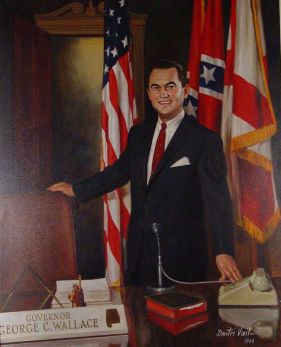
George-Wallace-Portrait1An image of George Wallace turned up on my Facebook news feed yesterday. Seven years ago, I posted a photo along with speculation about how George Wallace’s political career would have turned out of he had somehow managed to chart a different course during the segregationist era. He was a moderate Democrat at heart with no serious animus toward blacks and no seriously vested interest in segregation – at least, no more than the average white Southerner of the time.

I’ve written many times about the Wallace legacy – I find him one of the most fascinating and enigmatic political figures in Southern and U.S. history – and I’ll probably keep thinking and writing about him for the rest of my life.  He was not only a gifted politician but also an uncharacteristically intelligent one.  He was also a visionary who transformed American politics despite coming from what was considered by pundits to be a provincial backwater.

He started out no conservative. His former close friend and fellow University of Alabama law student, U.S. Judge Frank Johnson, once related that arguing with Wallace essentially amounted to debating a New Deal socialist.

As a student at the University of Alabama, Wallace was an outsider.  His idol was Carl Elliott, a wonder kid from my native Alabama county of Franklin who worked his way through Alabama and eventually was elected student body president, beating the student establishment know as “The Machine,” which exists to this day.   Elliot is remembered as one of Alabama’s most progressive-leaning Alabama congressmen.

Wallace was a Democratic Party stalwart who refused to bolt the 1948 Democratic Convention over the party’s proposed civil rights plank in the party’s platform. As an Alabama circuit judge, he cultivated a reputation for affording black litigants courteous treatment in his courtroom. His bitter defeat in 1958 at the hands of John Patterson changed all of this, driving him to become an ardent segregationist.

In a very real sense he sold his political soul for the sake of political expediency.

I’ve always wondered how differently the Wallace legacy would have been if our 45th Alabama governor had somehow managed not to carry the segregationist legacy.

Moreover, I have also wondered about how differently Wallace’s fortunes may have turned out if he had avoided an assassination attempt. Would he have brokered some sort of John Connally-style arrangement with Nixon, perhaps even serving in a cabinet post? Could he have prevented Jimmy Carter’s assent in 1976? All of these historical what if’s are the grounds of lots of fascinating historical speculation.

The Great Ethnicity Manufacturing Machine

23 Thursday Nov 2017

Posted by Jim Langcuster in The Passing Scene, U.S. Politics

≈ Leave a comment

Tags

Ford Foundation, Hispanic Caucus, Hispanics, Jim Langcuster, Lumbers, White Trash

This article could be just as aptly titled “How the Ford Foundation Created an Ethnic Group out of Thin Air.”

And while I am at it, what the hell is “white” – really? Do, say, Italians and Armenians, even though they are Caucasian, share the same American experience and legacy as a WASP family from the historic Beacon Hill section of Boston? 

I even take umbrage with the term WASP. There is arguably not much WASPish about the lumbers (desperately poor whites) who settled much of the American Back Country. 

I think that we all could make a fresh start by resolving that our ruling class will no longer supply classifications to the rest of us.  And, incidentally, this increasingly tangled ethnic American web – this ruling class strategy to pit one group against another – is another legacy of Wilsonian federalism.

← Older posts
Newer posts →

Subscribe

  • Entries (RSS)
  • Comments (RSS)

Archives

  • December 2023
  • November 2023
  • July 2023
  • June 2023
  • January 2022
  • December 2021
  • November 2021
  • October 2021
  • September 2021
  • May 2021
  • April 2021
  • March 2021
  • February 2021
  • October 2020
  • September 2020
  • August 2020
  • February 2019
  • December 2018
  • November 2018
  • June 2018
  • March 2018
  • December 2017
  • November 2017
  • October 2017
  • February 2017
  • December 2016
  • November 2016

Categories

  • Alabama History
  • American Education
  • American Federalism
  • American History
  • Brexit
  • Censorship
  • Christianity
  • Conservatism
  • Devolution
  • Federalism
  • Geo-Politics
  • Imperial Decline
  • Localism
  • Mainstream Media
  • Nullification
  • oligarchy
  • Patriotism
  • Red-State Faith
  • secession
  • Secularism
  • Southern Athletics
  • Southern History
  • The Passing Scene
  • U.S. Politics
  • Uncategorized

Meta

  • Create account
  • Log in

Website Powered by WordPress.com.

  • Subscribe Subscribed
    • Ruby Red Republic
    • Join 27 other subscribers
    • Already have a WordPress.com account? Log in now.
    • Ruby Red Republic
    • Subscribe Subscribed
    • Sign up
    • Log in
    • Report this content
    • View site in Reader
    • Manage subscriptions
    • Collapse this bar
 

Loading Comments...