• Introduction
  • About Ruby Red Republic
  • Contact
  • Blog

Ruby Red Republic

~ Thoughts on Red States and "Deplorables."

Ruby Red Republic

Category Archives: Uncategorized

The Mainstreaming of Secession

26 Wednesday Dec 2018

Posted by Jim Langcuster in American Federalism, Devolution, Federalism, Uncategorized

≈ 1 Comment

Tags

Federalism, Federations, Interstate Compacts, Jim Langcuster, secession, States Rights, Wilsonian Progressivism

texas-capitol

Texas: One of several states harboring a nascent secessionist movement. 

I’ve been bowled over the last few weeks reading the growing number of articles in which mainstream columnists are finally coming to terms with a reality that I embraced more than a quarter century ago: the likely, if not inevitable, transformation of the  American Union into a much looser federation or into a number of smaller nation-states.

Predictably over the last quarter century, I’ve even been labeled everything from a neo-Confederate and a racist to a secessionist and traitor for subscribing to such views.

Actually, far more prodigious intellects, notably, the late George F. Kennan,  foresaw this inevitability years before I did.

I, for one, and despite my conservatism, respect the right of California and other left-leaning states to experiment with different domestic policies. I hope when all the chips are down that these enlightened blue-coast cosmopolitans will afford their counterparts in the red American hinterland the same courtesy.  And lest we forget, that was the concept behind American federalism:  that states possessed the attributes of nationhood but had chosen out of a desire for self-preservation against Britain and the other maritime powers of Europe to delegate a comparatively narrow range of powers to a general government that operated on behalf of the states.

Aside from all the constitutional arguments, there just comes a point when people outgrow relationships, whether these are business contracts, civic groups, friendships or marriages.  And the simple fact of the matter is that America is simply too damned big and diverse to govern, at least, based on the cookie-cutter approach that Woodrow Wilson and the progressives devised for us roughly a century ago.  We have reached the point where cultural evolution throughout through Europe and America has outstripped the ability of the central government to keep pace with it.

I really believe that.  In fact, I think that this is one of the inherent flaws in federations: The constituent parts are often inherently fissiparous, with their own highly evolved cultures and political ideologies.  These constituent parts don’t stop evolving when they enter into a federation: Their cultural and political evolution continues apace, sometimes to the point at which they feel compelled to question the utility of their relationship with the other members of the federation. Maybe it’s time for us to take into account that incontrovertible fact whenever we undertake the design and execution of another federation.

How close is America to a crackup?  I’m not sure.  Even so, I do believe that in many notable respects, we are drawing close to where the beleaguered Soviet Union found itself in about 1990.  Either we find some way to renegotiate federal arrangements in the United States by devolving more power back to states and, most important of all, localities, or we face a situation where internal pressures build up to a degree that states and regions take it upon themselves to address these problems.

Deep-blue California’s nullifying tendencies vis-a-vis the policies of the Trump Administration are merely a taste of what is to come.

In fact, in an unusually comprehensive and informative column posted in the Intelligencer recently, one perceptive columnist, Sasha Issenberg, predicts that growing number of states may enter into interstate compacts to work through a number of intractable domestic problems.  In the end, the United States may comprise up to three de facto federations: blue, red and neutral, each conducting their own unique domestic policies, while remaining parts of the United States.

Yet, even this columnist concedes that these de facto arrangements will only work for a time before the internal stresses build up and rend apart these federations, forcing each to move close to becoming bona fide countries.

For his part Kennan offered a sort of middle way, one to which I’m sympathetic: a union of about 15 or so constituent republics, to which the bulk of domestic powers would be entrusted, leaving the central government to run a common market and defense pact.

Whatever the case, we are very possibly approaching a constitutional impasse in which large states, particularly California, increasingly will assume more and more powers on their own, drawing us closer to a Soviet scenario. By that I mean that, despite our attempts to stay ahead of the problem by introducing institutional reforms, the country inevitably comes apart.


Reassembling Humpty-Dumpty

26 Wednesday Dec 2018

Posted by Jim Langcuster in Christianity, Conservatism, Secularism, Uncategorized

≈ 1 Comment

Tags

Christianity, Culture Wars, Jim Langcuster, Peter Viereck, Secular Liberalism

stained-glass-restoration

Photo: Courtesy of Rodhullandemu.

There’s been a long-stated conviction among conservative Christians, particularly evangelicals, that the path out of the West’s current predicament requires their active re-engagement with culture, the now regnant, post-Christian secular culture, with the ultimate aim of restoring Christianity to some preeminent place in American and Western culture. But given secular culture’s largely hostile regard for all forms of Christianity, particularly evangelicalism, is this even possible?

Almost a quarter millennium ago, the term “Ottantotist” (literally, Eighty-Eighter) was invented to describe French reactionaries who doggedly and vehemently insisted that the clock somehow could be turned back on the 1789 French revolutionaries.  The late American political philosopher Peter Viereck borrowed that term to describe American reactionaries suffering from similar illusory thinking.

I particularly relate to this term having spent 29 years as a Cooperative Extension professional writing extensively about the implications of invasive species to Southern forests, croplands and pasturelands.  I’m well aware of how such infestations, after wreaking considerable havoc for a generation or so, eventually establish a sort of equilibrium within the ecosystem over time, acquiring a permanent niche.

After that line has been crossed there really is no turning back:  The effects of these invaders only can be mitigated; they cannot be reversed.

Restoring a status quo ante is simply impossible in a complex, vastly extended  ecosystem, whether the interloper happens to be human, plant, mammal or insects.

The historically Christian West has been beset with its own invasion over roughly the last two-hundred years: a secular one.

Secularism, has moved far beyond its beachhead and now functions as the unifying ideal of Western culture. The Christian culture of the West now comprises an embattled remnant. Indeed, far from any sort of resilient cultural beachhead with a real prospect of staging a comeback, Christian culture more closely resembles Chiang kai-shek‘s besieged Nationalist fortress on the peripheral island of Taiwan, though lacking anything resembling the backstopping that Chiang enjoyed from the United States.

I recall a remarkable observation offered years ago by the late Oregon State University religion scholar Marcus Borg that illustrates the increasingly marginalized status into which Christianity has fallen. He noted how his students would undergo a discernible change from engagement to one of disengagement and even hostility whenever the classroom topic switched from, say, Hinduism or Buddhism to Christianity.

This hostility has grown from several deep roots, though much of it can be traced to advances in textual criticism and evolutionary sciences.  In material terms, these two advances have carried humanity a long way, but by removing much of the adhesive that has bound together the civilization of the West, they have produced catastrophic effects too.

I am not a conventional Christian.  In fact, I count myself a nontheist – I won’t go to the trouble here of explaining all the differences between atheism and nontheism. Suffice it to say I believe that everything that we have achieved, including our insights into transcendence, has been the result of a network that has developed over eons and that has grown primarily out of language, writing and technology, all of which are fused in this network and, as a result, create a kind of synergistic effect. I have come to call this networking the Non-corporeal Human Exoskeleton, because this dense networking of language, culture and technology enshroud us, much as shells do crustaceans, providing us with all manner of sustenance and protection.

Religion has historically been bound up this network and has afforded humanity all manner of advantages in terms of providing a sense of purpose and keeping all of the psychological furies and common human fears at bay.

This networking amounts to scaffolding – in fact, that term more or less could be substituted for network or exoskeleton to underscore how everything in existence is contingent on everything else.

The Christian faith afforded European civilization invaluable scaffolding.  But with the destruction of much of this scaffolding,  I’m not that confident that we will ever manage to put anything of equal and enduring value in its place.

So much of this scaffolding was bound up in Christian dogma.  The promise of an afterlife and the fear of eternal damnation for egregious offenders provided an integral, if not essential facet of this scaffolding. These unique facets of Christianity, despite the enormous psychological burdens they imposed on millions of adherents, arguably breathed life into the faith and provided it with its strongest and most enduring scaffolding, at least, until the mid-19th century.

Textual criticism and evolutionary science have challenged this.  In the minds of of the most culturally influential members of Western society, these advances put a lie to the faith.

Nietzsche, as memory served, believed that this destruction of old scaffolding would clear space for well-integrated humans who would put aside the old slave morality of Christianity and construct a new ethos more aligned with humanity’s true character and better equipped to maximize human potential.

Some technophiles and techno-utopians even have expressed the fervent hope, if not certainty, that advances in Artificial Intelligence will enable us to construct a viable alternative.

Ientertain serious doubts, frankly.

The faith tradition that provided the unifying idea for Europe beginning in the Fourth Century conferred all manner of advantage on the culture of the West.  But the scaffolding on which this civilization was built is facing structural collapse.  And this has led many of these West’s leading public intellectuals to wonder if these structural deficiencies will lead us into another dark age.

Whatever the case, it seems painfully evident to many that Humpty-Dumpty is broken and that despite the most fervent hopes and best efforts of well-meaning people to reassemble him, he is ruptured beyond repair.

What An Irish Phenotype and an Ivy League Education Will Buy You in 21st Century America

09 Friday Nov 2018

Posted by Jim Langcuster in The Passing Scene, Uncategorized

≈ Leave a comment

Tags

2018 Mid-Term Elections, Beta O'Roarke, Camelot, JFK, Liberalism, RFK

BetoMan

Beto O’Roarke (Photo: Courtesy of Wikipedia.)

I am not a frequent listener of talk radio, though I readily concede that conservative talk show commentator Rush Limbaugh frequently offers pungent and even prescient criticism of the American ruling class.

I was especially struck by a recent observation.

Speaking at the Trump rally in Cape Girardeau, Missouri, Limbaugh observed that the hatred associated with the 45th president stems from boundless jealousy among our political class, haunted by the knowledge that not one of them — not Biden, not even the sainted Barack — can approximate the Trump’s star appeal.

Limbaugh’s observation was spot on, though I would argue that this observation, insightful as it is, doesn’t go deep enough.

The jealousy and enmity for Donald Trump run much deeper. And I’m convinced that this liberal disdain stems from a deep well of narcissism, which is reflected in the way that liberals — elite liberals, at least — both view themselves and their place within the American cultural and political context.

At the risk of oversimplifying the issue, I would even go as far to say that liberalism has always been less about ideals, more about perpetuating an image:  one in which the bold and elite-educated beautiful — the heirs of FDR, JFK and RFK —  are entitled by birth and intellect to be held in breathless veneration by the masses.

American liberalism has been bound up in this narrative for most of the past century.  It started with FDR, a handsome, polished scion of the American ruling class who, despite his physical infirmity, selflessly marshaled the slumbering masses toward a greater vision of themselves and the country.  But the young, telegenic Irish-American hero, John F. Kennedy, brought this narrative to the peak of refinement.  In fact, an aspiring professional historian could write a dissertation about how Kennedy’s assassination and subsequent martyrdom has driven this liberal narrative.

There has been a deep hunger among liberals ever since to find someone, some charismatic, Kennedyesque figure to modernize and carry forth this lofty narrative. A new movie scheduled for release on Nov. 21 explores the stellar rise and ignominious fall of the presumptive heir of JFK’s mantle, Gary Hart. But a string of other successful and unsuccessful Democratic contenders have also competed to fill this void: Bill Clinton, John Kerry, and John Edwards.  Once upon a time, a few people even compared Jimmy Carter to JFK.

That is why the recent political phenomenon of Betomania is very instructive.  Indeed, it’s not all that surprising that Beto O’Roarke, notwithstanding this week’s defeat, already is being touted as a hot Democratic presidential prospect in 2020. He underscores how far a tall, lean frame, an Irish phenotype, an Ivy League diploma, and a reasonably aristocratic pedigree will take you in modern America, of course, providing that you’re willing to subject yourself all the outrageous indignities and misfortunes of modern America politics.

O’Roarke, in fact, seems right out of central casting: a fourth-generation Irish American possessing an almost an uncanny physical resemblance to the late Robert F. Kennedy — a dynast from an old El Paso political family that can even point to modest links to the Kennedy clan.  Even better, he hails from the deepest reaches of red America in a region of the country likely on the verge of being flipped purple, if not  blue. And to top it off, he’s nicknamed Beto, which affords something akin to an ersatz Hispanic identity at a time when ethnic ties to rising demographic groups are at a premium.

Indeed, we’re likely to see many different permutations of Betomania in an era when liberalism, beset with disillusionment and division, seems more bereft of ideological substance than ever its history.  In such a context, form will always trump substance.

The changes in American elite education that have occurred over the last few decades will only contribute to this. Earlier American elites such as FDR and JFK arguably felt a sense of noblesse oblige, partly stemming from a sense of guilt that their status was largely unearned.  Way back then, elite universities on both sides of the Atlantic functioned as extensions of Eton, Harrow and Groton.  FDR, described as a man of “third class intellect but first-class temperament,” was typical of his class.

Yet, elite education has undergone a sea change in recently years, becoming far more meritocratic, far more SAT-driven.  And the people who pass through these elite institutions now fit a wholly different set of criteria, conforming very closely to the products described by William Dereciewicz in Excellent Sheep: The Miseducation of the American Elite.

Having clawed their way up to these to these stratospheric heights, they expect a payoff.  Even more than the old guilt-ridden WASP elites, they regard themselves as people worthy of deep respect, if not a healthy degree of adulation.  Many regard themselves as anointed by genetics to rule and to think on every else’s behalf.  And, oddly enough, this has only worked to reinforce the old elite liberal narrative.  Granted, many of them are not as poised and physically attractive as Roosevelts or Kennedys, but the old liberal elite narrative nonetheless resounds among them.

If you doubt this:  Consider what is unfolding even now in Silicon Valley as tech moguls arrogate to themselves the task of reengineering of a basic tenet of American liberty, free speech, simply on the basis that they have conceived something better.  Never mind the corpus of judicial rulings on free speech that have been handed down over the past quarter of a  millennium; they know better.

Simply put, the liberal narrative is undergoing significant revision, becoming even more virulently narcissistic as a new generation of meritocrats rise to assume the place of older elites.

Back to Trump.  He’s not one of them.  He openly mocks their pretensions to power.  Even worse, he even has inspired millions of ordinary Americans to turn their backs on them, the anointed, the heirs of this lofty narrative.

Small wonder why they hate him.


The Left’s Real Problem with the Senate

08 Thursday Nov 2018

Posted by Jim Langcuster in American Federalism, American History, U.S. Politics, Uncategorized

≈ 1 Comment

Tags

Federalism, Left, Mid-Terms2018, U.S. Senate

senate-logoThe outcome of the 2018 mid-term elections, especially in terms of how it is reflected in the composition of the U.S. Senate, underscores the perennial wisdom of the Founders. But the left’s dissatisfaction with this outcome and its increasingly strident criticism of the “undemocratic” nature of this upper chamber demonstrates two things: its ravenous thirst for power and its growing awareness of its power, especially as it’s manifested in the most influential facets of American culture, namely academia, the Establishment media and the arts.

Two other important points must be mentioned: First, the Senate represents the essence of America union and nationhood, and there would not have been a United States without this indispensable compromise. Second, no other institution established by the Constitution better embodies the limited nature of our federated republic

Indeed, the compromise reflects one of the primary concerns of the Founders: to establish a federal republic with sharply delineated powers and scope, one that enabled the individual states to carry on with virtually all the attributes of nationhood.

To put it another way, the Senate was conceived as a sort of chamber of state ambassadors to serve as a counterweight to the larger popular chamber: the House of Representatives. Its purpose was to ensure that the United States remained what Madison called a “republic of republics,” a federation with sharply circumscribed powers that chiefly functioned to protect the states against against dissolution and the inevitable threats from the chief European maritime powers, Britain and France.

Through its increasingly harsh criticism of the Senate, the left is calling one of the most vital safeguards of the Constitution and our federal republic into question. And, of course, there is an ulterior motive driving this, because abolishing or, at least, radically altering the composition of  both the Senate and the Electoral College would confer the blue coastal regions of the United States with virtually unbridled power to dictate to the rest of the country.

This demonstrates one of the perennial challenges of large, extended federal republics such as ours: the specter of sectionalism, the desire of one part of a federation to dominate at the expense of the others.  It was one of the factors that led to the outbreak of the bloody Civil War.  And without the vigilance of present-day Americans, it could lead to a similar upheaval.

For more insight into all of this, I recommend a thorough reading of the writings of South Carolina statesman John C. Calhoun – that is, if you are able to wrangle a contraband copy of it.

The Implacable Left

25 Monday Jun 2018

Posted by Jim Langcuster in American Federalism, Conservatism, Devolution, The Passing Scene, Uncategorized

≈ 1 Comment

Tags

Civil War II, Hard Left, Kirstjen Nielsen, Leftist Intolerance, Sarah Huckabee Sanders

leftist-protesters

Leftist Protesters in Washington, D.C.  Photo Courtesy of James McNellis. 

A close friend just passed along this fascinating piece.

It takes me back to an exchange I had with an old Sigma Chi brother a few days ago. In a previous social media exchange with another Sig brother, I bemoaned the divisive trends unfolding in America and offered pretty much the same view outlined in this article: namely, that these divisions seem irreconcilable over the long term. The old fraternity brother, a D.C operative who has been burnishing his liberal credentials and virtue signaling skills for decades, weighed in to decry the breakdown of American civil discourse, harkening back to those halcyon days of political discourse the Sigma Chi House when all of us discussed politics freely and openly.

Here’s the interesting part: He followed these plaintive remarks with a litany of reasons why he deemed conservatism a threat to democracy, engaging in the usual right-wing stereotyping.

In other words, we’re not complying with HIS expectations. And that’s the part that really fascinates me about the modern left. As I’ve stated before, most hard leftists secretly pine to run this country like an old-style Eastern Bloc peoples democracy. They’re all for political opposition, but only so long as it conforms with basic leftist precepts.

The very same rhetoric is evident in this article: If the left doesn’t succeed in the mid-term elections, the country will have hell to pay. As the columnist stresses, major Hollywood events have now become a means of rallying Blue America and disparaging the values and leaders of its red counterpart.

That’s the part about the left I find simultaneously remarkable, maddening and TERRIFYING. They will be happy only when the rest of the country hews to their expectations – only when the right capitulates, in other words.

I’ve read too much history not to know where this is heading. And that is why I remain a fervent proponent of radical devolution and barring that, peaceful secession.

But, to be sure, the left is not going to let us go easily, I know that.

The Ruby-Reddening of Alabama: A Short History

07 Thursday Jun 2018

Posted by Jim Langcuster in Alabama History, American History, Conservatism, Southern History, Uncategorized

≈ 1 Comment

Tags

Alabama Politics, Alabama Republican Party, James Douglas Martin, Ruby-Red Alabama

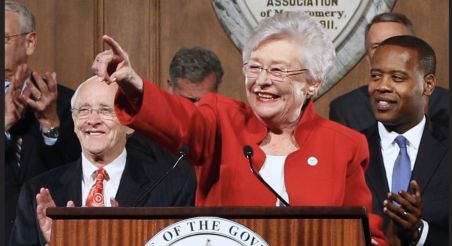
kay-ivey2

Alabama Republican Gov. Kay Ivey. (Photo: Courtesy of the Alabama Republican Party.

Based on the results of the June 5th primary, Alabama continues to affirm its reputation as one of this nation’s reddest of red states.

Case in point: My native northwest Alabama county of Franklin. Based on my quick but possibly faulty math garnered from The New York Times’ election data, I noticed that some 4,500 voters participated in Franklin County’s GOP primary, while only around 600 participated in the Democratic one.

This is a remarkable turnaround from the early 80’s, when I was a young Franklin county voter and GOP poll worker. The first GOP primary was held in Alabama in 1978. Before then, a GOP state convention nominated candidates, who generally served as sacrificial lambs in the November general elections.

The only basis for excitement for Franklin County Republicans way back then was the presidential elections in which GOP presidential nominees were generally competitive. With the exception of 1976, when Jimmy Carter swept the South, Republican presidential nominees carried the state. Franklin County, a historically yellow dog Democratic county, generally proved no exception to this rule, though Democrats continued to dominate the down-ballot offices, as they did in mf the rest of the state.

Early GOP Forerunners

Even so, there were a few talented Republican outliers holding aloft the Republican banner in spite of all these daunting obstacles.

One especially memorable Republican insurgent was an unusually gifted and charismatic GOP forerunner named James Douglas Martin, a highly decorated WWII combat veteran.

james-martin

James Douglas Martin

He was one of a handful of Republicans who secured a seat in Congress during the Goldwater sweep in ’64. How? By positioning himself to the right of Alabama Democrats, which, needless to say, took some doing.

He even employed a phrase about “returning to the principles of ’61 – 1861,” which, needless to say, sounded like a veiled call for secession – certainly a statement laced with irony, considering that he was a candidate of the party of Lincoln.

Martin was an unusually gifted public speaker with a very polished and charismatic bearing that rivaled Reagan’s. I can vouch for that, having attended in the late 70’s a Reagan Rally at the Jefferson County Civic Center, featuring Martin as a warm-up speaker to Reagan.

One of Martin’s most memorable acts of chutzpah was running against the wildly popular Lurleen Wallace as the GOP’s gubernatorial nominee in 1966. It proved to be another ill-fated Republican attempt at storming what remained an all but impregnable Democratic electoral wall. He polled only 31 percent of the vote and carried only Greene County and the maverick and perennial Republican county of Winston, known as the Free State.

He made a last attempt at a statewide office in 1978 against a relatively liberal Alabama incumbent senator named Donald Stewart. His campaign slogan: “Alabama Needs Another Jim,” referring to the late conservative Democratic Senator Jim Allen.

Martin was defeated handily and suffered a severe heart attack shortly thereafter but recovered and lived to be almost 100.

Comparatively late in life, he was appointed director of the Alabama Department of Conservation and Natural Resources. Several of my Cooperative Extension colleagues worked with him and described him as one of the most brilliant and dynamic people they ever encountered.

In a very real sense, Jim Martin was the John the Baptist of Alabama Republican politics, one who entered the political fray as a Republican about 20 years prematurely. If he he had been born a generation later, he not only would have secured high office but also would be remembered today as one of the most gifted and influential statesmen in Alabama history – of that I have little doubt.

The 1986 Breakthrough

Republican fortunes improved markedly after the election of 1986, when the Alabama Democratic Party was widely perceived among voters as stripping conservative Democrat Charlie Graddock of his gubernatorial nomination on highly specious grounds and handing it to party stalwart Bill Baxley. That was the first sign of fissures within what had been the indomitable Alabama Democratic Party.

The obscure 1986 GOP nominee, Amway salesman and former Cullman County Probate Judge Guy Hunt, was swept into office and subsequently won reelection in 1990.

Corruption charges forced Hunt out before the completion of his term and he was succeeded by Lt. Governor Jim Folsom, Jr., who was upset in the 1994 election by former conservative Democrat-turned-Republican Fob James.

James was defeated in 1998 by the Democratic nominee, then Lt. Gov. Don Siegelman, but this Democratic resurgence proved short-lived.

Siegelman was defeated by congressman Bob Riley in 2002. Less than a decade later, the GOP secured control of both houses of the Legislature in 2010, the first time in 136 years.

Today the Republicans dominate the Democrats by more than a 2-1 margin in the Alabama House of Re and by 5-1 in the Alabama Senate.

With the possible exception of Utah and Oklahoma, Alabama, once considered virtually synonymous with the Democratic Party, is now the ruby-reddest Republican of U.S. states.

MSM: American Pravda

27 Tuesday Mar 2018

Posted by Jim Langcuster in Mainstream Media, U.S. Politics, Uncategorized

≈ Leave a comment

Tags

Digital Surveillance, Jim Langcuster, Monopolies, MSM, Muckraking, Pravda, Stormy Daniels, Victor Davis Hanson

zuckerberg

One can always count on the perspicacious Victor Davis Hanson to put the issues of the day into sharp perspective.

And he’s right as rain on this one: The MSM’s refusal to soldier on in its traditional role as nonpartisan muckraker is deeply troubling.

A Hanson observes, “High-tech corporations have acquired massive power and wealth, dwarfing the might of the robber barons of the past.” Yet, MSM seem to have abrogated their traditional role of investigating corporations whose influence threaten the very sinews of a free society.

Yet, this seems to reflect the wholesale decline of media standards in general.

I watched part of the Anderson Cooper’s Stormy interview and was deeply appalled and, yes, troubled. As Sean Hannity recently observed, it sounded like a Jerry Springer interview. It was simply red meat thrown to the MSM’s liberal base. And ponder, for a moment, the outrage that the left would have expressed if Fox News had employed the same voyeuristic treatment of one of Clinton’s detractors some 20 years ago.

Yes, right-wing media have their own problems with marching in ideological lockstep, but, honestly, MSM’s editorial practices are coming to bear a striking resemblance to Pravada’s in the last years of the Soviet Union – simply put, they seem to regard facts as true only so long as the right people (the accredited segments of society) say that they’re true.

Jefferson as Post-National Prophet

15 Thursday Mar 2018

Posted by Jim Langcuster in American Federalism, American History, Devolution, Federalism, The Passing Scene, Uncategorized

≈ 2 Comments

Tags

American National Identity, American nationalism, American Unity, Identity Politics, Jim Langcuster, Socialism, The American Left

Jefferson-Memorial

The Jefferson Memorial (Photo: Courtesy of SamsonSimpson20)

A recent column in Vox explores the decline of dominant American identity and the ways that this identity could be rebuilt amid widespread demographic division and economic distress.

Ezra Klein, the author, contends that the vibrant, effusive American identity that prevailed throughout the 20th century was forged primarily on the basis of two world wars and the 70-year threat of Soviet communism.

I’m inclined to take a slightly different view. The modest imperial standing America acquired in the aftermath of the Spanish-American War formed a critical component of 20th century America identity too. Millions of Americans were carried on a wave of imperial euphoria, confident that the acquisition of a modest, backwater empire heralded our virtually unimpeded ascent to national greatness. And much of this was bound up in the war’s success in re-enlisting the defeated South in nation- and empire-building that followed in the aftermath of this war.

Up to that time, many people in the former Confederate states spent the Fourth of July commemorating the fall of Vicksburg rather than celebrating American Independence.

At the turn of century, some 35 years after one of the bloodiest struggles in history, the South reasoned that if it couldn’t have its own nation, it at least could participate in the building of a nation destined to ascend to the front ranks of global leadership.

This was a fortuitous turn of events for the American national enterprise: The post-Civil War South ended up supplying this nation not only with a significant share of its patriotic ballast but also a generous portion of men and women to guard the outposts of the global American empire that emerged after World War II.

Yet, we seem to be reaching an critical juncture, if not a major impasse, in defining American identity. And one wonders: How much practical value is derived from doubling down on one-nation rhetoric and insisting on more dialogue?

In the view of a growing number of heartland Americans, the only rhetoric deemed unifying by our ruling classes is that which conforms to the agenda of the left.

Moreover, another vital adhesive of American identity, centralized federalism, seems to be losing its efficacy too. Americans seem less inclined than ever to operate off the same page on issues that were once seen as vital to national security, such as regulating immigration and guarding our borders. Some on the left are even calling for the elimination of the Immigration and Customs Service (ICE).

Perhaps most disturbing of all, though, we seem to be rapidly approaching a cultural impasse that surprisingly few pundits have considered: namely, how this country will manage to soldier on when it is no longer regarded by ordinary Americans as standing at the pinnacle of the world’s most successful and exceptional nations.

So much of American unity and national identity is bound up with its perceived greatness and singularity.

A recent study ranked tiny Finland and several of the other Scandinavian countries as the world’s happiest, although the United States failed to rank in the top ten. Indeed, the results of the study point out a remarkable anomaly: Despite the United States possessing the world’s largest economy, millions of its citizens grapple with rising levels of obesity, substance abuse and high rates of depression, not unlike the problems that plagued the Soviet Union in the years leading up to its collapse.

Some on the left have expressed a desire to build a new national identity on the basis of socialism and identitarian politics, with the long-term goal of ridding the country of what they characterize as a historically evil and malignant white patrimony that has existed since the nation’s founding.

Given all these deep divisions over how to define the American enterprise in the future, perhaps we will return to some version of Thomas Jefferson’s 18th century vision of an American Empire: a continent of smaller states, either loosely tied or wholly independent of each other, sharing some degree of historical and cultural affinity.

Jefferson, it seems, may prove to a prophet of post-national American unity. At least, one can hope, amid all of this national division and rancor, that we can muster some semblance of mutual affinity and continental unity.

Whatever the case, a socialist, identitarian America should hold no appeal for any decent person, irrespective of race or ethnicity, who cherishes ordered liberty and constitutional government.

But if, God forbid, such an America emerges in the next 30 years, I suppose I’ll be one of those passing my autumn and winter years in a socialist gulag, at least, deriving a measure of solace that I will be living among what remains of sane people in America.

Remembering an Academic Outlier

06 Tuesday Mar 2018

Posted by Jim Langcuster in American Education, American Federalism, Conservatism, Southern History, The Passing Scene, Uncategorized

≈ 1 Comment

Tags

Academia, Jim Langcuster, Melvin E. Bradford, National Endowment for the Humanities, paleoconservatism, Political Correctness

Melvin-Bradford

Melvin E. Bradford. Photo: Courtesy of the Fort Worth Independent School District.

Something got me thinking last night about  one of the nation’s late, great academic outliers and mavericks, the late M.E. Bradford, and how, if he had survived into his 80’s, would be regarded today as a pariah on most U.S. college campuses. Bradford was regarded as a “paleoconservative,” one of the leading intellectual lights of the paleocon movement.


He was a student of the old Southern Agrarian tradition and a vocal and intrepid defender of the Constitution and the Old Republic.  He was also a searing critic of the legacy of Abraham Lincoln and the 16th president’s efforts to consolidate the American Republic. And while in intellectual terms he was considered an outlier, Bradford was one of a number of traditionalist conservative academics who, once upon a time in America, were valued for the role they served in leavening and balancing out academic discourse. He taught at several prestigious academic institutions, including the U.S. Naval Academy, and served as president of the Philadelphia Society.


I cherish two of Bradford’s works – “Remembering Who We Are” and “Original Intentions: On the Making of the Constitution“ – for providing me with critical foundational bricks in my intellectual development and maturation.


A vocal Reagan supporter in the 80’s, Bradford was tapped to head the National Endowment for the Humanities. However, due to fierce opposition from neoconservative elements, he ultimately was passed over for William Bennett, the neocons’ candidate, but not before receiving the endorsement of U.S. Senators from every geographic region of the country as well as by a number of prominent leading conservative intellectuals, including Russell Kirk, Jeffrey Hart, William F. Buckley and Harry Jaffa.

 
Bradford’s ignominious upending by the necons played a key role in deepening the already palpable ideological divide between paleocons and neocons intellectuals within the Reagan coalition that culminated in Pat Buchanan’s insurgent presidential candidacy against George H.W. Bush in 1992.

Bradford died while undergoing heart surgery at the relatively young age of 58 in 1993.  In a sense, he is fortunate not to have lived into his eighties to reflect on the intellectual wasteland that characterizes American academia today.


It’s one thing to be an outlier, quite another to be a pariah, which is precisely the way Bradford would be regarded today in America’s toxic academic environment. And this is remarkable considering that scarcely a generation ago, academic mavericks and nonconformists such as Bradford were still afforded a place, even an exalted place, in many American institutions of higher learning, valued for the role they served in refining intellectual inquiry and open discourse.

Reaping a Cultural Whirlwind

05 Monday Mar 2018

Posted by Jim Langcuster in Devolution, The Passing Scene, Uncategorized

≈ 1 Comment

Tags

authoritarianism, Confederate Symbolism, Cultural Warfare, Jim Langcuster, Left, Southern Heritage, White Nationalism

protester

Protester opposing “Trump/Pence Regime” in Portland. Photo: Courtesy of “Old White Truck.”

I’ve been something of a conservative cultural warrior for the last 30 years, albeit a weary and, at times, a very reluctant one.  For a long time, I essentially had thrown in the towel, happy to leave the struggle to younger warriors infused with a bit more zeal and encumbered with far less cynicism.

Hillary’s “basket of deplorables” comment galvanized me.  It reached deep into my psyche and activated some primordial something in me.  I resolved that, armed with my modest financial resources and meager rhetorical skills, I would fight to my dying breath the authoritarian social order that these reckless comments portended.

Actually, I saw where this was heading a long time ago.  A generation ago, I wrote extensively about the controversy over the Confederate flag.  As far back as the 1990’s, I and many others perceived that the left’s rage – or feigned rage – over Confederate symbolism ultimately would lead to an assault of the wider subject of American symbolism and ideals.  In the left’s view, after all, American symbols and ideas are, in moral terms, little removed from the patrimonial, slavocratic Confederacy.

Reflecting back on all of this, I’m reminded of what a prophet the late University of Georgia historian Eugene Genovese has proven to be.

Genovese predicted that in the course of the left’s sowing the wind, the entire nation would ultimately reap the whirlwind.  American society, he feared, ultimately would pay a price, perhaps an egregiously high price, for robbing white, predominantly working-class Southerners of their heritage and, in effect, rubbing their noses in the dirt.

Yes, I know,  a  legitimate argument can be made for eliminating government-sanctioned displays of the Battle Flag, which has all but been achieved within the last few years.  But there’s a difference between creating accommodating public spaces and asserting that Southerners who evince devotion to Confederate symbolism and the Lost Cause are little removed from reactionary racist pond scum.

There comes at point at which the quest for fairness degenerates into hitting below the below the belt.  The Obama administration’s twilight decision to remove displays of Confederate flags on fixed poles from National Cemeteries, even where Confederate veterans are buried and despite a previous decision by Congress not to impose this ban, was a malicious parting shot – a punch below the belt – by an administration sworn to “fundamentally transforming” America.

As Genovese predicted a generation ago, this denigration has only worked to augment the increasing sense of alienation among working-class whites.  They’ve grown weariy of being depicted as this nation’s problem demographic, especially considering that they have borne a disproportionate share of this nation’s imperial burdens, having filled enlisted ranks in every American military outpost in the world.

This sense of alienation will only intensify in the future.   The left has won the cultural war, but as Rod Dreher observes in a recent column, conservatism wields enormous political power and its adherents are still capable of marshaling a helluva lot of obstinance.

And there are lots of mad, obstinate people out there. Dreher cites the growing numbers of white Americans increasingly drawn to white nationalist rhetoric. He quotes extensively from a self-described well educated white intellectual who confesses to being both repelled and attracted to white nationalist rhetoric.

I’m a white guy. I’m a well-educated intellectual who enjoys small arthouse movies, coffehouses and classic blues. If you didn’t know any better, you’d probably mistake me for a lefty urban hipster.

And yet. I find some of the alt-right stuff exerts a pull even on me. Even though I’m smart and informed enough to see through it. It’s seductive because I am not a person with any power or privilege, and yet I am constantly bombarded with messages telling me that I’m a cancer, I’m a problem, everything is my fault.


For me, the CNN town meeting about gun violence – all the shouts of “Murderer!” and “Burn her!” – really put all of this into deep perspective.   I suspect it did for a lot of Americans.  I think it underscored to millions of us that a kind of Rubicon has been crossed and that the divisions in this country are only going to grow worse.

Frankly, I am surprised that the soft secessionist sentiment is largely confined to California and isn’t yet being expressed widely in red states. I think this a reflection of two factors: first, the conviction among blue-state “progressives” that they are now the dominant cultural force in America and that such talk is acceptable, so long it’s aimed at affirming and reinforcing progressive dogma; and, second, a stubborn perception among conservatives in red states that all eventually will be worked out – that America remains a singular nation and that we all will finally return to our senses.

In time, though, I think that many red state Americans will conclude that things in this country will become even more untethered – unstuffed, as the case may be – and that some form of devolution, perhaps even some desperate attempt at secession, ultimately may point the way out of this impasse.

And recall that Dreher, the creator of the Benedict Option, is a separatist of sorts.

A generation ago, I wrote extensively about how the South represented the most fertile soil from which a counterrevolution could be mounted. While my this conviction has wavered a bit in recent years, I still suspect that sooner or later, as these national divisions intensify, that the counterrevolutionary struggle will coalesce in the South.

Whatever the case, I think that conservatives should forget about cultural warfare.  Dreher is right to stress that the cultural war has ended with a resounding victory by the left. Our energies at this point should be invested in a devolutionary movement – or movements – not in fighting a rearguard cultural war, which has been irretrievably losts, at least, for the foreseeable future.

← Older posts
Newer posts →

Subscribe

  • Entries (RSS)
  • Comments (RSS)

Archives

  • December 2023
  • November 2023
  • July 2023
  • June 2023
  • January 2022
  • December 2021
  • November 2021
  • October 2021
  • September 2021
  • May 2021
  • April 2021
  • March 2021
  • February 2021
  • October 2020
  • September 2020
  • August 2020
  • February 2019
  • December 2018
  • November 2018
  • June 2018
  • March 2018
  • December 2017
  • November 2017
  • October 2017
  • February 2017
  • December 2016
  • November 2016

Categories

  • Alabama History
  • American Education
  • American Federalism
  • American History
  • Brexit
  • Censorship
  • Christianity
  • Conservatism
  • Devolution
  • Federalism
  • Geo-Politics
  • Imperial Decline
  • Localism
  • Mainstream Media
  • Nullification
  • oligarchy
  • Patriotism
  • Red-State Faith
  • secession
  • Secularism
  • Southern Athletics
  • Southern History
  • The Passing Scene
  • U.S. Politics
  • Uncategorized

Meta

  • Create account
  • Log in

Website Powered by WordPress.com.

  • Subscribe Subscribed
    • Ruby Red Republic
    • Join 27 other subscribers
    • Already have a WordPress.com account? Log in now.
    • Ruby Red Republic
    • Subscribe Subscribed
    • Sign up
    • Log in
    • Report this content
    • View site in Reader
    • Manage subscriptions
    • Collapse this bar
 

Loading Comments...