• Introduction
  • About Ruby Red Republic
  • Contact
  • Blog

Ruby Red Republic

~ Thoughts on Red States and "Deplorables."

Ruby Red Republic

Author Archives: Jim Langcuster

What Cancer?

06 Friday Oct 2017

Posted by Jim Langcuster in Mainstream Media, The Passing Scene, Uncategorized

≈ 2 Comments

Tags

Jim Langcuster, Second Amendment, Three-Fifths Compromise, Timothy Egan

In the aftermath of this horrible tragedy in Las Vegas, New York Times columnist Timothy Egan has characterized the Second Amendment as the “cancer in the Constitution,” essentially no different than the “three-fifths” compromise in the constitution that enabled slaveholding states to count a portion of their slave population toward congressional seat apportionment.

“We tried to fix that (the three-fifths provision) through our bloodiest war and a series of amendments that followed,” Egan contends.

The “cancer in the Constitution?” Two truly remarkable facets of the Constitution are the Second and Tenth amendments, which were conceived to underscore to those who governed on our behalf that there were barriers over which they could not step. Far from cancers, they have served, along with other constitutional provisions, as safeguards that have kept tyranny at bay for almost a quarter of a millennium. I often wonder: What will be left of liberty when the left is finished with us? Of course, they will never finish because perpetual revolution defines the very nature of the left.

Calhoun’s Spirit Alive and Well in California

05 Thursday Oct 2017

Posted by Jim Langcuster in American Federalism, American History, Brexit, Devolution, Federalism, U.S. Politics, Uncategorized

≈ Leave a comment

Tags

California, Catalonia, Decentrism, European Union, James Madison, Jim Langcuster, John C. Calhoun, Nullification, Sanctuary State, Spain, States Rights, Thomas Jefferson

Elites are apparently having a hard time coping with the phenomenon of “identity awakening.”

In a recent column, Ramón Luis Valcárcel, vice-president of the European Parliament, follows a predictable path: Catalonian nationalists are “undemocratic” – they even evince authoritarian traits – and threaten the peace of Europe (even though they aspire to be a part of the European Union). Indeed, he goes so far to contend that secession doesn’t even constitute a legitimate undertaking in a state that meets all of the hallmarks of a democratic one (Spain, in this case). And, of course, add to that the suspicion of Russian collusion – the secessionists are “aided by pro-Russian bots of the stature of Julian Assange.”

I was also a bit taken aback by the use of “deplorable” early in the text.

Finally, the writer conveniently forgets that the vaunted Spanish experience, while purportedly democratic now, carries the painful memories of Francoism, during which Spanish national identity was rammed down Catalan throats.

Yet, I suppose we can derive some solace from what has just transpired in blue-state California, where Gov. Jerry Brown just signed a bill into law establishing California as a sanctuary state.

It appears that decentralist tailwinds are sweeping all over the world.

The greatest of all national centralizers,  Old Abe Lincoln,  must be rolling in his grave. With the signing of this bill, America seems to have come full circle to the spirit of Jefferson, Madison, and yes, perish the thought, John C. Calhoun, the ultimate red-state deplorable and the philosopher of nullification doctrine.

But that’s okay.  Old habits die hard, and despite all the best efforts and fervent wishing of the European and American ruling classes, the basic human passion for local affinity and identity invariably trumps – no pun intended –  centralism.

As a close friend of mine brilliantly observed, sooner or later everyone eventually embraces his or her inner Calhoun.


America’s Coming “Identity Awakening”

05 Thursday Oct 2017

Posted by Jim Langcuster in American Federalism, Federalism, Geo-Politics, Localism, U.S. Politics

≈ 2 Comments

Tags

Alvin Toffler, Centralized States, Demassification, Devolution, European Union, Identity Awakening, Jim Langcuster, Nationalism, secession

Catalan-demonstration

A Demonstration of Catalan Nationalists.  Photo: Courtesy of Sergil.

Identity Awakening.  I like that term.

It’s a term that geopolitical analysts and commentators have improvised to account for how globalization has produced a sort of paradoxical effect.

“Everywhere we see regionalism, nationalism as well as religious devotion growing in intensity, sometimes morphing into intolerance. It’s the great paradox of globalization: Far from erasing the peoples’ identitarian and cultural claims, it reinforces them,” writes Li Figaro’s Renaud Giraud.

Technology in the form of digitalization has played a role, too. This takes me back to the writings of the recently deceased Alvin Toffler, a futurist who wrote extensively about the the implications of digital technology, especially in terms of how it would transform society, culture, politics and the economy.

Toffler perceived demassification as one very palpable effect of digital technology.  Mass media would no longer be, well, a mass phenomenon.  There would be no more news anchormen of the stature, not to mention, with the temerity, of Walter Cronkite ending newscasts with the hyper-confident pronouncement:  “That’s the way it is…”

As bandwidth expanded, Toffler predicted that media would scale down to accommodate smaller, more defined audiences.

Remarkably, though, this demassification is not only affecting media but also entire nations.

Demassification seems to have played a major role in the “identity awakenings” occurring throughout the world, particularly in Europe.  It even appears that identity awakenings soon will be playing out in America.  Judging from what’s occurring in California, Texas, Vermont,and Cascadia, they already are.

And why shouldn’t they?  If the Toffler’s musings drove home one realization to me, it’s that national identities based on strong, highly centralized governments are a relic associated with 20th century industrialism, just as mass media are – were.

While I am a great sympathizer with and proponent of identity awakenings, I’m no rigid ideologue.  We are urgently in need of decentrism in America, but  we also depend on a common American market and a common defense, much as Europeans require a common continental market and defense apparatus. But to demand that continents as culturally diverse as America and Europe march in cultural and even political lockstep? It’s madness, as more and more people are coming to realize.

Sooner or later, our institutions will reflect that new reality.  Let’s hope that this occurs as a result of peaceful evolution.

No Other Pathology but White Pathology

04 Wednesday Oct 2017

Posted by Jim Langcuster in The Passing Scene, Uncategorized

≈ Leave a comment

Tags

CNN, Jim Langcuster, Las Vegas Shooting, White Anger, White Pathology

Who doesn’t grow weary of the hypocrisy of CNN an other Establishment agit/prop media organs?

This morning a good and thoughtful friend of mine raised what I consider to be a valid point about CNN and one that I think would apply to most other mainstream media. Its reporting consistently characterizes obstreperous or violent behavior involving white white people as a pathology, even as it painstakingly avoids any such characterization of other racial or ethnic groups, such as the high rates of black homicide in inner cities.

Has CNN ever characterized any social problem as a black or Hispanic pathology? Of course, the answer is no, because those topics are considered off limits – beyond the pale of respectable discourse. Honestly, a network that bewails the hollow underpinnings of white national identity, sure seems to obsess a lot about white pathology.

And people wonder why there is such much anger and so many wrenching divisions in this country.


Jeff Sessions and the Stool of Everlasting Southern Repentance

09 Thursday Feb 2017

Posted by Jim Langcuster in American Federalism, American History, Conservatism, Uncategorized

≈ 1 Comment

Tags

Attorney General, Clarence Thomas, Hugo Black, Jeff Sessions, Jim Langcuster, Southerners, Supreme Court, The Left

jeff-sessions

Attorney General Jeff Sessions

I’ve said before that as a proud Southerner, I struggle sometimes with being an American – and the brouhaha over Attorney General Jeff Sessions is one of many reasons why.

I really wonder how much of the Senate and Establishment media opposition to Sessions occurred simply because he was a conservative Alabamian and a Southerner. For as long as the left reigns culturally in this country, white Southerners with conservative leanings, which, frankly, represent the vast majority of these Southerners, will be expected to remain on their stools of everlasting repentance, it seems.

And as I have argued before, this really is a disgrace, especially considering the disproportionate role Southerners, particularly working-class Southerners, serve in protecting this country’s national security interests all over the world.

I think that it’s also worth pointing out that with the exception of Justice Thomas, who spent most of his life outside the South, no other Southerner sits on the Supreme Court and hasn’t for generations. Throughout most of the history of the United States, there was an attempt to maintain at least the semblance of geographical diversity on the Supreme Court.  But since 2014, the Court is composed of a majority from the Northeastern United States, with seven justices coming from states to the north and east of Washington, D.C.

The last white Southerner to serve in the U.S. Supreme Court was Justice Hugo Black of Alabama.

Shortly after Black’s passing, President Richard Nixon opens a cultural hornet’s nest when he attempted to nominate two Southerners to the Court, Clement Haynesworth of South Carolina, and G. Harrold Carswell of Georgia.

The Elite Media’s Qualified View of Secession

01 Wednesday Feb 2017

Posted by Jim Langcuster in Devolution, U.S. Politics

≈ Leave a comment

Tags

Calexit, California Independence, Catalan Independence, Catalan Separatism, Jim Langcuster, secession, Separatism, Texas Nationalist Movement

catalonian-independence

Photo: Courtesy of Dzlinker

Once again, I’m fascinated with The New York Times’ growing emphasis on federalism, regionalism, and – perish the thought, secession!

Carme Forcadell, president of the Catalan Parliament, writes a about judicial efforts by the Spanish government to impede the the open discussion of debate of Catalan independence within Parliament.

Forcadell relates that the Spanish government’s special prosecutor filed a complaint charging her with contempt of court and neglect of duty for allowing separatist debate to occur. It is one of many judicial methods the Madrid government has employed to stifle debate over independence.  Some 400 municipal officials have also been charged with involvement in discussions advancing Catalan independence.

Forcadell extols the open and unimpeded discussion and debate about Scottish independence that has ensued for years in Holyrood, the Scottish Parliament as well as the acquiescence  of the British government, which even acceded to the 2014 Scottish Independence Referendum – a sharp contrast to Spain’s obstructionist attitude vis-a-vis the Catalans.

Despite the referendum’s unsuccessful outcome, “democracy was the winner,” Focadell affirms.

But Forcadell draws a sharp distinction between Catalan and Scottish independence struggles and others unfolding in Europe. She apparently regards sovereignty and independence movements as acceptable only if they are progressive in nature. Brexit and other Eurosceptic and “right-wing populist” movements don’t count as legitimate independence movements.

And, of course, this explains the Establishment media’s fascination with California’s growing separatist sentiment. California has legitimate grievances because these are pro-statist and progressive in nature.

And, conversely, this accounts for why the Texas Independence Movement has barely rated as a blip on the Establishment media’s news radar, except, of course, when the intention is to underscore the specter of right-wing extremism in America.

If Hillary were the 45th president instead of Trump and Texas were the state making the most noise about independence, I am virtually certain that federalism, sovereignty and secession would receive little, if any, positive mention in the hallowed pages of the New York Times or any Establishment agit/prop organ.

No, secession gets favorable mention only if it takes on a progressive hue.

But all of us red state hoi polloi  should take heart that Trump’s upset victory has galvanized “respectable” secessionist discourse in at least one blue state. That, at least, will ensure that the wider topic of secession will become a more frequent and mainstream topic of discourse over the next few years.

The Unpalatable American Truth about Secession

01 Wednesday Feb 2017

Posted by Jim Langcuster in American History, Uncategorized

≈ Leave a comment

Tags

Articles of Confederation, Calexit, Constitutional Ratification, Devolution, Jim Langcuster, secession, U.S. Constitution

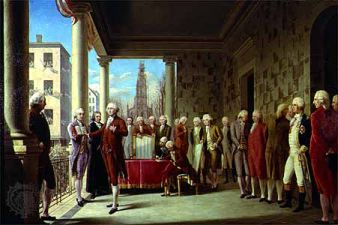
washington-first-inauguration

Washington’s First Inauguration in 1789.  He initially presided over 11 states, as North Carolina and Rhode Island had not yet acceded to the new Union.

It’s one of the great and, for many left-leaning Americans, unpalatable facts associated with American history.

And this great and unpalatable fact was raised, however unwittingly, by Georgetown University School of Law Professor David Super in a recent discussion of the Convention of States effort.  As Super stresses, the Founders broke the law during the ratification of the U.S. Constitution by abandoning the Articles of Confederation to form a new national compact under a new Constitution. How? By ignoring the provision in the Articles of Confederation and Perpetual Union that required not only the approval of the Congress of the United States but also the unanimous consent of all of the states before any revision of the Articles could occur.

The Delegates’ Commission under the Articles of Confederation

Bear in mind that delegates commissioned to represent their states at the convention in Philadelphia were “solely and expressly” charged with the task of revising the Articles of Confederation, not with drafting an entirely new framework of government.

Over the course of discussing the intractable limitations associated with the Articles, though, the delegates concluded that simple revision was an impractical goal.  Redressing their acute limitations would require a whole new written charter, one that likely would not be accepted by all the states.

So the delegates resolved to draft an entirely new Constitution, though one that would require the formal assent  of only three-fourths of the states for it to go into effect. Eleven States eventually ratified the new constitution in the intervening twenty months between the convention delegates’ signing of the new charter and the inauguration of George Washington as the first President of the United States.

The U.S. Constitution: Born of Secession

Think about that: Eleven states, in effect, seceded from the Confederation to form the new American compact we know today as the American Union. Yet, two states, Rhode Island and North Carolina, had not  ratified the Constitution and, consequently, were out of the Union when Washington took the his first presidential oath of office in

North Carolina finally came into the Union in November of 1789.  However, Rhode Island dragged its feet and grudgingly ratified the Constitution after the new federal government threatened to sever commercial relations.  And even then, ratification squeaked by with only two votes.

James Madison’s “Delicate Truth”

The 11 acts of secession that culminated in the new American Union poses what in 21st century parlance would be known as an “inconvenient truth.”

James Madison described it as “the delicate truth” beyond the American Union.

Writing in The Federalist Papers, he described the 11 states’ secession from the Articles of the Confederation to form a new compact as a simple matter of “self-preservation.” He justified this self-preservation on the basis of what he characterized as “the transcendent law of nature; and of nature’s God, which declares that the safety of and happiness of society are the subjects at which political institutions aim, and to which all such institutions must be sacrificed.”

California Secession: Not Treasonous at All

Simply put, the Articles of Confederation and Perpetual Union were no longer capable of securing a lasting,sustainable union and had to be scrapped out of necessity and replaced with something entirely new. And this could be achieved only by a super majority of states seceding from the old constitutional system and creating a newer, more sustainable one.

So, viewed within the wide context of American constitutional history, California’s current secessionist sentiment isn’t treasonous at all but is merely the latest expression of a very well-established American tradition.

Twice Born of Secession

The United States was twice born of secession: first in 1776, when thirteen former colonies issued a joint declaration declaring their intent to withdraw from the British Empire, and later in 1789, when the majority of the states withdrew from the Articles to form a new and improved confederation (Washington’s term for the new union).

And, incidentally, speaking of unpalatable facts, the great nationalist Founding Father Alexander Hamilton repeatedly described the new American  government as a “Confederate Republic” and as a “Confederation” and described the new constitution as a “compact” throughout the Federalist Papers.

But that is another remarkable and rather unpalatable constitutional fact that I’ll save for discussion at a later date.

When Rooting for the Crimson Tide Was an Act of Southern Patriotism

21 Wednesday Dec 2016

Posted by Jim Langcuster in Southern Athletics, Southern History, Uncategorized

≈ Leave a comment

Tags

1926 Rose Bowl, Alabama Football, Crimson Tide, Jim Langcuster, Nick Saban, Paul "Bear" Bryant, University of Alabama, University of Washington

paul-bryant

Coach Paul “Bear” Bryant

Almost a century ago, the Alabama Crimson Tide football team, representing an economically prostrate state and region derided by the rest of the country as a cultural backwater, undertook the long transcontinental journey to compete against the University of Washington Huskies in the 1926 Rose Bowl.

The Tide was widely regarded as the underdog. The sports pundits of the time expected those Deep South provincials to return to Alabama as “Tusca-losers,” the term Will Rogers invented to emphasize the low regard in which the team was held.

The WSJ article posted today about about that epic match underscores two vital truths: first, how far Crimson Tide Football and the University of Alabama in general have traveled in the 90 years since the first Alabama/Washington  match in 1926 and, second, and even more significant, how a rising Crimson Tide has lifted Alabama and Southern fortunes more than once in the last century.

Alabamians and other Southerners at the time regarded the Rose Bowl as a sort of Civil War rematch.  The subsequent upset not only marked the resurgence of Southern pride but also the ascent of a Southern football tradition that would dominate so much of college football, with the Crimson Tide in the forefront.

But the Rose Bowl upset was only  the first of many notable examples of how thr  Crimson Tide has lifted both Alabama and Southern fortunes.  As a middle-aged man, I can remember how a racially integrated Crimson Tide under the tutelage and inspiration of Coach Paul “Bear Bryant” captured the imagination of black and white Alabamians and Southerners during a troubling juncture in history when my native state and the rest of the Southland was subjected to merciless derision by national elites.

To a significant degree, I remain that odd thing in Alabama: a man of divided loyalties. I spent 29 years working for one of the greatest Cooperative Extension programs at one of the greatest land-grant universities in the South and the country: Auburn University, which remains Alabama’s biggest athletic rival.

I love Auburn.  I love her traditions, and I dearly cherish her remarkable educational and athletic legacy.

But I’m a congenital Alabama fan. According to family legend, I was conceived in the Tutwiler Hotel in Birmingham after a big Alabama 21-6 upset over the Georgia Bulldogs in the fall of 1960. (Actually, given the date of my birth, that doesn’t seem right, but that’s another story entirely.)  I’m a proud alumnus of the university (MA, 1985) who also grew up as the son and grandson of former former Alabama students.  I can still remember feeling a rush of pride, if not a measure of reverence, on autumn Sunday afternoons listening to the tolling of the Denny chimes marking the start  of the Paul “Bear” Bryant Show, featuring Bryant’s play-by-play analysis of the previous day’s game.

Every Alabama home that was not deep-dyed blue and orange (Auburn’s colors) tuned in faithfully to those broadcasts. For millions of us, a connection with the Crimson Tide was inextricably bound up with a sense of being an Alabamian and even a Southerner at a time when those identities were not held in universally high regard.

Needless to say, the  University of Alabama and Crimson Tide Football have come an exceedingly long way since 1926.  The university is now deeply invested in becoming a national university, even competing favorably with elite universities such Stanford University and the University of Virginia in attracting cognitively gifted out-of-state elites into its Honors Program, partly by assuring these students and their parents that Alabama-born and bred students now comprise only a minority of the school’s enrollment.

Like most Southern flagship universities – Georgia, South Carolina and, most assuredly, Florida – the University of Alabama increasingly seems less and less discernibly Southern with each passing year.  And so, for that matter, does Crimson Tide Football.

To be sure, what self-respecting Tide fan isn’t proud of the program’s remarkable fortunes under Saban’s leadership? Saban is a profoundly intelligent and gifted individual and coach – not at all surprising considering that he majored in physics as an undergraduate. But there has always been an ersatz quality associated with the Saban legacy.  His whole demeanor is that of a polished CEO presiding over a well-established, well-heeled corporate enterprise, which, after all, is what the Crimson Tide Football has become.

As for the university’s host state, Alabama, well, it’s still dealing with a troubling historical legacy and, with it, the derision of the elites who frankly have never devoted so much as a millisecond trying to understand its immensely complicated historical legacy. It is an an enduring burden that has been felt all the more acutely recently in the aftermath of the Donald Trump upset.  Indeed, I’m still rather incensed after reading an article about the outrage that spontaneously erupted in an upscale Brooklyn organic market several days after the Trump victory when Sweet Home Alabama was played over the loudspeaker.

It’s partly the derision of these elites, I suppose, that has bonded me permanently to the University of Alabama and its hallowed football tradition. Despite the loss of their cultural moorings, the University of Alabama and Crimson Tide Football will always remain both Alabama and Southern icons to me and countless other aging Southerners.

They will always be inextricably linked with the fortunes and culture of the Alabama and the South, even if they no longer want to be.


 

Of Electoral College Coups and Popular Uprisings

19 Monday Dec 2016

Posted by Jim Langcuster in American Federalism, Mainstream Media, U.S. Politics, Uncategorized

≈ Leave a comment

Tags

Donald Trump, Electoral College, Jim Langcuster, Mainstream Media, Political Uprising, Ukrainian Revolution, West Coast

ukrainian-uprising-2014

2014 Ukrainian Revolution. Reference Photo Credit 

There are a few things associated with this media-driven Electoral College spectacle that really intrigue me.

First, the electors who vote today in their respective states  have been verbally harassed and, in some cases, even threatened with bodily harm.

Imagine if electoral fortunes were reversed and Hillary had won under identical circumstances – an Electoral College victory but a popular vote deficit.  Likewise, imagine that red state Americans were engaging in the same sort of angry behavior, bombarding electors with harassing e-mails and even threatening physical harm. The Obama Administration, characterizing all this outlandish behavior as a full-blown crisis, would have fully mobilized all of the resources of the Justice Department.

Within this electoral reality, however, the President has  focused solely on the specter of Russian interference in the presidential election, which remains more speculation than hard fact, while entirely ignoring what, in constitutional terms, should be his first priority: to ensure a safe environment for the 538 individuals charged with undertaking one of this country’s most critical constitutional tasks.

Second, who among thoughtful conservatives isn’t amused by the newfound affinity of Hollywood for the Founding Fathers and the hallowed institution of the Electoral College.

Ponder this irony for a moment: The Electoral College was conceived roughly a quarter millennium ago by these reactionary white-privileged WASPS to thwart the unbridled democratic impulses – the very impulses to which the vast majority of glitterati have paid such perfervid lip service for generations, certainly since the advent of FDR’s New Deal.

Talk about elite political discourse turning on a dime!

Third, I’m shocked that mainstream media are actually indulging talk of incipient revolution – a popular uprising that could topple Trump, much the same way that Ukrainians deposed ex-President Viktor Yanukovych.

Red state Americans raised similar concerns about what could follow a Hillary Clinton presidency throughout the election cycle, and many of their arguments were valid. Clinton Foundation shenanigans, the underhanded dealings of the Democratic National Committee to throw the nomination in favor of Hillary, and the Obama Administration’s politicization of the Justice Department and intelligence gathering apparatus really pointed to a regime resembling far more a Latin American banana republic than the historic Anglo-American republic bound by an ironclad commitment to the rule of law.

Yet, imagine the outrage within the mainstream media that would follow if the the specter of an popular insurgency were raised by right-leaning news sources and opinionators in the aftermath of a Hillary victory.  And to add an extra layer of irony to all of this: These are the same people who are devoting serious discussion to the topic secession, now that West Coast progressives have evinced an interest in the topic.

Fourth and finally, I am no less intrigued by the lengths to which the New York Times and other elite media have underscored the smallness of the Trump win.  Quite conveniently, as as the Electoral College meets today in state capitals throughout the country,  the New York Times posted an article with considerable graphic enhancement illustrating that Trump’s electoral victory ranks 46th among 58 presidential elections.  The Times stresses that among presidential victors Trump edges out only the rock-bottomed ranked Rutherford B. Hayes and John Quincy Adams in his popular vote share.

Yet, there is really nothing small at all about this election outcome when one considers it within the wider context of American  political history.  The biggest political maverick among all presidential contenders, minimized, scorned and denigrated by elites as the mouthpiece of the most socially and culturally marginalized segment of the electorate – Flyover Americans – overcame a series of what were considered at the time mortal blows to win what will likely be recalled by historians as the biggest political upset in American history.

In that respect, Trump’s victory was not a small one, not by a long shot.

The only other presidential maverick/victor who comes anywhere close to this electoral upset is Andrew Jackson.  And almost two centuries since Jackson’s victory, we still recall how he completely re-sifted the American political and cultural landscape.

Donald Trump presents an immediate, perhaps even mortal, threat to the interests of the American ruling class.  And I believe it’s this existential threat that accounts for all this talk within Establishment media of Electoral College coups and popular uprisings.

Richard Florida’s Nine Precepts of Devolution

17 Saturday Dec 2016

Posted by Jim Langcuster in Devolution, Federalism, Localism, Uncategorized

≈ Leave a comment

Tags

Devolution, Donald Trump, Federalism, Jim Langcuster, Localism, Richard Florida

richard-florida

Richard Florida, urban studies expert and best-selling author.  Photo: Courtesy of Jere Keys.

I’ve maintained for some time that American devolution will not be taken seriously until prominent public intellectuals on the left endorse it. One of my decentrist liberal friends in New England,  (@ethnobot), pointed me to a series of tweets by Dr. Richard Florida (@Richard_Florida), an urban studies expert and best-selling author who has written extensively on the nature and promise of the urban creative class.

Florida recently tweeted what could be accurately described as 9 precepts of devolution and localism.

Note that Florida, too, perceives the divisions between red and blue America as being essentially intractable, though he still holds out hope that some form of peaceful coexistence can be maintained. However, he believes that this can be achieved by what he calls “massive devolution,” reflected by a “re-tuned federalism,” though with a heavy bipartisan emphasis on devolving as much power as possible to localities.

Frankly, I couldn’t agree more.

Incidentally, I also wholeheartedly agree with his characterization of the U.S presidency, which I think is long overdue for a complete re-tooling, perhaps along the lines of Ireland’s, Germany’s and Israel’s monarchical presidential models or, at the very least, France’s bifurcated model.

Following are Richard’s 9 devolution precepts:

1. The problem runs way, way way deeper than Trump.

2. The problem is nation-state & imperial presidency that has far, far too much power & is out of sync with clustered knowledge capitalism.

3. The problem is a nation that is terribly divided & cannot be put back together …

4. The problem is a nation that has now been taken over not just by Trump but by the taker class of finance & resources …

5. The only way out I can see lies in massive devolution of power & local empowerment across multiple scales – neighborhood, city, metro…

6. American federalism is a powerful & dynamic instrument that can be re-tuned for our new age of geographic concentration & division.

7. The two America’s can find a way to live together – a mutual coexistence.

8. The only true alternative & opposition to Trumpism I can see is a broad partisan coalition for local empowerment …

9. Compare Jerry Brown’s speech to anything said by national level politicians … Mayors can be even more effective …

← Older posts
Newer posts →

Subscribe

  • Entries (RSS)
  • Comments (RSS)

Archives

  • December 2023
  • November 2023
  • July 2023
  • June 2023
  • January 2022
  • December 2021
  • November 2021
  • October 2021
  • September 2021
  • May 2021
  • April 2021
  • March 2021
  • February 2021
  • October 2020
  • September 2020
  • August 2020
  • February 2019
  • December 2018
  • November 2018
  • June 2018
  • March 2018
  • December 2017
  • November 2017
  • October 2017
  • February 2017
  • December 2016
  • November 2016

Categories

  • Alabama History
  • American Education
  • American Federalism
  • American History
  • Brexit
  • Censorship
  • Christianity
  • Conservatism
  • Devolution
  • Federalism
  • Geo-Politics
  • Imperial Decline
  • Localism
  • Mainstream Media
  • Nullification
  • oligarchy
  • Patriotism
  • Red-State Faith
  • secession
  • Secularism
  • Southern Athletics
  • Southern History
  • The Passing Scene
  • U.S. Politics
  • Uncategorized

Meta

  • Create account
  • Log in

Website Powered by WordPress.com.

  • Subscribe Subscribed
    • Ruby Red Republic
    • Join 27 other subscribers
    • Already have a WordPress.com account? Log in now.
    • Ruby Red Republic
    • Subscribe Subscribed
    • Sign up
    • Log in
    • Report this content
    • View site in Reader
    • Manage subscriptions
    • Collapse this bar
 

Loading Comments...