• Introduction
  • About Ruby Red Republic
  • Contact
  • Blog

Ruby Red Republic

~ Thoughts on Red States and "Deplorables."

Ruby Red Republic

Category Archives: Uncategorized

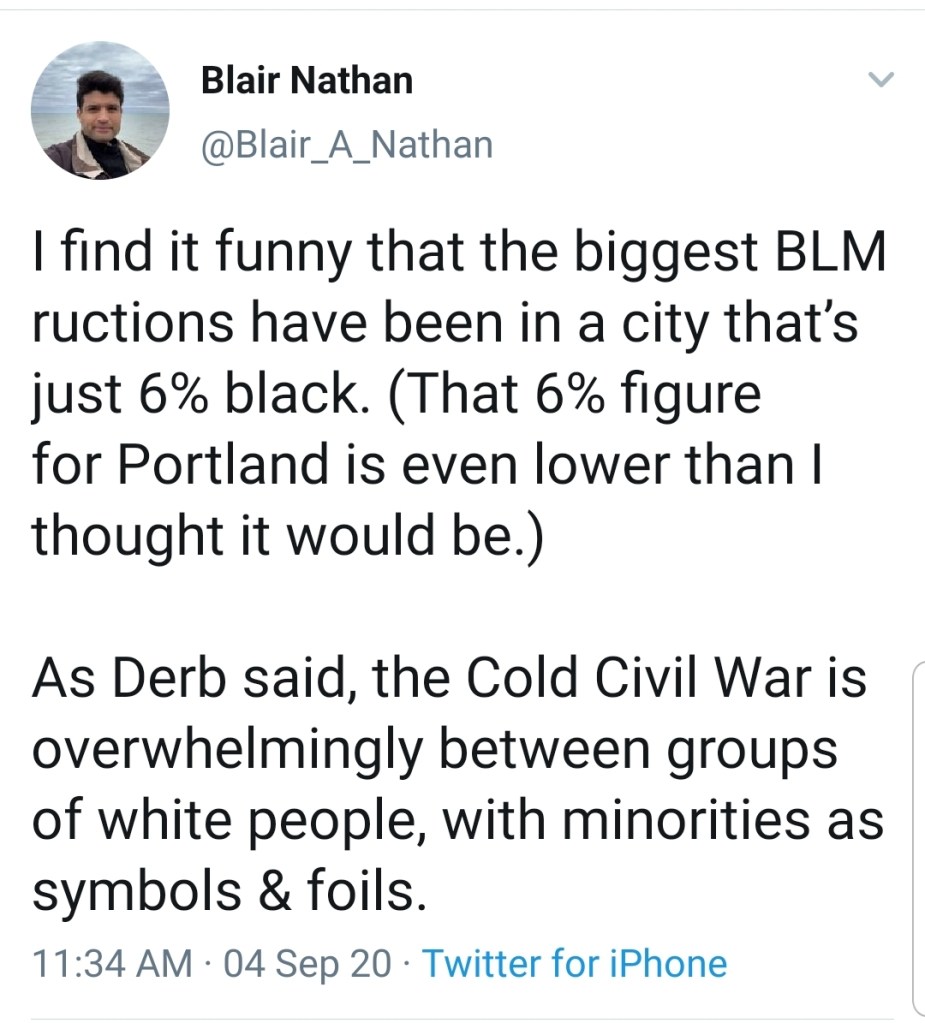
White Animosities, Black Foils

05 Saturday Sep 2020

Posted by Jim Langcuster in Uncategorized

≈ 1 Comment

Tags

BLM, Civil War, regionalism, riots, secession

Observations by Blair Nathan and other outstanding thinkers on Twitter have prompted some thinking on my part regarding the intractable divisions that seem to have have overtaken the country in recent years.

Yet, I don’t think that these divisions are of recent vintage at all but rather that they reflect deep historical animosities and rivalries that stretch back centuries and that predate colonial settlement.

Indeed, based on a long and fairly extensive reading of British and American history, I believe that because of these deep-seated animosities one could make the case that the North and South never should have confederated in the first place.

The recent upheavals in this country, which were only exacerbated by Trump’s 2016 electoral success, simply have placed these divisions into deeper perspective.

Within the last few years, I and other close observers of our national divisions have been surprised by the increasing candor with which some academic and professional political pundits have expressed this rather unpalatable fact, notably columnist Michael Malice in The Case for Secession, written shortly after the 2016 election.

These regional amosities may even be traced to genetic factors rooted in the ethnic cultures of the British Isles – a theme deftly explored by historian David Hackett Fischer in Albion’s Seed: Four British Folkways in America.

A scientific exploration from this perspective of longstanding political division was supplied recently by Scientific American.

From the very beginning, the incipiently mercantilist Northeast, stemming significantly from the region’s East Anglian and Puritanical ethno-cultural roots, regarded itself as entitled to rule the country and was enraged that the agricultural South had garnered what they considered an unfair competitive advantage. In time, they contrived a brilliant strategy, feigning outrage over Southern slavery as a means of obfuscating their ambitions to become the young republic’s cultural and political hegemon.

The Civil War and a series of cultural and political flashpoints in the century and a half that followed have only served to underscore that the United States remains a deeply sundered country, though 20th century material prosperity and two world wars were effective in obfuscating for a time these profound  and intractable differences. But within the last half century, these deep-seated divisions have been exposed again in unusual raw form and conceivably could lead to a conflagration that even could rival the Civil War under certain  conditions.

Why Even Pretend Anymore?

03 Thursday Sep 2020

Posted by Jim Langcuster in Uncategorized

≈ 1 Comment

Tags

American secession, Andrew Cuomo, Jim Langcuster, national division, Thomas Jefferson

New York Gov. Andrew Cuomo

Question if the day: Why do we still pretend to comprise the same country?

We’re constantly being served up accounts by the mainstream media about how the right specializes in fomenting division, though New York’s Governor Andrew Cuomo seems to spew more venom than any other public official official in America and in ways that only exacerbate these deep divisions.

His most notorious stunt of late is his warning to the President of the United States that he would be wise to carrying along an armed guard to walk the streets of his state’s major city

As memory serves, this is the same governor who said that there is no place in New York for pro-lifers and the same city that has featured artwork depicting red-staters in the vilest of ways.

All of his poisonous rhetoric simply serves to underscore that various regions of the country have evolved different views on governance and even personal morality. And, hopefully, more Americans ultimately will be forced to conclude, however reluctantly, that this divergence will be settled in only in one of two ways: through centralized tyranny or undertaking radical decentralization up to and including secession. We seem to be rapidly approaching an inflection point.

Indeed, with each passing day I marvel at how prophetic Jeffersom has proven. He perceived that a continent this size simply was too vast to accommodate a single republic and predicted that a myriad of republics ultimately would emerge. He was right, just off by roughly a quarter millennium.

A Great, Unbridgeable Divide

02 Wednesday Sep 2020

Posted by Jim Langcuster in Uncategorized

≈ Leave a comment

I’ll say it again – as a matter of fact, I’ll keep saying it as I have for the last 25 years: We are approaching our own Gorbachev moment, the point at which we realize that this country’s political animosities and divisions have grown so deep and our the  mechanisms of compromise established in our constitutional framework so seemingly ineffective that compromise no longer seems possible

As conservative columnist and Alabama native Byron York intimated recently in the disturbing Tweet above, the impending presidential election may prove to be a catalyst for any number of things: a protracted constitutional crisis, massive rioting and perhaps even threats of nullification or even secession by one or more states.

We seem to be faced with a remarkably similar set of circumstances – something a handful of astute political sages perceived as far back as three decades ago but, predictably, were scarcely heeded.

Some 30 years ago Mikhail Gorbachev, faced with a somewhat similar set of deep social political divisions set out to negotiate a new Union Treaty that would have transformed the Soviet Union from a tightly knit federation into a loose Union of Sovereign States. But he was eventually outpaced by events.

The raging animosities so conspicuously evident in our poisoned and dysfunctional political discourse simply have underscored to millions of ordinary Americans that our divisions not only are perilously deep but also unbridgeable.

Anglicanism, RIP

02 Wednesday Sep 2020

Posted by Jim Langcuster in Uncategorized

≈ 2 Comments

Thomas Hooker, one of the major contributors to Anglican theology and identity.

I recently ran across this thought-provoking read about the future of Anglicanism in Britain. I’m a conservative, more or less a Disraeli conservative, though, like most of you one who acknowledges the absolutely indispensable role that the Enlightenment legacy has played in advancing the fortunes of the West and, for that matter, human civilization in general, despite our having broken a great many eggs to make this omelette. 


Moreover, and despite my lack of orthodoxy, I readily acknowledge how orthodox Christian belief has simultaneously worked to accommodate as well as to soften the rough edges of scientific/technological progress. Yet, with the effective end of Christendom, as it commonly has been known, fast approaching, I am not at all convinced that a rational technological society fully equipped to ensure upward progression for us all is even possible. 


Quite a few secular philosophers have expressed confidence that humanity sooner or later will construct a new ethos that not only will effectively supplant Christianity but that also will ensure our moral and technological progress proceeds apace. 


I, for one, remain less convinced of this than ever. 

A Great Evangelical Crackup Looming?

01 Tuesday Sep 2020

Posted by Jim Langcuster in Uncategorized

≈ Leave a comment

Evangelical contemporary worship. (Photo: Courtesy of Wikipedia.)

Evangelical Christianity always has functioned as the de facto faith of the South and much of the rest of the red American hinterland, though not in the same way that Catholicism historically has served as the faith and the basis for national identity in Poland.

Yet, there seems to be a rising concern among evangelical Christians that the faith – this cultural bulwark of red heartland culture – is becoming unmoored from its historical distinctives. Yet, there is an element of irony bound up in this, namely because the strong case could be made – and has on occasion – that evangelicals have never managed to develop significantly strong distinctives. And partly because of this, contemporary evangelical Christians have failed to cultivate a sufficiently strong and enduring grasp of what defines their faith tradition – what sets them apart from others.

As one who took up a rather exhaustive and disciplined study of evangelical history a generation ago, I don’t find this anomaly all that surprising. While all faith traditions are the product of significant improvisation on the fly, evangelicalism, as far as improvisation goes, arguably represents an extreme outlier.

So much of the American Back Country was populated by people who were to a significant degree unlettered and culturally deracinated – essentially poor people desperately in search of land on which they could lay down roots and to construct the foundations of a culture – indeed, what many of these egalitarian-minded pioneers hoped would be a new culture constructed from scratch and that reflected a radical departure from many beliefs and practices that distinguished the old culture of Europe.

The evangelical identity that emerged within this cultural milieu is unique among all the other forms of Christianity throughout the world. While resembling European Anabaptists in some respects, its adherents undertook a conscious abandonment of older traditions, setting aside the creeds and the ecclesiastical structures and liturgies of older traditions in favor what could be accurately described as a lean faith emphasizing the absolute primacy of scripture, the radical priesthood of the believer (which, interestingly enough, mutated over the course of time into a unique American theological concoction known as soul competency), and an unyielding emphasis on congregational autonomy.

Within the last two centuries, these distinctives have contributed both to what could be accurately described as its adaptive genius – a strong factor contributing to its expansion into a worldwide faith – as well as to its obstinate shortcomings and weaknesses.

Speaking as a strictly amateur historian of American evagelicalism, I often wonder how these profound contradictions ultimately will play out. A faith tradition that has been unusually well-equipped to adapt to and to weather all manner of socioeconomic change has also been encumbered by the very factors that have accounted for its enormous growth and spread: its emphasis on soul competency as well as on para-church structures (at the expense of individual parishes) to facilitate evangelical outreach, and its longstanding and arguably excessive reliance on charismatic leaders who inevitably pass from the stage and must be replaced by others.

Only time will tell if evangelicalism ultimately manages to adopt to prevailing cultural winds that threaten not only them but expressions of the Christian faith.

A Dystopian Bellwether

31 Monday Aug 2020

Posted by Jim Langcuster in Uncategorized

≈ 1 Comment

Tags

California, dystopia, leftism, yellow dog Democrats

California, which possesses the fifth-largest economy in the world and has assumed many attributes of a nation-state, is widely viewed as the nation’s principal bellwether state.

To return to an earlier theme: I still marvel at some the folks back home in my native Northwest Alabama – diehard Southern Baptists and other conservative Christians – who still affirm their “yellee-dawg” Democratic loyalties. One of them quickly comes to mind: a high school teacher who dressed me up and down for summoning the temerity to wear a “Gerald Ford for President” button to her class room way back in the fall of 1976. (Yes, I’m notorious for holding grudges, even across decades.)

And this brings me to another one of my perennial themes, the troubled, if not imperilled, state of the Golden State – California.

In the view of many, this bellwether state is assuming contours that strike many of us as disturbingly portentous – possible signs of dystopian future perhaps not too far removed from a few of the iconic science fiction movies such as “Mad Max” and “Escape from New York” that left such searing impressions on those of us who reached maturity the 70’s and 80’s.

California has for at least the past half century been regarded as this nation’s social, cultural and political bellwether. And within the last 20 years, this increasingly midnight-blue state has been regarded as the Democratic Party’s crown electoral jewel as well as its policymaking bellwether. Moreover, to an increasing degree, Democratic policymakers establish policy benchmarks for other blue states, if not the rest of the nation as a whole.

And this brings me back to the folks back home who still doggedly cling to the political identity to which they still apparently regard as tribal. What are they thinking? How do they manage to rationalize the dysfunction of California? Why do they assume that this pathology somewhow will remain contained – that it will not be carried East, ultimately into the ruby-red states of Arkansas, Alabama and West Virginia? 

What assures them that the rest of the country will somehow remain cordoned off from the megastate to which our cultural and political elites have looked for inspiration for much of the past century?

Why do they still assume that life will go on as it always has?

For many of us who were raised around this doggedly tribal cultural identity, even marveling at it on occasion, these remain million-dollar questions.

Negotiating the American “Gorbachev Moment.”

31 Monday Aug 2020

Posted by Jim Langcuster in Uncategorized

≈ 1 Comment

Tags

American Federalism, American secession, Gorbachev, secession, Soviet Coup

Thousands rallying sound the Russian “White House” in Moscow in defense of Russian sovereignty during the post-Soviet “August Coup” in 1991.

A perversely interesting read, and, frankly, I find it fascinating that this scholar made no mention of Mikhail Gorbachev’s furious efforts to negotiate a new union treaty that would have transformed the post-communist Soviet Union into a union of sovereign states.

The fact is, the United States is also fast approaching a similar inflection point – its own Gorbachev moment – the point at which it dawns on most everyone that existing constitutional arrangements simply are not equipped to handle the stressors playing out around the country. This partly stems from the fact that the hard left is banking on full-blown hegemony and has little use for the Madisonian protects that once safeguarded American liberties.


Meanwhile, the right, for it’s part, is so invested in flag waving and nationalist rhetoric that it can’t summon the courage to admit that everything is falling apart and that the most viable solution lies in the radical decentralization of federal power that would better address all of the cultural rifts playing out in this country. So what we face, as a result, is an impasse, a dangerous impasse, that resembles in some respects the late Soviet Union. Either we find some constitutional means of dealing with these cleavages, namely by returning power to regions of the country with strong cultural and historical affinities, or we face something even more horrendous: authoritarian leftist political and cultural hegemony or civil war or outright dissolution, with all the domestic and geopolitical upheaval this entails.


Yet, I would venture to day that most of us on this group are roundly convinced that the feds will never acceded to this, so the ultimately solution will be states, clusters of states, acting unilaterally, much as they did in 1776,

Donald Trump: Political Architect

31 Monday Aug 2020

Posted by Jim Langcuster in Uncategorized

≈ Leave a comment

In a recent interview commentator and UC-Berkely Emeritus Prof. Victor Davis Hanson raised an important point: Trump, despite his being rejected as a political thinker/theorist, by virtually all pundits, left and right, has achieved a truly singular feat. He is only one of a paltry handful of presidents – namely, Jefferson, Jackson, Wilson and FDR – who have successfully achieved lasting ideological transformation of their political parties.

Trump has distinguished himself in his first term as a political architect.

For better or for worse, depending on one’s political orientation, the GOP is now a worker-populist party, far removed from the technocratic, Establishment Republicanism of the Bushes.

It’s worth pointing out that such transformations are damnably difficult and have eluded quite a number of other presidents, even a few whom are remembered today as great or near-great. Eisenhower’s Modern Republicanism was effectively swept away with the advent of Reagan in ’80, though the 40th president owes Goldwater a significant debt for this change. Richard Nixon, arguably one of the most brilliant political strategists and Machiavellians of history, tried to build a sort of Disraeli-style anti-Establishment party, which even portended a break with the GOP, but ultimately was brought down by Watergate.

Carter attempted a sort of moderate-liberal populist model but ended up disenfranchising his Establishment wing, leading to a progressive insurgency via Ted Kennedy that seriously weakened his prospects.

Clinton, however reluctantly, constructed a moderate alternative to McGovernism, but that legacy now appears to have been swamped by the party’s progressive wing.

Even if he is defeated in November, Trump arguably has conceived and breathed life into a populist insurgency that will likely function as a potent force in U.S. politics for years, perhaps even decades, to come.

Toward a Detoxified, Humanized Federalism

28 Thursday Feb 2019

Posted by Jim Langcuster in American Federalism, Devolution, Federalism, Southern History, The Passing Scene, U.S. Politics, Uncategorized

≈ 2 Comments

Tags

Brexit, Demassification, Devolution, Federalism, Great Britain, Jim Langcuster, secession

pluribus-unumMuch like the fall of the Berlin Wall and the Tiananmen Square protests, the result of the 2016 European Union Referendum — Brexit, as it’s commonly called — will be one of those memories that stay with me the rest of my life.

Late in the night as the Leave vote amassed an insurmountable lead, I reflected on how Brexit likely would constitute a wakeup call not only for the European Union but possibly for the American Union too.

I was motivated as much as I was inspired by the results.  The next morning, I got busy setting up a devolutionary weblog as a forum for discussing how the Brexit outcome likely would affect federalism in the United States.

Reflecting weeks later on how the results of the referendum had galvanized Scottish nationalist sentiment, I also began to wonder if Britons would take up a serious discussion of drafting a constitution for a new federal British union encompassing England, Northern Ireland, Scotland and Wales. And this led me to speculate about whether such a union of sovereign states ultimately would inspire one or more American states to demand a return to the principles of state sovereignty enshrined in the Constitution, particularly in the Tenth Amendment.

Sclerotic, Dysfunctional American Federalism

Brexit should have been regarded as a wake-up call for all Americans.  Indeed, American federalism is arguably just as sclerotic and unresponsive to present-day needs as its European Union counterpart and perhaps equally as imperiled.

Challenges to American Federalism

Some of the maladies associated with American federalism date back as far as colonial times, while others have emerged considerably more recently. The deep cultural chasms stemming from the Civil Rights Movement and the Vietnam Conflict some 50 years ago certainly have contributed. But so have more recent technological advances, namely, the demassification of media that followed the expansion of cable television within the last 50 years and, more recently and significantly, digitization, particularly social media.

These new media, despite all the good that they have produced, have added an extra layer of complexity to our cultural and political discourse. For better or worse, they have enabled growing numbers of Americans to self-organize into a myriad of subcultures.

Demassification has also compounded the challenges of our current federal model. In the face of this demassification, our highly centralized and sclerotic federal system has only grown more unresponsive, unworkable and even toxic, contributing to the deep regional and cultural divisions, particularly as they are expressed at the national level.

Some readers may regard such disparaging talk about our federal system as shocking.  After all, many Americans tend to regard our Constitution and the institutions and mechanisms that developed out of it as truly singular, if not beyond reproach.  To characterize these vital components of our constitutional system not only as unresponsive but even unworkable comes off sounding, well, downright un-American, if not treasonous, to many.

Deep Cultural Cleavages

Yet, the time for a frank dialogue about the inadequacies of our federal system is long overdue.  American federalism, despite its many notable successes over the last almost quarter of a millennium, has never managed to compensate fully for the deep cultural cleavages that have challenged this country from the very beginning.

Author and columnist Michael Malice was right and, I would contend, rather courageous, to argue that one part of the country, which could be broadly described as the cultural and political heirs of Puritan New England, have spent almost a quarter of a millennium trying to impose their vision of the American Experiment on the part of the country that traces its cultural and political legacy to Jefferson and that could be broadly characterized as the South.

He even argues that America was never that united a nation in the first place. Even in those rare times when we have enjoyed a measure of ideological unity, we have seldom marched in cultural lockstep.

And why should that come as a surprise?

The Failures of Centralized Federalism

Ponder this fact for a moment: The United States now possesses a population of 300-plus million people spanning a continent-sized country, the fourth largest in the world. Yet, we are governed on the basis of a badly antiquated federal model conceived a century ago by a progressive-minded political scientist named Woodrow Wilson, our 28th president.  He and other academics concluded that the country would be better off divesting states and localities of many of their traditional responsibilities, entrusting these instead to a central government manned by technocrats steeped in the emerging insights of social science.

Even today a few proponents of this centralized model would steadfastly contend that the wisdom of these reforms were affirmed by the degree to which they guided us through two world wars, the Cold War, and the Civil Rights Movement.  In the interest of time and space, I’ll defer that topic for a later date.  Suffice it to say that this model is showing its age in the highly diffused and decentralized economic, political and cultural environment of the 21st century.

America’s Oldest Cultural Impasse

Yet, as Malice stressed in his column, the deepest and most intractable problems associated with American federalism stem from the longstanding regional rivalry and animosity between the political and cultural heirs of New England and the South, two regions with competing visions of the American Experiment.

The fact that New England emerged as the nation’s most culturally preeminent region after the Civil War should surprise no one.  Historical research has revealed that New England was the most literate region on the planet following American independence.  Its emphasis on mass education, particularly higher education, afforded the region immense intellectual and, ultimately, material advantages over the agrarian, slave-holding South and parts of the emerging American Back Country.  And even today, this region and other sections of the country directly shaped by its cultural and political vision continue to project their aspirations onto the rest of the country, particularly the South.

To be sure, the South, despite its statesmen supplying the theoretical foundations for many of the founding principles of this country, not to mention, the fact that seven of the first ten U.S. president were Southern, was encumbered by an slave-holding economic system that impeded economic diversification and, as a result of which, provided Southern political elites with less incentive to educate the region’s farming and laboring classes.

The South’s economic disadvantages proved disastrous over the long run. Following the South’s defeat and economic dispossession after the Civil War, New England and its regional offshoots emerged as the nation’s unrivaled cultural and political hegemons.

If one good thing besides the end of slavery followed this disastrous outcome, it was how defeat provided an impetus for the defeated and economically prostrate South to reinvent itself. One even could argue that the South owed its New England counterparts a debt in terms of its being forced to abandon an economic system that had sapped its intellectual and economic potential for some two centuries.

Lessons from Ireland and India

Yet the story is a bit more complicated.  The case can be made — and has time and again throughout U.S. history by Southern political leaders, academics, and writers — that certain traits bound up with the New England cultural legacy have also worked to exacerbate American unity as much as they have mitigated them.  Virtually from the founding of this country, the cultural heirs of England, many of whom comprise the core of this nation’s current ruling class, have tended to regard the South as the nation’s problem region, fit, in a manner of speaking, only to don the dunce’s cap and to sit on a stool of everlasting repentance.

As they see it, the South comprises the central, defining core of the worst aspects of the American cultural legacy, reflected in gun ownership, religious dogmatism and reactionary conservatism.  And, predictably, this animus has sparked a reciprocal reaction not only in the South but in other so-called red-states, many of which not only share significant cultural affinities with the South but also lay equally strong claims to the Jeffersonian legacy of strictly limited government.

Speaking as an amateur student of history and particularly of 20th century nationalist movements, I’ve always found it remarkable that this cultural animus never sparked enduring nationalist sentiment in the defeated, post-war South comparable to what emerged in Ireland beginning in the late 18th century — or, for that matter, India, in the 19th century.

Whatever the case, I think it behooves Southerners and, for that matter, inhabitants of other red states that share strong ties to the Jeffersonian political tradition to reflect on all of this constructively.

History has demonstrated time and again that conquest and economic dispossession are not one-way streets. Even the inhabitants of conquered lands sometime derive immense cultural, material and even political benefits over the course of time.

Many a contemporary Irish or Indian citizen would concede a considerable debt to the British colonial legacy.  Deep historical scars remain, yes, but despite all of this, they credit their former British hegemons with a few things of estimable value: a national communications and transportation infrastructure as well as a legal and parliamentary tradition, which provided both aspiring nations with critical facets of nation-building. These factors contributed immeasurably not only to a united Ireland and India but to their becoming singularly successful parliamentary democracies.

Southerners likewise owe their New England cousins a measure of debt.  New England’s intellectual and material advantages not only proved instrumental in defeating the South but also were major factors that forced the region over the course of time to undergo much needed economic diversification.  But even before the war, New England’s rich religious legacy also left an indelible mark on the South and much of the Back Country.  Indeed, much of the impetus behind the evangelical religious revivalism in the South and the rest of the American frontier were incubated in New England.

Well-Articulate, Vibrant Regional Identities

No doubt about it: Every region of the country, even the relatively disadvantaged ones, have benefited from American federalism.

Yet, this doesn’t obviate the fact that we now regard ourselves as a deeply sundered and increasingly embittered nation, increasingly divided by religion, culture and politics. Indeed, we have arguably grown even further apart within the last couple of years following Donald Trump’s electoral upset.  And this division is exacerbated by the very nature of Wilsonian model of centralized federalism.  Each side of the great political divide in American, blue and red America, still harbors hopes that they ultimately can harness this centralized federal model to impose their will on the other.

As Malice stresses, this has prompted growing numbers of us to ponder the unthinkable: the merits of breaking up this big, increasingly unwieldy federation into smaller, more manageable, and arguably more humane political entities.

Indeed, if an increasingly restive, assertive California has demonstrated one thing , it is that the South’s preeminent Founding fathers, Thomas Jefferson and James Madison, were right all along.  Even at a time when America was overwhelmingly Protestant and culturally British and thoroughly wedded to a single language, these two men categorically rejected centralized federalism on the basis that a country as large and diverse as the United States simply could not be managed centrally.  For his part, Jefferson even occasionally wondered out loud whether liberty ultimately would be best secured across this vast continent through an aggregation of smaller republics, all sharing common cultural and political affinities, all pledged to securing the blessings of prosperity and liberty for their citizens.

In the midst of all these wrenching, seemingly intractable divisions, we are being challenged to return to questions that once preoccupied our Founding Fathers.

We are being called upon to search for ways to detoxify and humanize our federal system. But how?  How do we best govern ourselves in an age of sweeping media demassification?  What political relations are best suited to securing liberty and fraternity among Americans of diverse backgrounds stretched across a vast distance?  Are these relations best secured by some version of Madisonian federalism — a large republic encompassing smaller republics — or are the times calling for a more radicalized, Jeffersonian view?  Has our current political union grown so large, so diverse and so ungovernable that we would be better off living in smaller federations, each of which arguably would be better designed and equipped to serve human needs?

Some readers may regard this last question as needlessly cynical and unpatriotic, if not downright treasonous.  But I would argue that engaging in a frank discussion now about the future of our political association may better ensure that we avoid a disastrous impasse, if not a breakup, further down the road.

Yes, I believe that the cultural and political divisions in this country really are that deep and wrenching.

We must find a way not only to detoxify American federalism but also to humanize it.


Why We Can’t Whistle Dixie Past the Graveyard of American Unity

27 Thursday Dec 2018

Posted by Jim Langcuster in Devolution, Federalism, Patriotism, Southern History, Uncategorized

≈ Leave a comment

Tags

American Breakup, American Restorationism, American Unity, Jim Langcuster, Liberalism, Southern nationalism

Grant-Christian-MuralSome 37 years ago, the eminent Southern writer John Shelton Reed posed an intriguing question: Why No Southern nationalism?

I have thought a lot within the last 25 years about the prospect of a renascent Southern nationalism in the face of American decline. And, yes, the South, for several reasons, simply must represent a vital and essential facet of discussion about the future of American constitutional liberty in the midst of this decline.

Here is the problem as I see it: There currently is no coherent Southern nationalist identity to speak of, at least presently. What we currently have in the South is a sense of Southern distinctiveness and identity amid a deep well of hyper-American patriotism, one that is particularly evident in the Deep South, where I live. To put it another way, we have nationalism IN the South but not nationalism OF the South.

Southern Historical Roots

Much of this is deeply rooted in Southern history.

In the last decade of the 19th century, as the South dug its way out of defeat, economic dispossession and grinding poverty, the United States not only was regarded the world over as the most successful post-colonial nation but also the one most likely to overtake and to supplant Britain as the dominant global power.  Reed rightfully noted that this prospect appealed especially to the defeated and economically prostrate South, which retained a strong martial tradition and an enduring affinity for cultural rootedness and identity.

Also, as he stressed, the South’s enduring racial legacy certainly has played a significant role in detracting Southerners, black and white, from forging a strong regionalism comparable to Welsh or even Scottish identity. Indeed, the fact that the South’s legacy remains the focal point of the so-called Culture War has only reinforced the Southern penchant for embracing a wider American identity rather than a distinctly Southern one.

One could argue that the Culture Wars, far from driving Southerners away from American identity, has intensified this sense of hyper-American patriotism.  The left’s unrelenting assault on Confederate symbolism and the Confederate legacy in general has only worked to drive many Southerners, particularly younger ones, away from anything that smacks of a distinctly regional identity.

The South’s Evangelical Christian Legacy

The present-day cultural struggles within Evangelical Christianity have also reinforced this disposition. This brand of Protestant Christianity has historically served as the de facto state religion of the South and still comprises its moral and ethical cultural ballast. Yet, the largest and most culturally influential Evangelical faith, the Southern Baptist Convention, not only officially decries the display of Confederate symbolism but even has considered whether to retain Southern in its name.

It’s worth pointing out that Evangelical Protestantism has never served the South in terms of supplying a nucleus of cultural identity, certainly not in the way that the Catholic Church has historically sustained the cultural and national identities of Ireland and Poland.   And considering the frontier roots of Evangelicalism, that’s not surprising. Evangelicalism, a product of Back Country settlement, was incubated in an environment of strong cultural deracination, just as Southern pioneers were settling the region.  Southern identity is not fused with Evangelical Christianity in the way Irish nationalist identity is Catholicism or Russian identity is with Eastern Orthodoxy.  And the faith’s strong emphasis on soul competency at the expense of tradition and church authority only reinforces this tendency.

The View among Rank-and-File Southerners

A survey of Southerners randomly chosen from the various socio-economic levels would support these arguments.  Most native-born Southerners — whites and, no doubt, a respective number of blacks — are proud of being Southern.  They feel a sense of rootedness with Southern culture, with its faith, its cuisine and particularly with its sports traditions.  Undoubtedly, the minority of those who have followed closely the growing levels of political and cultural acrimony in this country and who have  considered their long-term implications would acknowledge the South as the region of the country best suited to restoring the founding principles of American constitution liberty in the aftermath of some of federal breakup.

But the vast majority of these Southerners, especially the middle-class, college-educated ones among them, would express these views within a decidedly post-racial, post-Confederate context.

This is the great paradox facing the 21st century South.  The region, because of historical and cultural cultural distinctiveness, represents the best prospect for restoring a viable counterweight to the culturally corrosive liberalism now represents this country’s regnant culture and political ideology.  Yet for such a restorationist movement to survive and grow, it must remain explicitly American and not take on so much as a tincture of Confederate restorationism or symbolism.  In time, Southerners could and undoubtedly would conceive a national identity with a more distinctly Southern hue, though one explicitly post-Confederate in nature.

What emerges over time likely would resemble a kind of symbiotic nationalism, one in which an over-arching American identity provides a safe harbor for a uniquely Southern national identity to emerge, one deeply rooted in the region’s culture and faith.

Lessons from Ireland and Taiwan

We can draw lessons from other countries around the world.

Historians have observed that the late Edward Carson, the father of Northern Ireland was arguably as much an Irish nationalist as Eamon de Valera or Michael Collins, only he perceived the British Union as the most congenial context for preserving Protestant Irish identity.  Protestant identity on the island has been sustained through affiliation with a wider sense of British identity.  But the case also could be made  that Catholic and Protestant Irish identities have co-existed in Northern Ireland only because of the adhesive effect British identity has provided.

There is an added lesson here for Southerners:  If the American Union ultimately splits into smaller federations, maintaining a kind of  residual American identity in the South very well could provide the basis on which black and white Southerners can forge a new distinctly Southern identity.

There are also lessons to draw from the besieged Nationalist Chinese redoubt on Taiwan.  Some 70 years ago, the forces of the Republic of China vacated the mainland and established the government on the Island of Taiwan. Initially, this island remained officially Mainland Chinese.  Over the course of time, though, as this exiled republic became more democratic and materially prosperous, it provided a harbor for the formation of a strong, home-grown Taiwanese identity.

Today, Taiwanese identity exists in two forms: a soft nationalism, combining elements of both Chinese Mainlander and Taiwanese identities and that emphasizes separateness of the Taiwanese people, though without necessarily eliminating the official name (The Republic of China), versus a much more explicit nationalism calling for replacing the current official name with “The Republic of Taiwan” and seeking United Nations recognition as a fully sovereign nation separate from Mainland China.

Preparing for the Possibility an American Breakup

Granted, we can’t predict what the future will bring for the South and for the United States in general. Even so, we all should be fully cognizant of the growing number of columnists and other public intellectuals on both ends of the American political spectrum who are taking note of the perilous state of American unity.  We must begin preparing for the possibly of an American breakup.

For us Southerners, the prospect of an American breakup forces us to consider this remarkable paradox:  that the South, because of its very uniqueness, represents the best prospect for restoring a constitutional republic in the aftermath of an American federal crackup.  But we can’t assume that this will initially take any form other than one largely American in substance.

The days of saving Confederate dollars and pining for the Confederate restoration are long gone. In time, we will build a distinctly Southern edifice, though one that closely comports with the realities of the 21st century.

To put it another way, we can’t afford to whistle past the graveyard of American unity, and we sure can’t be whistling Dixie.


← Older posts
Newer posts →

Subscribe

  • Entries (RSS)
  • Comments (RSS)

Archives

  • December 2023
  • November 2023
  • July 2023
  • June 2023
  • January 2022
  • December 2021
  • November 2021
  • October 2021
  • September 2021
  • May 2021
  • April 2021
  • March 2021
  • February 2021
  • October 2020
  • September 2020
  • August 2020
  • February 2019
  • December 2018
  • November 2018
  • June 2018
  • March 2018
  • December 2017
  • November 2017
  • October 2017
  • February 2017
  • December 2016
  • November 2016

Categories

  • Alabama History
  • American Education
  • American Federalism
  • American History
  • Brexit
  • Censorship
  • Christianity
  • Conservatism
  • Devolution
  • Federalism
  • Geo-Politics
  • Imperial Decline
  • Localism
  • Mainstream Media
  • Nullification
  • oligarchy
  • Patriotism
  • Red-State Faith
  • secession
  • Secularism
  • Southern Athletics
  • Southern History
  • The Passing Scene
  • U.S. Politics
  • Uncategorized

Meta

  • Create account
  • Log in

Website Powered by WordPress.com.

  • Subscribe Subscribed
    • Ruby Red Republic
    • Join 27 other subscribers
    • Already have a WordPress.com account? Log in now.
    • Ruby Red Republic
    • Subscribe Subscribed
    • Sign up
    • Log in
    • Report this content
    • View site in Reader
    • Manage subscriptions
    • Collapse this bar
 

Loading Comments...